3.2 Construct Only (Lump Sum or Fixed Price)
This is a commonly used form of contract. The government has full responsibility for the design and documentation and engages a design team to develop the design documentation that forms part of the tender for the works. 1 The works are for the construction component only.
The following figure illustrates the contractual relationship of the principal with the design team and the contractor in a construct-only model.
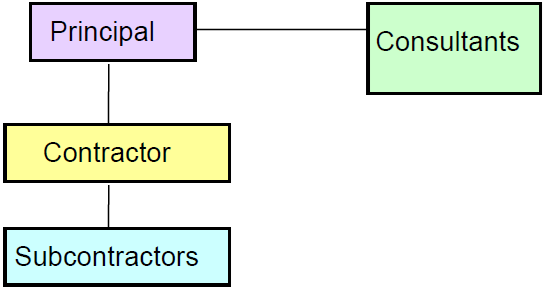
Figure 4: Construct-Only Structure
The contractor tenders a price for the works subject to adjustments provided for in the contract e.g. if there are variations. Irrespective of the actual cost of the works, the contractor will be entitled to be paid the contract sum, as agreed between the parties prior to commencing the works. However, in practice, the construct-only contract can exceed the original contract sum if not properly planned and managed.
Some examples of where construct-only contracts may be appropriate are:
• the scope is well-defined and there is little likelihood of scope creep or wholesale changes to requirements;
• there is little incentive or need for innovation from the contractor; and/or
• it is desirable and there is sufficient time to complete design documentation prior to tendering.
The following table lists features of the construct-only model -
| Advantages | Disadvantages (and issues that may need managing) |
| • Highest level of departmental control and certainty re. scope because principal engages design consultants and scope is well defined prior to works commencing • Contract value is known before construction commences because: - the full design is prepared and endorsed prior to tendering - design complexities are resolved before contract award • Potential for lower cost of tendering for tenderers and departments (although design costs borne by departments) • Larger pool of potential tenderers, increasing competition • Greater scope for competitive prices because of design certainty • Government can manage stakeholder management process | • Separate design and construction contracts mean no single point of responsibility for the project • Potential claims and delays due to design deficiencies and separation of design from construction • Minimal opportunity for cost value management or "buildability" input from contractor into design • The Government retains the risk of constructability of design, design-construction coordination, fitness for purpose and design generally • Inability to fast-track - long lead times to prepare design documentation - longer overall project duration • Little incentive for innovation • Government acts as project manager requiring skills and resources • Adversarial contract environment - potentially higher costs from claims • Potential lack of focus on lifecycle costs and considerations |
__________________________________________________________________________________________________
1 Consultant engagement contracts for design services for major works may already be in place when the procurement strategy is being developed. With some of the delivery models, there is a design services contract separate from and/or preliminary to a construction works contract.