3.5 Project Alliancing
In project alliancing government collaborates with one or more non-owner parties (e.g. a designer and constructor) to share the risks and responsibilities in delivering the construction phase of a project. All project delivery risks are shared by the alliance participants. The alliance contract and supporting structures promote a positive culture based on "no-fault, no-blame" and unanimous decision-making, and requiring all participants to find "best for project" solutions. Because the behavioural culture is crucial to the success of alliancing, the selection of the right participants is paramount.
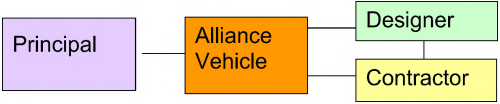
Figure 8: Simplified Alliance Structure
Under an alliance model, the non-owner parties are typically guaranteed reimbursement of their direct project costs and payment of corporate project overheads in an open-book arrangement. Targets for cost, schedule and other key parameters are developed jointly during the pre-construction phase. If actual delivery is better than the agreed targets, all parties share the reward ("gain-share"). Conversely, if delivery does not meet agreed targets, the pre-agreed "pain share" formula applies.
The following table lists features of an alliance -
| Advantages | Disadvantages (and issues that may need managing) |
| • All parties have shared responsibility for ensuring design is appropriate • Provides flexibility to modify design and allows on-going changes to be incorporated during construction • Provides incentives to all parties to complete the project on time and within budget under the "gain-share, pain-share" philosophy • Cost of adversarial conduct, claims and disputes is eliminated, in the "no-blame" culture • Can deliver highly complex projects with uncertain risks which would otherwise be extremely difficult or impossible to deliver • Culture promotes innovation e.g. technical, safety, environmental • Project management efficiencies through integrated management and elimination of all claims • Stakeholder issues can be well managed through an alliance • There is an integrated planning, design and construction process with early contractor & consultant involvement • All parties commit to finding "best for project" solutions • Potential for greater job satisfaction and skill enhancement for personnel involved • Ability to attract greater number of tenderers for complex projects | • Less tender price competition and related certainty demonstrating value for money (unless multiple Target Out-turn Cost approach is used) • Requires all parties to be genuinely committed to openness and collaboration - relies on success of relationships, teamwork and individuals' performance • Requires on-going involvement of appropriately senior staff with authority to resolve issues - may require extra departmental input • Cost to establish and maintain relationships can be high • Limited alliance experience to date for building projects in the public sector (though commonly used for civil engineering, road, rail and water projects) • The government bears the cost risk and other unspecified risks • Overall design and fit-for-purpose risk lies with the government • Government's recourse in the event of catastrophic failure is limited • Lack of focus on lifecycle costs and considerations |
Project alliancing should generally be considered only:
• in the delivery of complex and high-risk infrastructure projects;
• where the solution is unclear;
• where a high level of innovation is required;
• where risks are unpredictable and best managed collectively; and
• if the owner can be closely involved and add value.
Generally alliancing is not appropriate where risks can be identified and understood.