Perceived value for money
7. Responses to the NAO's survey of 121 PFI projects where contracts had been let prior to 2000 showed that 81 per cent of authorities said that the value for money of their PFI projects was currently satisfactory or better. But 15 per cent said value for money was marginal and 4 per cent said it was poor (Figure 1).4 And 23 per cent of authorities who gave a perception of value for money considered that it was not as good as at contract letting.5 We noted that the positive perceptions given by many authorities were based on a subjective impressions of what was happening on their PFI projects. Having entered into the contracts authorities were not likely to admit that they had got it wrong.6
Figure 1: Authorities' perceptions of their projects' value for money
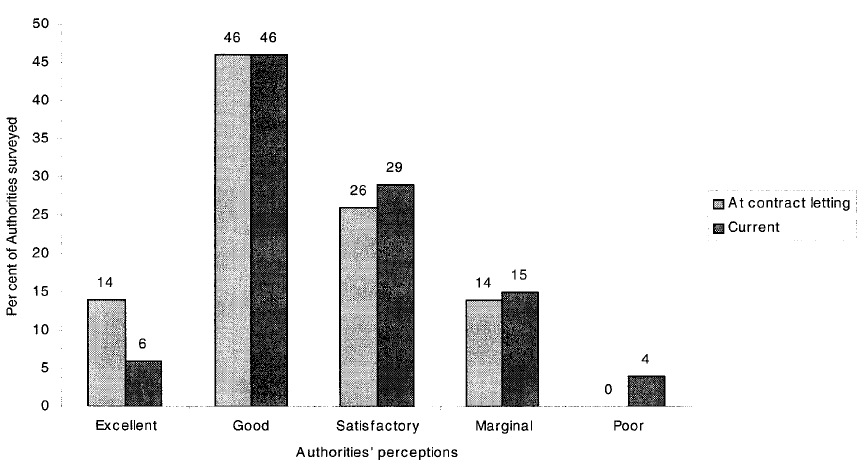
Based on 98 authorities who gave their perception of value for money at the time the contract was let, as well as at the time the survey was completed.
8. The OGC attributed the fact that the majority of projects were perceived as delivering at least satisfactory value for money to competent staff applying good practice and guidance. In these projects the management of value for money was a priority, there was focus on outputs and service levels, and specialist experts such as the former Treasury Taskforce and Partnerships UK helped to keep the projects on track. However, there was no room for complacency in the level of achievement to date.8 Once any project, whether PFI or non-PFI, became operational the client's perception of value for money might well change as factors in the original evaluation related to the construction phase of the project ceased to be relevant, and other aspects of quality assumed greater importance. The client's view of the relative importance of monetary and non-monetary considerations could also change over the life of the project.9
__________________________________________________________________________________
4 C&AG's Report, para 7 and Figure 1, p2
5 ibid, para 3.39
8 Q1
9 Ev 22