Construction of the new laboratories has taken considerably longer than planned
1.10 Initially, construction proceeded as programmed, but, in summer 1999, JLC Ltd confirmed that it was experiencing problems with some of the mechanical and electrical systems in the first phase modules. It stated that completion of the phase would be delayed by a month, but the delay became progressive. As the build continued, problems emerged with construction of the other construction phases. The problems translated into delays to the completion of all of the phases, which for three phases amounted to nearly four years (Figure 5).
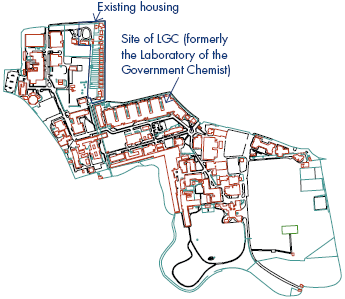
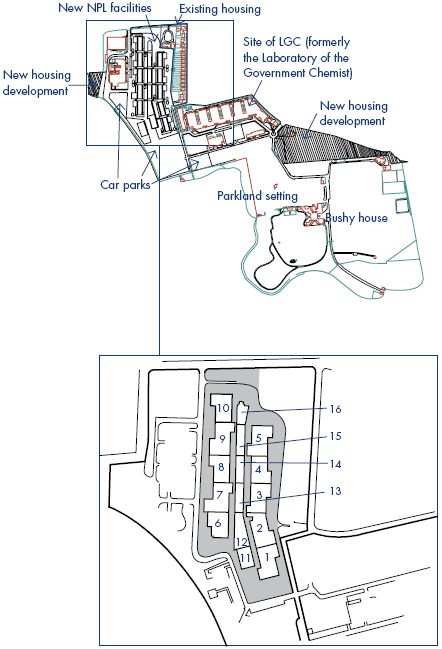
4 | Laser's proposed redevelopment and reorganisation of the NPL site | ||
| |||
The National Physical Laboratory Site at Teddington | |||
Before Development | After Development | ||
|
| ||
The contents of the new laboratory facilities | |||
Module | Contents |
| |
1 | Information systems; Electrical measurements; Environment |
| |
2 | Dimensional metrology; Information systems; Optical metrology; Electrical measurements; Time | ||
3 | Dimensional metrology; Information systems; Metre and wavelength standards; Optical metrology; Electrical measurements; Optical radiation; Photonics | ||
4 | Metre and wavelength standards; Basic metrology; Optical metrology; Electrical measurements; Time; Optical radiation; Photonics | ||
5 | Basic metrology; Temperature; Thermophysics; Optical radiation | ||
6 | Ionising radiation | ||
7 | Materials; Force and mass; Humidity; Ionising radiation | ||
8 | Materials; Pressure; Environment | ||
9 | Materials | ||
10 | Materials; Acoustics | ||
11 | Goods in/out | ||
12 | Engineering workshop; IT support | ||
13 | Materials; Reprographics; Graphics; Conferencing | ||
14 | Senior management; Finance; Marketing; Personnel; Health/safety and quality | ||
15 | IT support; Restaurant; Library | ||
16 | Meeting rooms; Security; Reception | ||
Source: National Audit Office and the Department | |||
5 | Laser planned to complete all 16 modules between October 1999 and March 2001 but it incurred delays which ranged from seven to 46 months | ||||
|
|
|
|
| |
Construction | Modules | Original target | Issue of completion | Delay | |
Phase 1 | Modules 1, 2, 11 and 12 | 13 October 1999 | 29 June 20001 | 8.5 | |
Phase 2 | Module 13 | 21 October 1999 | 14 June 2000 | 7.8 | |
Phase 3 | Module 14 | 23 February 2000 | 07 September 2000 | 6.5 | |
Phase 4 | Module 3 | 26 February 2000 | 23 December 2003 | 45.9 | |
Phase 5 | Module 6 | 04 March 2000 | 26 April 2001 | 13.7 | |
Phase 6 | Module 7 | 04 May 2000 | 14 July 2003 | 38.3 | |
Phase 7 | Module 4 | 30 June 2000 | 08 April 2004 | 45.3 | |
Phase 8 | Module 15 | 06 July 2000 | 12 March 2001 | 8.2 | |
Phase 9 | Module 8 | 18 August 2000 | 06 October 2003 | 37.6 | |
Phase 10 | Module 16 | 05 October 2000 | 23 May 2001 | 7.6 | |
Phase 11 | Module 5 | 20 October 2000 | 05 July 2004 | 44.5 | |
Phase 12 | Module 10 | 02 March 2001 | 02 May 2003 | 26.0 | |
Phase 13 | Module 9 | 11 March 2001 | 12 February 2003 | 23.0 | |
Phase 14 | Car parks and gas bottle store | 24 September 2001 | Never issued2 |
| |
Source: The Department |
|
|
| ||
NOTES |
|
|
|
| |
1 Excluding four laboratories, the completion of which the Department agreed to transfer into Construction Phase 4. | |||||
2 The Independent Certifier issued construction completion certificates for three sub-phases of Phase 14, which covered various elements of the phase including the gas bottle store. | |||||
1.11 The problems causing the delays were many and various (Figure 6 overleaf). Two were particularly intractable:
■ The design of the environmental control systems in 29 laboratories within Construction Phases 1, 4, 7 and 9 that were required to achieve the most stringent temperature control - Recognising that meeting these requirements would take a considerable time, the Department agreed to exclude these types of laboratories from Construction Phase 1 and incorporate them in Construction Phase 4. When the Independent Certifier issued his completion certificates for the three remaining phases, construction delays to the phases ranged between 38 and 46 months (Figure 5).
■ The design of eight laboratories governed by stringent sub-audible noise requirements - In 2003, tests revealed that none of these laboratories met these requirements. Seven of the laboratories also had to comply with the most stringent temperature control requirements and, on investigation, Laser concluded that the air-conditioning needed to achieve the temperature control precluded attainment of the most stringent sub-audible noise requirements. After reviewing the issue, the Independent Certifier decided that the non-performance did not constitute a major defect preventing beneficial use of the modules. On this basis, he certified completion of the two affected construction phases: Phase 4 (Module 3) in December 2003; and Phase 7 (Module 4) in April 2004.
6 | The Department identified numerous problems with JLC Ltd's design | |
|
| |
Module/Area affected | Problem | |
Modules 1 & 2 | The temperature and humidity controls were found to be inadequate. | |
Modules 2, 3, 4 & 8 | Temperature control did not adhere to the most stringent requirements. Temperature control in line with the reduced control space agreed in the Technical Arrangement was eventually achieved after several years delay. | |
Modules 3 & 4 | Stringent requirements governing control of sub-audible noise were not met. | |
Module 8 | The Department considered that, in some of the laboratories, the gas extraction systems were unsafe. | |
Module 8 | A pillar was put into a laboratory space in order to support plant in the roof space above. Contrary to the specification, the pillar was constructed of magnetic material that could potentially interfere with experiments sensitive to magnetic effects. Tests to date have not revealed interference problems although the pillar may become magnetised over time. | |
Module 9 | Fume hoods designed to extract gases were found to be ineffective. Scientists were forced to move out of some module 9 laboratories until Laser fitted temporary corrective measures. | |
Module 12 | The layout of the main workshop conflicted with the Department's interpretation of health and safety regulations. | |
Module 12 | Difficulties were experienced in adhering to environmental control specifications in the main computer room. | |
Various Modules | There were strict dimensional specifications for access to the laboratories. JLC Ltd fitted large doors that were extremely heavy and impeded disabled access. As a result, it had to fit electronic door openers at extra expense. The Department maintains that there were alternative design solutions that could have avoided this extra cost. | |
Various Modules | Water dilution tanks were found to be ineffective. | |
Various Modules | The Department specified that residual current devices had to be fitted in the majority of laboratory spaces. These were not fitted. The devices are designed to prevent electric shocks and are considered best practice in industrial buildings. Laser fitted the required devices approximately two years after the first construction phase had been certified complete. | |
Various Modules | Humidifiers were installed incorrectly. | |
Site wide | Pipes used in the process cooling water system were susceptible to corrosion. | |
| The environmental process cooling water system was not separated from the process cooling water system used to cool scientific equipment, therefore a system failure could result in scientific equipment becoming damaged. | |
Site wide | Marginal and, in some cases, inadequate capacity of machinery used to chill water for air-conditioning and process cooling water purposes. | |
Site wide | The electrical circuits servicing the site were arranged as a network of radial branches rather than a loop. Higher than designed electricity demand in a branch would result in electricity supply in the branch shutting down so threatening scientific work in the affected modules. | |
Source: The Department |
| |
1.12 The Department was not satisfied with the Independent Certifier's decision to issue completion certificates for the construction phases that included the eight laboratories that did not meet the most stringent sub-audible noise requirements. In October 2004, the Department referred the matter to adjudication. In December 2004, the adjudicator found in the Department's favour.
1.13 The adjudicator considered that the non-compliance did not constitute a defect as defined by the contract because the evidence before him had not demonstrated that the non-compliance could be directly attributed to a breach of contract by Laser. However, he considered that the non-compliance prevented beneficial use of the laboratories and decided that the Independent Certifier ought not to have issued his completion certificates. Consequently, the two construction phases affected were deemed not complete when the Department and Laser terminated their contract in December 2004.