The Agency's proposed form of joint venture company reduced bidder interest
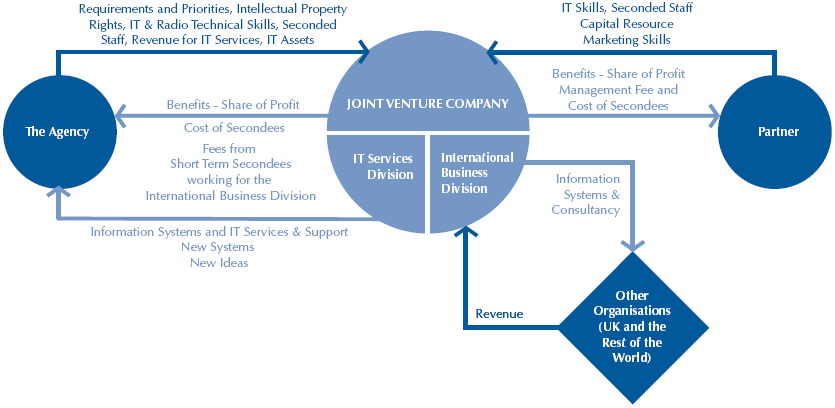
2.14 In November 1996, the Agency had meetings with each of the six potential bidders at which the Agency presented their intention to found the partnership on a joint venture company. At this time only one of the potential bidders expressed reservations about the Agency's proposed partnership model. In April 1997, the Agency issued to all six potential bidders the full specification, which required them to submit descriptions of a partnership that accorded with the Agency's proposals (Figure 3). By this time five of the potential bidders had reservations about the proposed partnership and, to some extent, these were compounded by concerns about the apparent unwillingness of the Agency to consider alternatives.
2.15 CMG and Logica responded to the full specification, but Logica's bid was based on a partnership structured differently from that sought by the Agency. Logica accepted a joint venture company for the exploitation of the Agency's expertise, but not for supplying IT services, which they wanted to supply directly. The Agency did not consider that they would be able to resolve their differences with Logica and, after consulting with their lawyers and CCTA, decided to reject the proposal, leaving only one bidder in the competition. At this stage, there had been no pricing of the bids so the Agency could not assess the cost of their decision to pursue a partnership founded on a joint venture.
2 |
| The Agency's organisation to procure the partnership |
|
|
Source: The Agency |
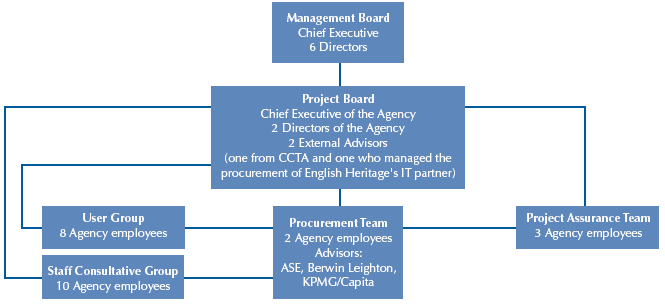
3 |
| The Agency's high level proposals for the joint venture company |
|
|
■ The Agency will incorporate a limited liability company under the Companies Act as the vehicle for the collaboration between the Agency and their partner. ■ The Secretary of State for Trade and Industry and the partner will be shareholders in the joint venue company. ■ The Secretary of State will have a majority shareholding. ■ The Agency will second staff to the joint venture company. ■ The joint venture company will, for an initial period of seven years, provide the Agency with IT services to meet their existing and future needs. ■ The joint venture company will be licensed to provide spectrum management and related consultancy services to national and international bodies. Source: The Agency |
2.16 We interviewed the four bidders who did not respond to the full specification to ascertain their reasons for withdrawing and we also interviewed Logica to learn the reasons why they submitted only an alternative bid (Figure 4).
2.17 All five of the potential bidders who did not proceed further with the competition had concerns about the Agency's proposed involvement in the supply of IT services (Figure 4). They told us that these concerns stemmed from their knowledge that the Agency were seeking to reduce the cost of IT services through the replacement of their numerous contractors. They felt that once these savings were realised the Agency might use their proposed majority shareholding in the joint venture company to block proposals for adding value through improving the efficiency of IT services if such improvements threatened posts occupied by the Agency's IT staff. All five said that it was not in their commercial interests to participate in a relationship that could limit their exploitation of opportunities to add value.
2.18 With the exception of Logica, the potential bidders also told us they were concerned about the Agency's requirement that the joint venture company exploited the Agency's expertise. Three said that they were prepared to invest in this part of the partnership despite the absence of a robust business case supporting the business. A more serious concern was the weight that the potential bidders understood the Agency attached to the exploitation of their expertise. All three considered that one of their competitors, CMG, already possessed a good understanding of the commercial potential of the Agency's expertise and systems because of CMG's, then, current work developing systems important to the Agency's spectrum management business. Furthermore, CMG had linked up with The Smith Group, a leading company in the spectrum management business. The three potential bidders told us that in their opinion their bids would be at a disadvantage in competition with a bid from CMG/Smith because of the weight the exploitation of the Agency's expertise would carry in the evaluation of the bids.
4 |
| Reasons why potential bidders, after receiving the full statement of service requirements, either withdrew or submitted only an alternative bid | |||||
| |||||||
|
|
| |||||
|
|
| Potential Bidder No. 1 | Potential Bidder No. 2 | Potential Bidder No. 3 | Potential Bidder No. 4 | Logica |
The Agency were not prepared to negotiate on the form of the partnership
|
| • | • | • | • | ||
There was a conflict of interest for the Agency if they were to be both supplier and purchaser of IT services
| • | • | • | • | • | ||
The exploitation of the Agency's expertise was not a viable business proposition
| • | • | • |
|
| ||
The weight that the Agency attached to the bidder's ability to exploit the Agency's expertise favoured IT services contractors already working for the Agency
|
| • | • | • |
| ||
There would be further delays to the procurement
|
| • | • | • |
| ||
The transfer of services created too much uncertainty about obligations and opportunities
| • | • | • | • |
| ||
|
| Source: Potential bidders |
|
|
|
|
|