Findings
6 We examined the procurement of the project. Our main findings are as follows.
7 The Agency had good value for money grounds for transferring the risks of major cost and time overruns inherent in such a large telecommunications project. The Agency procured the project as a PPP because it transferred risk to a contractor that had borrowed money to upgrade the systems and had something to lose if things went wrong.
8 At the pre-qualification stage, two of the higher scoring potential bidders withdrew from the tendering process. Six potential bidders for the project were identified early on but interest wavered during the extended time taken to produce the bid documents. Concerned that some of the potential bidders might be losing interest, the Agency took the unusual step of issuing a second advertisement. Two of the higher scoring potential bidders did not re-apply. Later on in the tendering period, the competitive field reduced further when two bidders that had responded to the second advertisement dropped out of the running, one because of doubts over the financial viability of a consortium member and the other because of doubts that its proposed technical solution could be developed sufficiently. These withdrawals left two bidders in the competition.
9 Having selected GeneSYS as the preferred bidder, the Agency negotiated the final details of the deal without conceding an increase in price or reallocation of risks. The preferred bidder stage lasted nearly 10 months, which was five months below the average for PFI projects that closed between 2004 and 2006 (Figure 9 in the National Audit Office's report Improving the PFI tendering process, HC 149, Session 2006-2007). During this stage, GeneSYS's bid price fell by £2 million, without changes to the allocation of risks. The outcome of these negotiations demonstrates that price rises during the preferred bidder stage of a PPP procurement are not inevitable.
10 The tendering phase lasted more than four years, over two years longer than originally planned and the cost of professional advice at £15.5 million exceeded the Agency's estimates by £10 million. There were a number of external events and major changes in scope that lengthened the timetable. The majority of the lengthening was due to the Agency's requirement for high quality contract documents. As a consequence, the advisers' costs increased. The frequent revisions of the budget for the advisers (Appendix 5) suggest that the Agency struggled to quantify the amount of work needed to complete the procurement.
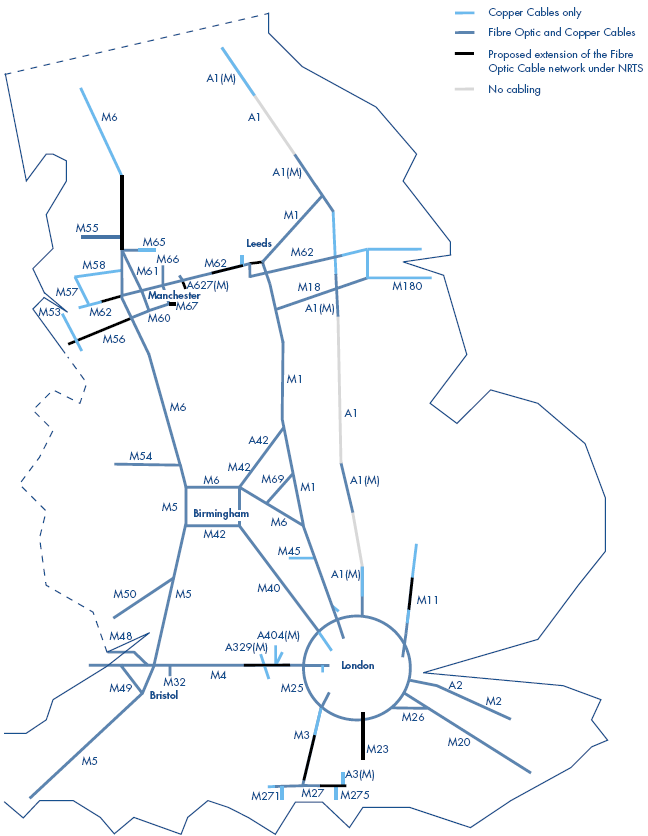
1 | In 2003, the original tender documents included extending the Agency's fibre optic cable network by 278 kilometres |
Source: Highways Agency | |
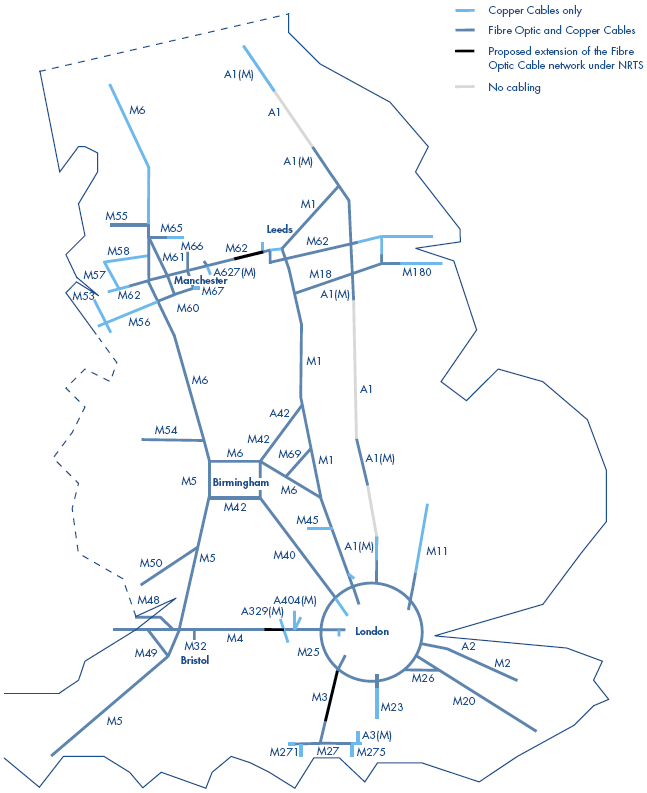
2 | On affordability grounds, the Agency reduced the extension to its fibre optic cable network under the NRTS contract from 278 kilometers to 110 kilometres |
Source: Highways Agency | |
NOTE 1 Between 2003 and the award of the NRTS contract in September 2005, the Agency installed 168 kilometres of fibre optic cable under its then existing contractual arrangements. Some of this work included lengths omitted from the NRTS project under the affordability review, including lengths along the M3, the M4 and the M62. | |
11 At contract award, the Agency's estimate of the present value cost of the Public Sector Comparator (PSC) (£415 million in 2004 prices) was marginally more expensive than the PPP deal (£385 million in 2004 prices). While negotiating the deal, the Agency sought to benchmark the cost of the PPP by estimating, in the PSC, what a conventional procurement might cost. The PSC was designed to produce a single figure comparison for a given quantity of work and included an upward adjustment of £85 million for risks. The purpose of the risk adjustment was to inform the Agency's decision on whether to pursue a PPP deal or a conventional procurement for the complex NRTS requirements. In calculating the risk adjustment for this novel project, and given the inevitable uncertainties, the Agency relied on the experience and judgement of its advisers. In our view, for most PPP contracts involving the construction of fixed assets, it is preferable to provide a range for the costs for the comparator, as opposed to a single point estimate. We would also expect to see allowances for events turning out better than expected.
12 The new services are now up and running and benefits for road users from other Agency projects dependent on the NRTS are beginning to be realised. The upgraded telecommunications systems went live in October 2007. Enhancements to existing means of communicating with road users are beginning to come on stream and new means are planned. It is, however, too early to make a full assessment of operational performance or of the effectiveness of the pre-pricing arrangements for additional works.