The Agency concluded that a Public Private Partnership was the best way to build and operate the new systems
1.14 As well as considering the scope of work to complete the network of fibre optic cables, the Agency had to select a procurement route. The advisers reviewed a comprehensive set of options ranging from:
■ conventional contracting in which the Agency would manage separate contractors to design, build and operate the new systems; through to
■ a Public Private Partnership (PPP) in which a consortium of contractors would not only take the risks involved in the design, build and operation stages but also provide the finance necessary to get the project underway.
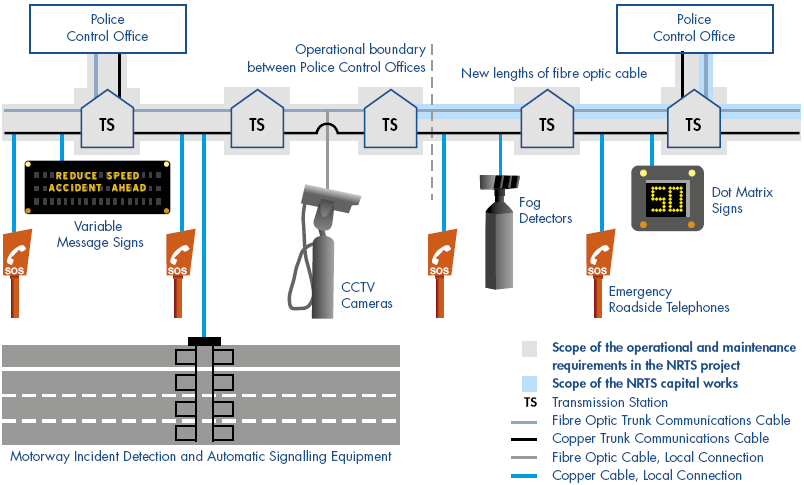
6 | The original scope of the NRTS project encompassed maintaining, upgrading and extending the national trunk communications cable network and links to police control offices |
Source: National Audit Office | |
1.15 At the stage of the feasibility study, it was KHHD's view that a private sector partner would be more successful than the Agency at raising third party revenue. High level financial models of the PPP approach and a conventional procurement, at the time, indicated that when allowances were included for third party revenues, the present value of the net cost of a PPP option stood at £40 million (1999 prices)2, while the net cost of a conventionally procured option was £60 million. If third party revenues had been excluded, the net cost of the conventional procurement would have increased to £90 million and the net cost of a PPP would have increased to £110 million.
1.16 KHHD informed the Agency that any comparison between the costs of the alternatives should be treated with caution as the models were early estimates based on initial proposals for the project. Although it seems that a conventional procurement would have been cheaper were third party revenues excluded, the Agency concluded that the most suitable arrangement was a PPP. It reasoned that this type of arrangement would:
■ encourage a longer term, strategic approach to the Agency's service requirements;
■ improve resilience in the trunk cable network;
■ replace hitherto bespoke investments with off-the-shelf technology;
■ spread the cost of upgrading and improving the telecommunications systems over the contract term through payment of the unitary charge; and
■ facilitate opportunities to generate third party revenue.
1.17 Apart from spreading the cost of the project through the use of private finance (which is not a value for money consideration), the benefits of the PPP approach listed above could, however, have been obtained using conventional procurement. The Agency believed that a key attraction of a PPP was the opportunity to transfer risk to a private sector partner that had borrowed money to upgrade the systems and, in the event of encountering difficulties, would act to avoid losing its investment. The Agency's reasons for transferring risk were that:
■ It had not before attempted such a large telecommunications project involving a nationwide upgrade to new technology;
■ Telecommunications was not considered a core activity. The Agency therefore decided that the more appropriate course was to buy in the skills of a telecommunication network operator while concentrating its skills on the newly acquired role of road network operator; and
■ Even if such capacity and skills could have been assembled, the financial consequences of cost and time overruns would have remained with the Agency.
1.18 In pursuing a PPP, the Agency wanted to ensure that the price of the risk transfer was reasonable. It, therefore, checked to ensure that the cost of the PPP was no higher than the cost of a conventional procurement, adjusted for risk.
____________________________________________________________________________________
2 The Agency discounted the cash flows using a discount rate of six per cent, which was the Government's discount rate for procurements commencing prior to April 2003. For consistency, all present values appearing in the main text of this report have been calculated using the six per cent discount rate.