The project evolved to take in telecommunications elements of other projects
1.19 After receiving ministerial approval in July 2000, the Agency began planning for a competition to procure the new transmission systems. By March 2001, however, the project had changed from that contemplated in the feasibility review. To realise potential economy and efficiency gains, the Agency decided to incorporate into the NRTS:
■ The operation and maintenance of links between roadside devices and transmission stations, which were then costing the Agency about £7 million per annum (1999 prices);
■ The planned £6 million (1999 prices) upgrade of transmission equipment; and
■ The £80 million (1999 prices) programme to install local connections linking new roadside devices to the system.
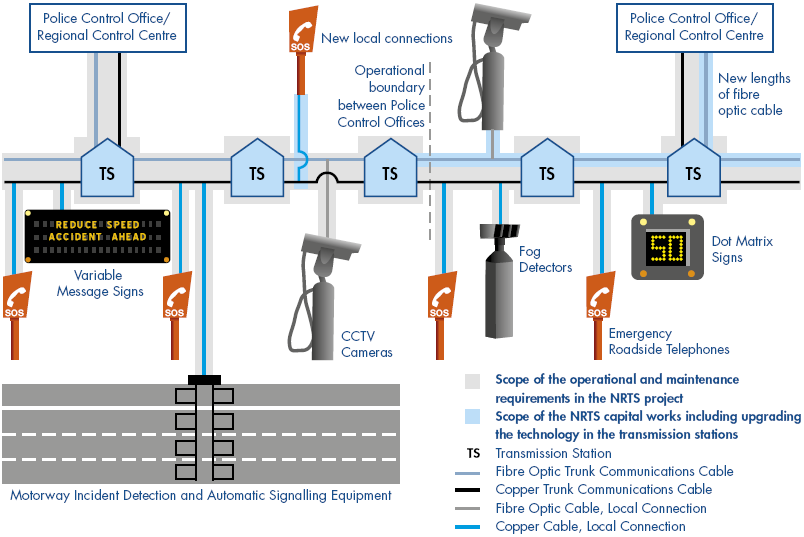
Under the changed scope, the contractor would have end-to-end responsibility for transmission services, while responsibility for roadside devices and police control office applications would to remain with the Agency (Figure 7). As a result, the estimated net cost of the project increased from £40 million to £345 million (1999 prices).
7 | The expanded scope of the NRTS project encompassed: upgrading and extending the national trunk communications cable network; upgrading the technology in the transmission stations; upgrading links to police control offices; and adding and maintaining local connections |
Source: National Audit Office | |
NOTE 1 In January 2003, Ministers brought forward the Agency's plan to replace the 32 police control offices with seven regional control centres. | |
1.20 In September 2005, the Agency and GeneSYS, a special purpose company owned by Fluor Corporation and HSBC, signed a 10½-year PPP contract for the NRTS. The Agency had considered a 20-year contract but decided that the technology risk was too great. The Agency structured the contract so that:
■ Upgrading and operating the telecommunications systems were captured in a PFI type structure. As is common with this type of arrangement, GeneSYS agreed to finance the upgrade works and in return will receive a contractually set, monthly charge of £3.7 million (2004 prices) from completion of the works through to the end of the contract, provided the services meet the Agency's performance requirements.
■ The Agency can order changes to the services from a pre-priced schedule of additional works. Under the related provisions, GeneSYS's prices cover the direct costs of the all work required to implement the ordered changes.
1.21 At the end of the procurement, the Agency assumed that the present value of its payments under the contract would be £345 million (1999 prices), the mid-point of an estimated range from £230 million to £460 million for the Agency's future payments to GeneSYS (Figure 8 shows the amounts in 2004 prices). The actual value of the payments will depend on the number and value of additional telecommunications services ordered by the Agency. This outcome resulted from a tendering process that involved the following stages:
■ A period of pre-tendering preparation of bid documents and investigation of market interest (including the publication of two notices in the Official Journal of the European Communities);
■ A competitive bid process from January 2003 to August 2004;
■ A period of negotiations with a preferred bidder; and
■ A comparison of costs under the PPP option with the costs of the public sector comparator at each of the key stages of the tendering process.
8 | 2004 present values of the estimated range for the Agency's payments to GeneSYS | ||
|
| 2004 present values discounted at: | |
Estimated range of payments | 6 per cent1/ £ millions (1999 prices)2 | 6 per cent1/ £ millions (2004 prices) | |
Lower limit3 | 230 | 255 | |
Upper limit4 | 460 | 515 | |
Mid point | 345 | 385 | |
Source: National Audit Office |
|
| |
NOTES 1 The Agency discounted its projected future payments using a discount rate of six per cent, which, at the start of the procurement, was the Government's discount rate. For consistency, all present values appearing in the main text of this report have been calculated using the six per cent discount rate. In 2003, the Government reduced its discount rate to 3½ per cent for projects not already in procurement. Applying the new discount rate to the Agency's range of payments under the NRTS contract yields present values at 2004 prices of £300 million (lower limit), £600 million (upper limit) and £450 million (mid point). 2 The 2004 present values in 1999 prices were calculated by deflating the 2004 present values in 2004 prices using the Office for National Statistics' Retail Prices Index CHAW (all items). 3 The Agency's lower limit was based on the assumption that over the course of the contract it would order no additional works other than a minimal number associated with pre-existing commitments. 4 The Agency's upper limit was based on the assumption that over the course of the contract it would have the funds to order all the additional works on its related forward investment programme. | |||