Benefit realisation will depend on the programme of projects supported by the NRTS
4.9 The Agency has a programme of projects designed to enhance its management of the motorway network. Some of these are already in operation, such as Variable Message Signs and active traffic management schemes. The functionality of these schemes is being enhanced by the improved capability of the telecommunications systems. For example, through the NRTS, the Agency now has telecommunications services that allow tracking of traffic volumes second-by-second rather than relying on one minute averages.
4.10 Though some applications, such as road monitoring CCTV cameras, are in place already and could operate without the NRTS, the project has provided upgraded levels of performance in terms of image quality and coverage of the road system. For example, the Agency has, during the upgrading of the telecommunications systems, installed more CCTV cameras across the relevant sections of the motorway network. These images can now be accessed by all seven regional control centres rather than from just the local centre. The resilience inherent in the NRTS network design also enhances reliability of the services. Without the NRTS, other projects, such as future, more sophisticated traffic control systems, would have required ad hoc upgrading of the telecommunications systems.
4.11 Figure 19 on pages 36-39 sets out the state of progress with projects dependent on the NRTS. Many are due to be introduced in 2008 in some form. The projects range for example from the current introduction of Automatic Number Plate Recognition systems to the greater use of digital speed enforcement technology. While no allowance has been made to support any future possible road pricing initiative, the capacity of the NRTS could be expanded to do so.
4.12 It is too early to assess the success of the schemes that rely on the NRTS, and no full assessment can therefore be made of the realisation of benefits associated with the project. The benefits will also depend on the extent to which these schemes are rolled out, which in part is determined by the resources available to the Agency over the life of the contract.
4.13 Currently, the Agency expects benefits from the projects it is taking forward to exceed the costs. This expectation implies that, by enabling these other projects, the NRTS will be realising a net benefit. However, this implication can only be confirmed as the projects involved are rolled out and evaluated. The Agency has told us that it has plans to conduct this evaluation.
19 | Projects facilitated by the NRTS |
|
|
|
|
Project/Initiative | Description | Pre-contract operational performance | Performance expected under the NRTS | Benefits | Project timetable |
Motorway Incident Detection and Automatic Signalling | A system which automatically detects slow moving and stationary traffic and provides warning to drivers of an incident ahead. The system also periodically reports traffic data to Regional Control Centres. | Traffic conditions determined using one-minute averages at a limited number of sites. | Technical constraint limiting the number of sites lifted. Data collected and analysed on a vehicle by vehicle, real time basis. | Better observation of network performance. Lane by lane incident detection. Permits analysis of speed restriction compliance. | Road trials planned for Spring 2008. |
CCTV cameras | Video images of traffic conditions. | Continuous video link between each camera and the local police control room even when not viewed. Picture quality of analogue signal degraded with increasing transmission distance. | Digital transmission of CCTV images facilitated. Cameras are only connected when they need to be viewed, allowing almost unlimited growth in the number of cameras without increasing the capacity of the network. | A subsidiary project will enable public to view the pictures captured by all cameras on the Agency's network via a website. The Agency is investigating linking temporary road works CCTV back to Regional Control Centres (RCC) to enable the RCCs to direct resources to incidents within road works. The NRTS will allow CCTV footage to be stored and used to analyse the events leading up to incidents and the way in which traffic officers have responded to incidents. Higher quality and more robust CCTV footage creates potential for the Agency to monitor traffic management within motorway road works. | Implemented January 2008. |
Weight in Motion project | A system that detects the weight of a lorry in motion, records the lorry's number plate, checks the number against a database that records the maximum allowable weight and produces high quality photographs of lorries. | Pre-contract telecommunications systems could not support the high levels of telecommunications traffic generated. | Constraints on the levels of telecommunications traffic will be alleviated. | More intelligent analysis of the types of vehicles committing offences will be facilitated. | End of 2007-08 with more sites planned 2008-09. |
Automatic Number Plate Recognition (ANPR) camera projects | Data from ANPR cameras can be used by the Agency to monitor movements by vehicles, allowing for analysis of the impact of interventions on traffic behaviour. Data can also be used by third parties. | Many of the current ANPR cameras have their data collected manually (requiring a site visit). | The NRTS will allow data to be collected automatically from future installations. | Network intelligence, e.g. measuring journey times and assessing the impact of traffic management schemes. Law enforcement. | On-going but two major schemes due end of 2007-08. |
Motorway Access management | Allows the flow of traffic joining a motorway, at peak times, to be regulated to minimise the disruption to traffic flow on motorways. Traffic signals are used on motorway slip roads, which measure traffic flows on the main carriageway and queue lengths on the slip roads. | 30 sites have been installed over the last couple of years but in the absence of a high bandwidth network to these sites, telecommunications links were provided using lines leased from public telecoms operators. | Programme to install 25 additional sites during 2007-08 and more sites in 2008-09 will use the NRTS. A plan to transfer the original sites onto the NRTS network is also being developed. | Reduces congestion. Improves journey times. | End 2007-08 for next 25 sites. |
Speed Enforcement | Digital Speed Enforcement Cameras capture images of speeding vehicles. | Previously speed enforcement cameras used wet film technology, requiring regular site visits to change films. Wet film cameras were used on the controlled motorway section of the M25. | The NRTS allows the further roll out of the Agency's Digital Enforcement Camera System. Digital images can be instantly transmitted to the relevant enforcement agency. | Improves safety. Ensures compliance with traffic management regimes, enabling their benefits to be delivered. | End 2007-08 for M20 and M25. |
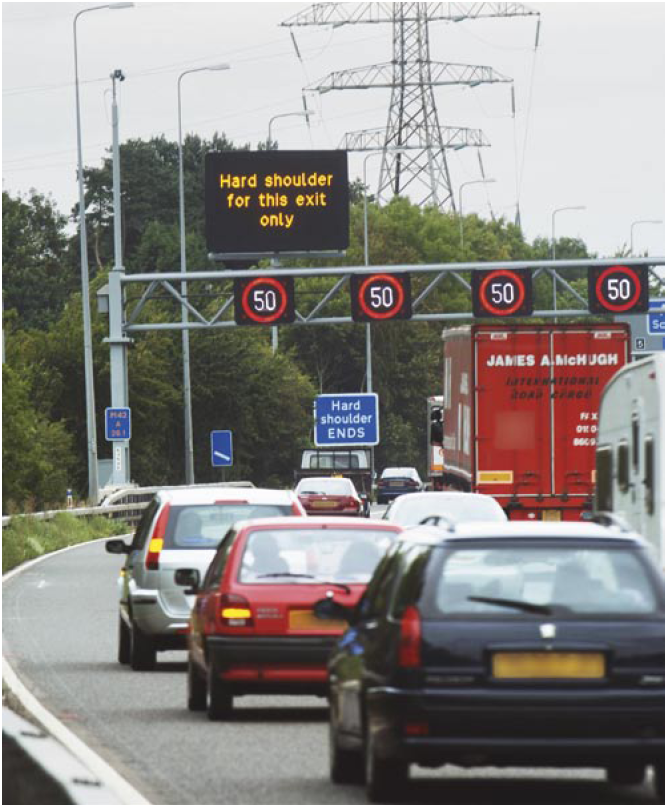
Active traffic management schemes | Active traffic management enables the Agency to make best use of road space according to traffic conditions and any other events, for example, using the hard shoulder as a running lane during peak periods. | A dedicated network was installed on the M42 but without the level of resilience provided by NRTS. | The system relies on a large number of fixed CCTV cameras to ensure that the hard shoulder is clear of debris and stranded vehicles. Transmitting these CCTV images requires the levels of bandwidth provided by the NRTS. | up to 500km of active traffic management could be delivered with the bandwidth provided by the NRTS. Called-off additional works would be needed to provide the local transmission paths from the roadside to the nearest transmission station but beyond the local transmission station sufficient bandwidth exists in the NRTS network. | New West midlands sections in phases starting end of 2008. |
Support for Regional Control Centre disaster recovery plans | Disaster recovery plans are being drawn up for Regional Control Centres, which include a range of scenarios from temporary evacuation of a RCC to the complete loss of a RCC for several months. | Not comparable. Previous plans involved manual systems. | Plans for disaster recovery can be easily accommodated following the migration of all circuits onto the new NRTS network, due to its capability for transferring information from anywhere to anywhere. |
| Interim plans by end 2007-08 |
Emergency Roadside Telephony and Inter-RCC Telephony | Emergency Roadside Telephone systems connect road users with Regional Control Centres. Inter-RCC telephony refers to other operational telephony systems used by the Agency for voice communications with traffic officers, neighbouring RCCs and other stakeholders. | The current Emergency Roadside Telephone system only allows calls to be answered from the local Regional Control Centre and has no capacity for onward connection of calls, for example, to a neighbouring RCC or the emergency services. | A system integrating Emergency Roadside Telephone systems with other operational telephone systems would use the NRTS to deliver greater resilience and support more flexible working. Such a system could divert calls to a neighbouring RCC in the event of a major failure at one RCC, or to share call loads. |
| Business Case was approved January 2008. The first RCC Area rollout is planned for 2008-09. |
Next generation of traffic control systems | Traffic control systems are used to set motorway signals and message signs, monitor traffic flows and weather conditions and implement traffic management regimes. The Agency is considering the opportunity presented by the NRTS for a single logical system spanning all RCCs. Such a system would provide a single definitive view of the state of the road network . There is also the potential for roles to be reassigned between RCCs at night time or during a major incident. |
|
|
| Project expected to deliver new systems in 2011. |
Provision of traffic data to third parties | Traffic data collected by the Agency, including the National Traffic Control Centre (NTCC) in Birmingham, is distributed to public websites and a range of third party organisations who, for example, supply traffic information to satellite navigation systems to inform drivers of traffic delays. Such data could also be shared with researchers. | The NTCC obtained its data about motorway traffic conditions using the Agency's low resilience legacy networks that provided only limited CCTV coverage. Otherwise, the NTCC obtained data from other sources including motorway incident detection and automatic signalling equipment and automatic number plate recognition cameras. | The NRTS infrastructure allows traffic data to be transferred from motorway locations to the National Traffic Control Centre. New roadside monitoring equipment (motorway incident detection systems and CCTV cameras) and the additional capacity of the NRTS allow more data of better quality to be captured. Improved resilience. The Agency is considering improved and more flexible access to CCTV. | Improved journey times Better informed travellers | Improvements in CCTV expected in 2008-09. |
Improving the capability of the Traffic Officer Service | The Agency is currently exploring new ways of delivering and receiving data and video images from traffic officer vehicles attending incidents on the roadside. A number of wireless technical solutions are possible, some of which may use the NRTS network. |
|
| Ongoing research. | |
Road Pricing | Network capacity could be increased to support road pricing initiatives, although no allowance has been made for this in the NRTS bandwidth calculations. |
|
| None. | |
Facilitating future research projects | A wider range of research projects can be trialled with ease and timeliness since easily accessible bandwidth is now provided at the roadside following the implementation of the NRTS. |
|
| n/a. | |
Source: Highways Agency |
|
|
| ||