Appendix 1 The Public Private Partnership approach
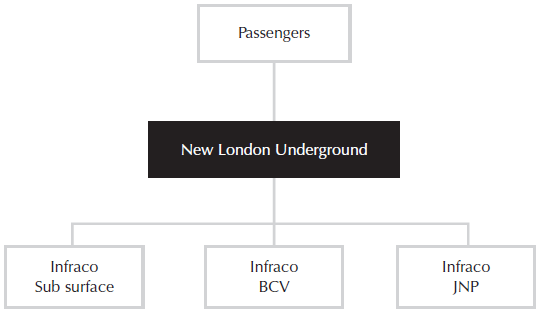
1 On 20 March 1998 the Deputy Prime Minister announced that the Government would be introducing Public Private Partnerships (PPP) to bring stable, increased investment into London Underground. The plans involved dividing London Underground into a publicly-owned operating company responsible for delivering services to customers, and three privately owned infrastructure companies. The objectives were to deliver £8 billion worth of investment in London Underground over the next 15 years, to maintain and upgrade the infrastructure, improving services for passengers and with the intention of providing value for money for the taxpayer.
2 Under the PPP, train and station services would continue to be planned and operated by a publicly owned, publicly accountable London Underground. London Underground would be responsible for safety on the whole of the Underground. Private companies have been invited to bid for the responsibility to maintain and upgrade the track, tunnels, signals, stations, lifts, escalators and trains under 30 year contracts to London Underground. At the end of the contracts, the assets would return to the public sector.
3 The line groupings that have been offered to the private sector are:
■ BCV - Bakerloo, Central, Waterloo and City and Victoria lines.
■ JNP - Jubilee, Northern and Piccadilly lines.
■ Sub-surface - Circle, District, Metropolitan, East London and Hammersmith and City lines.
4 Two bidders were shortlisted for the BCV and JNP contracts in July 2000, LINC and Metronet for BCV; and Tubelines Group and Tuberail for JNP. Members of each consortium are shown opposite.
5 This report is only concerned with the BCV and JNP groups, as the SSL bid process is on a later timescale.
3 |
| Bidders for the deep tube contracts |
LINC: | Tube Lines Group: |
■ Bombardier | ■ Bechtel/Halcrow |
■ Mowlem | ■ Amey |
■ Fluor Daniel | ■ Hyder |
■ Alcatel | ■ Jarvis |
■ Anglian Water |
|
Metronet: | TubeRail: |
■ Adtranz | ■ Brown & Root |
■ WS Atkins | ■ Alstom |
■ Balfour Beatty | ■ Amec |
■ Seeboard | ■ Carillion |
■ Thames Water |
|
6 The private sector would take over three infrastructure companies (Infracos), and the responsibility for delivering a large infrastructure investment programme. These companies are being asked to provide long term investment planning, professional project management and effective delivery of day to day maintenance.
7 Under the PPP, the private sector would not have any operational responsibilities; on the network they would mainly be responsible for the work that goes on overnight, while the system is shut down. Operations -including drivers, stations staff and responsibility for safety - would remain in the public sector.
8 Transport for London (TfL) is a new body, reporting to London's Mayor. It is responsible for a wide range of transport in London, primarily implementing the Mayor's integrated transport strategy. On 3 July 2000 TfL took on all of London Transport's previous responsibilities apart from London Underground. Once the competitions are completed, London Transport will be wound up and London Underground will be transferred to TfL and the Mayor.
4 |
| How the Tube would be run in 2001 |
Source: Department of the Environment, Transport and the Regions.