APPENDIX SIX The Source and Sharing of Refinancing Gains
|
Source Maturing PFI market Confidence in the market has increased as projects have proved successful. There are now more banks and monolines involved in the refinancing of PFI deals. |
Reason for Gain As the market has matured there has been more competition to provide finance and less perceived risk in PFI investment. This has meant that better rates of finance have become available for new PFI projects at their inception, and for older PFI projects at their point of refinancing. |
Shared with the authority? Yes |
Effect on deals under the Voluntary code Gains increase As the market becomes more mature greater refinancing gains arising from this factor will be seen as the interest rates which banks/monolines are now prepared to offer will be lower than when the market was immature.
|
Effect on deals under the 50:50 guidance Gains decrease Now that the market has become more mature we are likely to see lower refinancing gains arising from this factor as the interest rates which are initially offered will be relatively lower. There are still some sectors, for example waste management, where the market remains immature and in these areas there may still be opportunities to derive larger refinancing gains in the future.
|
|
|
|
|
30% sharing |
50% sharing |
|
End of construction phase
|
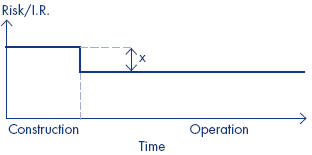
As the construction phase of the project comes to an end the inherent risk in the project drops, meaning that better terms of finance can be secured. In the graph to the left 'x' represents the difference between the risk in the construction and operational phases of the project. It also represents the difference in the level of interest rates which can be secured in the two phases.
|
Yes |
There are potentially large gains to be made from older projects. Historically risks at construction were viewed as much higher than those at operation meaning that a great drop in costs can be achieved at refinancing.
|
The overall risk of PFI projects is now viewed as lower, and the difference perceived in risk levels between construction and operation has also narrowed somewhat. Many new deals now have a stepped interest rate included from the outset so as to automatically drop rates after the successful completion of the construction phase. This means that in general there are now greatly reduced benefits available from this factor during refinancing.
|
|
|
|
|
30% sharing |
50% sharing |
|
Better underlying rates of interest which can reduce the debt repayment on a loan in the case where the contractor has not hedged. |
The interest rate spread and underlying rates change over time. |
No - Where the contractor explicitly bears the interest rate risk following financial close and then benefits at a refinancing from better available rates, the contractor is entitled to keep that part of the gain. |
|
|
|
Increased borrowing |
Increasing borrowings (beyond what is actually required for the project) allows the private sector to accelerate the benefits to their shareholders by enabling them to pay out inflated dividends shortly after refinancing. The private sector companies may find themselves able to borrow more for a variety of reasons, for example; the market has matured; the project has been successful to date; there has been a general fall in market interest rates, the lengthening of the borrowing period. An increase in the project's debt means an increase in termination liabilities for the public sector, and therefore the private sector requires permission from the public sector before it can proceed to increase its borrowings. The Treasury has advised that authorities must carefully consider the balance between the gains which they are to receive and the extra risk which they will accept if they agree to an increase of private sector debt during refinancing. |
Yes |
The gains received by the public sector will vary according to the magnitude of the increased borrowing. 30% sharing |
The gains received by the public sector will vary according to the magnitude of the increased borrowing. 50% sharing |
|
Contract extension |
Contract extensions are perceived to generate future savings (rather than the current gains derived from the sources discussed above). These future savings are assumed on supposition that the cost of the services secured now, by extending the contract, will be cheaper than those which would be available in the future. Contract extensions are closely tied to the gains which can be derived from increasing debt. By extending the contract the private sector is also able to extend the term of their debt and hence they are able to borrow more. For this reason the extension of a contract and the increase of debt often go hand in hand. |
Yes |
|
|