Land Securities Trillium seemed capable of doing the job
1.23 Although the Department could foresee advantages in taking the non-competitive negotiated route with Land Securities Trillium, it would not be worth doing so if it was failing to deliver on the PRIME contract. Land Securities Trillium operates the contractual performance measurement system, but the Department has access to the information produced and rights to audit it and in certain circumstances at Land Securities Trillium's expense. The Department exercised these rights early on in the contract, and continues to do so, as it was concerned that the level of deductions Land Securities Trillium was reporting was not consistent with the standard of service its staff were reporting. To date, Land Securities Trillium has contributed just over £1 million to the cost of the Department's audit of Land Securities Trillium's performance.
1.24 Initially in the PRIME contract, Land Securities Trillium relied on paper-based systems to record performance, which did not allow it to readily identify problem locations and service partners, and access the detail behind each of the performance issues. Performance in the early days suffered as a result.
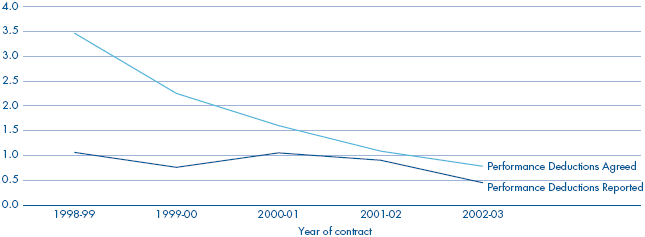
1.25 In March 2001, Land Securities Trillium introduced Athena, a web based application to measure its own performance and its service partners' against agreed contract key performance indicators. This allows much better monitoring of buildings and the actions needed to prevent problems. Since the introduction of Athena, performance deductions have declined and there is a smaller gap between reported and actual deductions. At the time of the negotiations to expand the PRIME contract, performance was strong enough to give the Department confidence that Land Securities Trillium could deliver an expansion of the contract in a satisfactory way. Figure 4 shows that agreed performance deductions have fallen substantially from some £3.5 million in 1998-99 to £0.775 million in 2002-03. The reported performance deductions have fallen from £1.1 million in 1998-99 to £0.4 million in 2002-03. The agreed performance deductions represent a performance achieved by Land Securities Trillium of 93.5 per cent in 1998-99 and 94.7 per cent in 2002-03, when a performance of 95 per cent would result in no performance deductions. At the same time, unavailability deductions have ranged from £128,000 to £731,000 a year.
4 | The eight case study projects |
Value (£million)
Source: Department for Work and Pensions | |
1.26 In view of the performance problems, Land Securities Trillium and the Department clarified ambiguities within the contract to make clear to all staff what they could expect from the contract and what had to be supplied. At senior levels a good relationship developed in both organisations and the links between the two parties strengthened. While both parties agreed that further improvement was possible, they considered at the time of the negotiations that the relationship was and remains a good honest one which had matured significantly over time, with good issue resolution procedures.
1.27 To implement the PRIME contract in a single stage was a major undertaking. Despite issues about performance against contract early on, the Department recognised Land Securities Trillium's achievement in delivering required services across its estate from 1 April 1998. Land Securities Trillium has since then implemented other similar deals with the BBC and BT with few problems. As a result the Department did not expect Land Securities Trillium to have any major difficulties in implementing the PRIME expansion. In the event, Land Securities Trillium experienced few problems with implementing the PRIME expansion.
1.28 The PRIME contract included a number of value for money mechanisms designed to incentivise Land Securities Trillium to make savings which it would share with the Department. To date, the Department has received some £46 million through the operation of those mechanisms. Land Securities Trillium has made savings on energy use and business rates, life cycle capital expenditure, and gains on disposal of surplus property.