The necessary accommodation flexibility
2.1 The Department based its flexibility needs on its estate strategy, has struck a balance in the ways it pays for flexibility, and expects to have sufficient flexibility for the foreseeable future, including to meet government wide initiatives such as the Lyons and Gershon reviews.
2.2 Flexibility in this context means the ability to vacate space. The Department has acquired flexibility in two broad categories: that for which the cost is included in the Unitary Charge; and that for which the Department pays an additional cost on vacation. The former can be considered as 'included' flexibility, and the latter 'pay as you go' flexibility. The flexibility in the deal is summarised in Figure 5 and described in more detail in the following paragraphs.
5 | The Department may vacate up to 54 per cent of the space it occupied when transferred to Land Securities Trillium | ||||||||||||
|
|
|
|
|
|
|
|
|
|
| |||
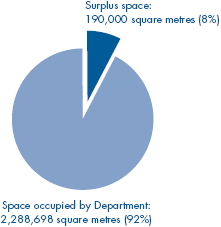
Figure A: Space usage by the Department
| Figure B: Of this 92 per cent space occupied by the Department, the following table indicates the square metres that the Department can vacate: | ||||||||||||
Square Metres the Department can Vacate |
| % of total combined estate occupied by the Department | |||||||||||
PRIME1 |
|
| |||||||||||
PRIME expansion estate1 |
|
| |||||||||||
Core3 | 495,7404 | 22 | |||||||||||
| Less: Flexible space used to date | -47,000 | -2 | ||||||||||
| Net Total Space to vacate available | 1,232,060 | 545 | ||||||||||
Source: Department for work and pensions |
|
| |||||||||||
NOTES 1 Paid for in the unitary charge. 2 For the PRIME estate, the Department can vacate up to 32,888 square metres a year for each of the first 15 years of the contract. If the Department does not use the flexibility in any one year, it can be carried forward for use in subsequent years. 3 Land Securities Trillium's Unavoidable Costs paid when the property is vacated. 4 The total amount of core space the Department can vacate is calculated as 20 per cent of the total area transferred to Land Securities Trillium. 5 Figure may not add up due to rounding. | |||||||||||||
2.3 The Department chose the balance between the two types of flexibility to reflect the fact that it knew that it needed to vacate a certain amount of space within a given timeframe, and that it would gain a cheaper price for the right to vacate by giving Land Securities Trillium certainty. It did, however, follow our past recommendations and sought variant bids from Land Securities Trillium to determine the cost of buying different levels of flexibility. The purchase of 228,000 square metres of allowance, it described as flexi-core, provided the best value for money, and the Department can choose such properties to vacate from a pool of 290,000 square metres. The Department, however, could not forecast how much of the remaining space it would require over the life of the contract. It, therefore, negotiated the right to vacate space it defined as core on a pay as you go basis. It can vacate ten per cent of core space through the payment of unavoidable costs, and a further 10 per cent if it pays a premium on unavoidable costs.
2.4 Pay as you go payments comprise Land Securities Trillium's unavoidable costs including its loss of profit, but mitigated by any additional revenue it can generate from the vacated space, for example, from sublet income or sales proceeds brought forward. Once the Department has vacated a property that proportion of the unitary charge relating to that property, its facility price (FP), is no longer paid.
2.5 Before the signing of the expanded contract, the Department had only used 47,000 square metres of the 197,328 of the flexible space it had purchased the right to vacate on the PRIME deal. At the time, the purchase of this much flexibility seemed reasonable, but as circumstances changed not so much was required. The Department could not reduce the amount of flexibility it had purchased under the PRIME contract as this would have been regarded as a fundamental change to the contract which could not be done through the non-competitive negotiation of the expanded PRIME contract. Following our past recommendations, however, the Department structured the flexibility package on the PRIME expansion estate to mitigate the risk that too much flexibility was bought "up front" through the unitary charge and then not used but balanced it against the higher cost of "pay as you go" flexibility. The Department can:
■ acquire more flexi-core vacation allowance, or sell back unused allowance. The price is the same for purchase and sale, is not property specific, and declines as the contract progresses;
■ vacate flexi-core space as if core by paying Unavoidable Costs (UACs), once all the flexi-core allowance has been used. This mitigates the risk that the Department needs to vary its "pre-paid" flexi-core allowance; and
■ reduce the costs of "pay as you go" flexibility by offsetting UACs against the cost of new acquisitions.