PART ONE The project went through a major restructuring in 1998
This part of the report provides a summary of the restructuring of the project after the original deal came close to collapse in 1998. The part sets the scene for the rest of the report as many later developments relate to the arrangements arising from the 1998 restructuring.
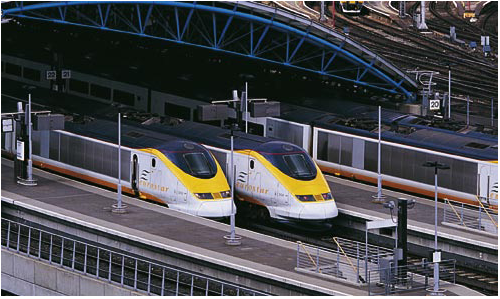
1.1 In February 1996, the Department awarded a contract to London and Continental Railways Limited (LCR)7 for the development of the Channel Tunnel Rail Link (the Link), a high speed railway linking St Pancras Station, London, to the Channel Tunnel. LCR contracted to build, own and operate the Link, and to own and operate Eurostar UK, the British arm of the Eurostar international train service8. LCR agreed to raise private finance to construct the Link and cover anticipated losses from Eurostar services in the early years of the concession. As part of the agreement, LCR would receive, over time, direct grants from the Government that, in 1997, had a present value of £2,012 million (Figure 3 overleaf).
1.2 Demand for the Eurostar train service ran well below forecasts. By the end of 1997, LCR realised that it would not be able to raise the funds from the debt and equity markets that it needed to build the Link, so it turned to the Department for an increase in direct grants in return for a share in future profits.
1.3 In June 1 998, the Deputy Prime Minister announced an alternative way forward. The solution, a major restructuring of the project9, included, among other things:
■ Splitting construction of the Link into two distinct phases - Section 1, from the Channel Tunnel to Fawkham Junction, via Southfleet in northwest Kent and Section 2, from Southfleet to St Pancras. At the conclusion of the 1998 restructuring, the Department and LCR agreed that work to construct Section 1 would start in October 1998 with commencement of the Section 2 works planned for July 2001.
■ Bringing Railtrack Group into the project - Railtrack Group, then responsible for operation of the UK domestic rail network, agreed to participate in the project. It was a key player in the 1998 restructured deal, taking construction risk on Section 1 should the cost exceed an agreed target.10 Railtrack Group contracted to purchase Section 1 after its completion for a price based on the actual cost of construction, but its revenues from Eurostar UK for access to the section were calculated to provide an agreed return against a target cost of construction. Railtrack Group also accepted a capped share of Eurostar UK revenue risk and secured an option to purchase Section 2 on a basis similar to its agreed purchase of Section 1.
■ Assuring Railtrack Group that it would receive a minimum income stream - The restructuring involved a separate agreement whereby the Department, for a period of 50 years from the opening of Section 1, guaranteed Eurostar UK's payments of Section 1 track access charges. To reduce the likelihood of a call on the guarantee, the Department provided LCR with a loan facility - the access charge loan facility - that LCR could draw upon should it lack the funds to meet Eurostar UK's obligation to pay access charges.
3 | Following the 1998 restructuring, the 1997 present values of the Government's grants remained at £2,012 million3,4 in January 1997 prices | |||
Grants | The 1997 present value of the grants (£ million in January 1997 prices) | Payment particulars following the 1998 restructuring | ||
Capital Grant | 557 |
| Paid in eight equal instalments, subject to the achievement of relevant construction milestones for Section 1 | |
Deferred Grant | 1,044 |
| Paid in eight equal instalments, subject to the achievement of relevant construction milestones for Section 2 | |
205 |
| Paid in 34 equal, semi-annual instalments from August 2005, provided the Permit to Use for Section 1 has been issued | ||
206 |
| Paid in 34 equal, semi-annual instalments from January 2008, provided the Permit to Use for the full length of the Link has been issued | ||
Total | 2,012 |
|
| |
NOTES 1 The Department pays LCR the Domestic Capacity Charge for providing capacity on the Link for other train operating companies to run services between London and north and east Kent. 2 Since 1995, the project has received from the European Commission instalments of a project development grant because the Link forms part of the Trans-European Network of transport corridors across the European Union. When LCR won the contract in 1996, it became the recipient of the payments, which have amounted to £141 million (cash). Under its contract with the Department, LCR agreed that the amount received from the European Commission would be deducted from the Capital and Deferred Grants. 3 In our previous report, published in 2001, we stated that the present value of the grants in 1997 prices was £2,014 million. The slight difference is attributed to minor changes in the way the grant payments have been discounted to establish a present value. 4 The 1997 present value of the grant payments is approximately £2,530 million if the payments are discounted using a 3½ percent discount rate. | ||||
■ Contracting in Inter-Capital and Regional Railways Limited11 (ICRR) as operational manager of Eurostar UK - The Department wanted Eurostar UK to operate under new management. In 1999, at the conclusion of a competition between ICRR and Virgin Group Limited, LCR appointed ICRR to manage the business of Eurostar UK until 31 December 2010.
■ Changing radically the plans to raise private finance - The financing proposals for the project changed fundamentally during the restructuring but did not involve increasing the present value of the direct Government grants (Figure 3). The flotation of LCR was abandoned. To fund construction of Section 1 and concurrent losses incurred by Eurostar UK, LCR secured two sources of private finance. The first was bank debt guaranteed by Railtrack Group. The second was through an issue of Government Guaranteed Bonds (GGBs), which are bonds issued by a party other than the Government, in this case LCR, but carrying a Government guarantee to honour the bond if the issuer defaults. To fund construction of Section 2, the operation of Section 1 and projected further Eurostar UK losses, LCR planned to use the proceeds from its sale of Section 1 to Railtrack Group and to issue a second tranche of GGBs.
1.4 The Department and LCR agreed a target cost for Section 1 of £1,930 million in cash outturn terms (£1,670 million at January 1997 prices, plus a £260 million allowance for inflation) and a target cost for Section 2 of £3,303 million in cash outturn terms (£2,513 million at January 1997 prices, plus a £790 million allowance for inflation).
_________________________________________________________________________________
7 LCR's shareholders are Bechtel Ltd (22.41%), SG Securities (UK) Ltd (22.41%), National Express Group Plc (20.94%), French Railways Ltd (SNCF) (13.6%), EDF Energy plc (13.18%), Ove Arup & Partners (2.76%), Sir William Halcrow & Partners Ltd (2.43%) and Systra (2.27%).
8 The operation of the Eurostar train service is the responsibility of Eurostar UK, SNCF and SNCB, the latter two being state owned companies responsible for domestic rail services in France and Belgium respectively. Within the UK, responsibility for Eurostar services rests with Eurostar UK.
9 We examined the restructuring of the deal in our earlier report entitled, "The Channel Tunnel Rail Link", HC 302, Session 2000-2001.
10 The target cost was derived from risk assessment modelling. It was an estimate of the cost of constructing Section 1 and was prepared on the basis that there was a 75 per cent probability that it would not be exceeded. The probability level was the benchmark set by Railtrack Group for its capital investments.
11 ICRR is a consortium comprising National Express Group (40%), SNCF (35%), SNCB (15%) and British Airways (10%).