Generally, the health and safety record during construction of Section 1 was considerably better than the national average for the construction industry
2.19 Rail Link Engineering took an active role in the promotion of a strong health and safety culture during the construction of Section 1. Before receiving his/her security pass, each member of the workforce had to attend a health and safety induction and demonstrate his/her understanding by answering a questionnaire. Rail Link Engineering designed the programme so that it did not discriminate against those with literacy difficulties or for whom English was a second language. There were additional health and safety inductions when individuals were relocated to other areas of the section. These high level health and safety inductions were backed-up on site by each gang planning and reviewing the safety aspects of its activities, often on a daily basis. Rail Link Engineering also introduced its Target Zero Accidents programme. The programme was based around a mobile facility that used short videos and open discussion to present relevant health and safety information to groups of about 10 to 15 members of the workforce. To reinforce the presentation, "top-pocket" cards containing salient information were distributed.
2.20 Rail Link Engineering wanted to bring about behavioural changes within the workforce so that attitudes were more in line with those of workforces in the petro-chemical, power and processing industries, which have a better health and safety record than the construction industry. To encourage the open and honest reporting of accidents, Rail Link Engineering operated a no blame regime. This, together with a policy of engaging the workforce to participate in improving the health and safety culture, provided Rail Link Engineering with information from which it could spot trends and take steps to prevent further or future accidents. The accident record for Section 1 was generally well below the national average across the construction industry.
7 |
LCR considers that extensive use of target-price contracting across the project led to significant benefits for the project's implementation |
|
Target
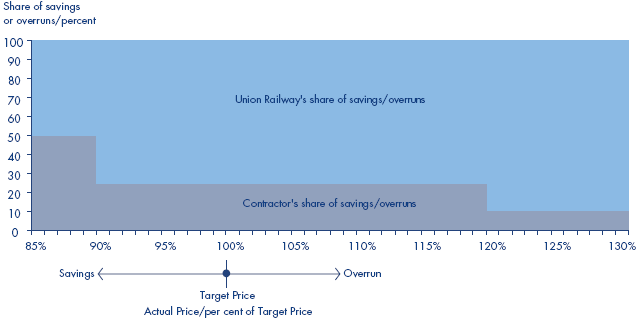
Contracts contractors were reimbursed their costs at the tendered rates for labour, materials and overheads. After completion, the contractor shared in cost savings or overruns against the target price:-
LCR decided to implement target-price contracting using a new form of contract that had been developed by the Institution of Civil Engineers in consultation with industry experts. The contract provided specific advantages in terms of clear risk allocation, early resolution of issues, and provisions for partnering arrangements. Together with an incentive regime under which all parties shared in the risks and rewards, LCR saw the following benefits in managing the project: ■ the contracting approach encouraged partnering arrangements in which the project client, project manager and contractors col ■ a non-co ■ the incentive regime encouraged collaboration between contractors in which, after contract award, neighbouring contractors combined resources and/or collaborated at their interfaces. For example, during the substantial ground works over the length of the section ■ the overall project programme could be delivered more quickly because significantly less engineering and design works were required, before contracts were tendered, than would have been needed to tender fixed-price lump sum' contracts. Also, the completed design benefited from the contractors' practical input into how the works would actually be implemented. Source: LCR |
|