Poor planning of staff numbers
1. When Best and Final Offers were invited from bidders in 1998, the Home Office stated a requirement to accommodate 2950 staff based on a forecast reduction in its central London headquarters staff from 3200. This reduction did not occur and in fact, between 1998 and 2003, numbers increased to 4900 (Figure 1). Although the design of the building was adapted to provide for an additional 500 staff, further expansion was not possible due to the size of the site and planning restrictions. At present, total Home Office and Prison Service headquarters staff numbers are 1500 in excess of the capacity of the new building.8 The Home Office has now had to change its working assumption that the Prison Service would be accommodated at Marsham Street. In the short-term, one option was for it to remain in Abell House and Cleland House, which were currently occupied by the Prison Service and were very close to the Marsham Street building. In the longer term, the Home Office was looking at whether it could get better value for money either elsewhere in central London or outside London.9
Figure 1: Home Office forecasts of staff numbers underestimated actual increases
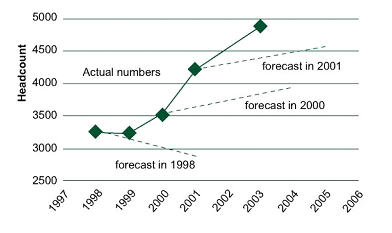
Source: C&AG's Report
2. When it was making the original projections in 1998, the Home Office assumed that staff numbers would fall. Despite some machinery of government changes that have reduced Home Office functions, staff numbers have since gone up because of changes in the Home Office's role and the addition of some new responsibilities. Figure 2 shows that some 800 extra staff have been employed to meet these new responsibilities. These additional staff do not, however, fully account for the total rise since 1998. In 2002, before the deal was signed, the Home Office considered whether the project still made sense. Although the building would not be large enough to accommodate all the staff, the Home Office considered that the deal still offered good value for money and decided to proceed.10
Figure 2: Increases in staff numbers arising from new
New role/responsibility | Additional staff |
Creation of the National Probation Directorate | 300 |
Creation of a trilateral criminal justice team working to the | 150 |
The Home Office has taken over the Drug Co-ordination Directorate | 200 |
Increase in numbers working on policing, crime reduction and | Unspecified |
Increase in the prison population leading to an increase in prison | 150 |
TOTAL | 800 |
Source: Q 34
3. The Home Office acknowledged that it should have put more effort into ensuring that staff projections were as accurate as possible. There was currently no fixed projection for staff numbers in 2005 as the Home Office was working on a strategic plan for the whole Home Office group for the next five years. As part of that exercise, all headquarters numbers were being reviewed to see if more resources could be shifted into the front line. The Home Office also said that numbers were likely go up and down over the next few years and that it was having to plan for a degree of uncertainty. For example, there were major reviews underway of drugs policy and the structure and workings of prisons and probation. Both of these reviews could have significant implications for staff numbers.11
4. The Home Office considered that in the future it might have flexibility to increase the number that could be accommodated in Marsham Street. Home working, remote working and hot desking could enable a greater number of staff to be based in the new building, on the assumption that no more than 3450 would be there at any one time.12
8 C&AG's Report, para 1.25
12 Q 47