NATS no longer bears the full risk of downturns in traffic
1.9 Under the original structure of the PPP, NATS was expected to bear the full effects of fluctuations in its income from changes in the amount of air traffic that it handled. In line with practice from other privatisations, its prices were determined by the Government for the first five years after sale, following advice from NATS' economic regulator, the Civil Aviation Authority. To increase its prices above the agreed cap the Company had to apply to the Authority for a modification to its operating licence, the outcome of which would take a minimum of several months to determine. This was a serious matter for the Company because though its costs, in the form of systems and staff, are largely fixed, its revenues can be volatile. NATS is particularly vulnerable to any decline in the level of transatlantic traffic, which accounts for 14 per cent of its flights but 43 per cent of its revenues, because North American flights traverse more UK airspace and use larger aircraft. At the time of the original PPP, there was no enthusiasm for the introduction of a mechanism for flexing NATS' charging rates dependent on traffic volumes.
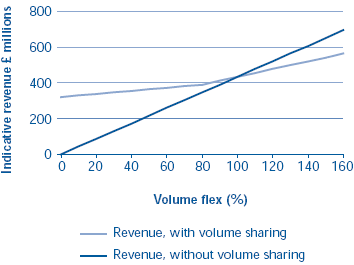
1.10 As part of the new regulatory structure, the Civil Aviation Authority has, for the first price control period to December 2005, introduced flexibility to reduce the impact of traffic fluctuations on NATS. The Company and its airline customers now each face 50 per cent of both upside and downside volume risk. If traffic were to fall by a certain amount compared to a benchmark level, set at NATS' Base Case Forecast set in November 2001, prices will automatically rise so that, all else being equal, NATS would lose only 50 per cent of the change in revenue. NATS' base case estimate represents its view of how traffic should perform over the next three years, and so already takes into account effects of traffic falls following September 11th. In addition, if traffic falls even further, below a floor meant to represent a very severe crisis, NATS' share of the lost revenue would fall to only 20 per cent. This relationship is shown in graphical form in Figure 4.
1.11 Notwithstanding this fundamental change to the regulatory framework of the PPP, NATS still regards its remaining exposure to downturns in traffic as its most fundamental business risk.
4 |
| Sharing the traffic risk |
|
| NATS is exposed to reduced risk from reductions in traffic under the new 'volume flex' arrangements. Its charges to airlines automatically increase as traffic decreases, making its total revenue less variable.
|
|
| Source: CAA and NAO |