NATS' good safety record has been sustained
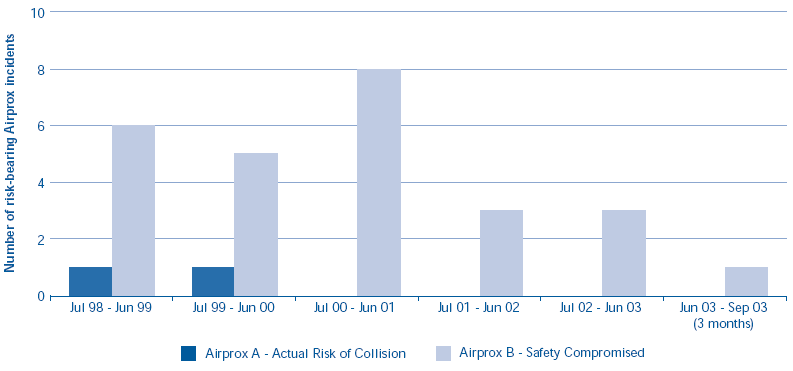
1.29 The Civil Aviation Authority's Regulator has examined the safety performance of NATS since the PPP. The key measure, the number of Air Proximity Incidents, is defined as a situation in which, in the opinion of a pilot or a controller, the distance between aircraft, as well as their relative positions and speed, have been such that the safety of the aircraft involved was, or may have been, compromised. From the Authority's own assessment of such incidents (Figure 5), NATS' overall performance under the PPP appears to be comparable with, if not better than, that achieved previously.
5 |
| The number of risk-bearing air proximity incidents involving a NATS contributory factor |
|
| There has been no discernible deterioration in the rate of safety incidents since the PPP was signed in July 2001.
|
|
| Source: Civil Aviation Authority |
6 |
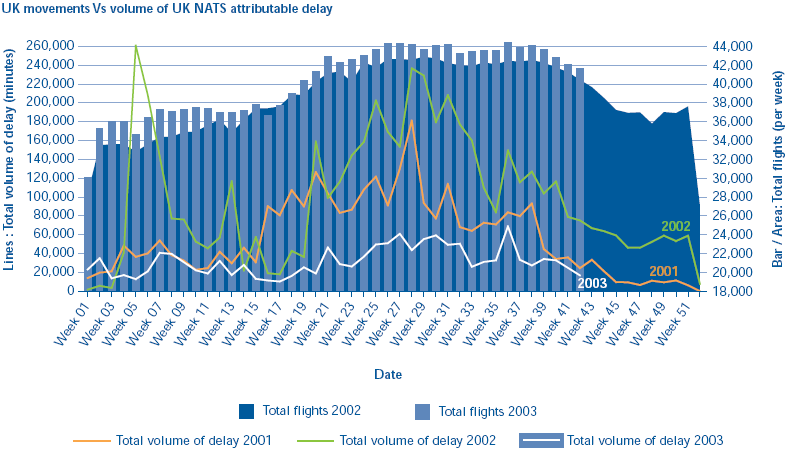
| Key trends in flights and delays |
|
| After a bad 2002, NATS' performance in minimising flight delays has improved considerably despite record traffic levels.
|
|
| NOTE Though the total number of flights has risen in 2003, growth has mainly been in relatively small aircraft flying to Europe, which yields less income for NATS than do transatlantic flights, which have reduced. Source: Data from NATS |
7 |
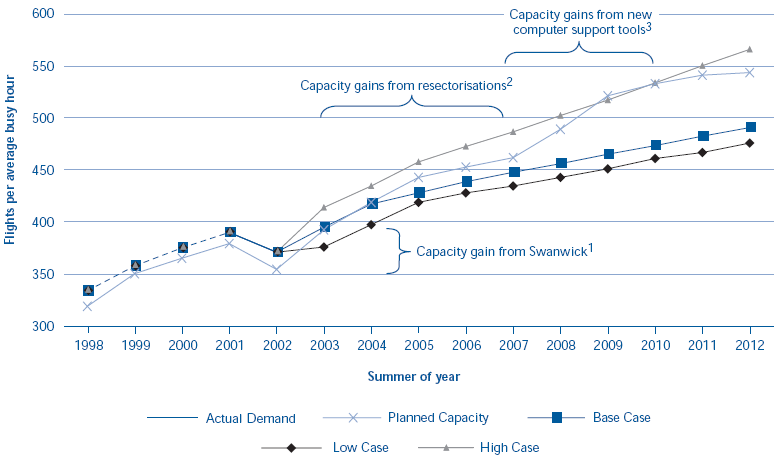
| The growth in capacity proposed in NATS' 2003 Business Plan |
|
| NATS' business plan proposes increases in capacity to deal with a high rate of traffic growth.
|
|
| NOTES 1 For example, providing more controllers per sector. 2 Capacity gains from splitting the airspace into smaller sectors. 3 New computer tools to carry out some of the functions currently done by controllers. Source: NATS |
1.30 NATS' controllers are also able to freely report occasions on which they consider that their workload in terms of aircraft being handled has been excessive. The number of overloads reported by controllers (43 between January 2002 and June 2002), in the first five months following the opening of the new En-Route Centre at Swanwick, was significantly higher than the norm. But the rate of reporting has now settled back to a figure consistent with the five year rolling average. Initial indications are that many reports resulted from unfamiliarity with the new workstation environment, minor technical issues, and some instances of heavy traffic (above agreed traffic flow rates) which did not however, result in safety being compromised. Since the PPP, no Air Proximity events have resulted from controller overloads.