Price changes appear reasonable
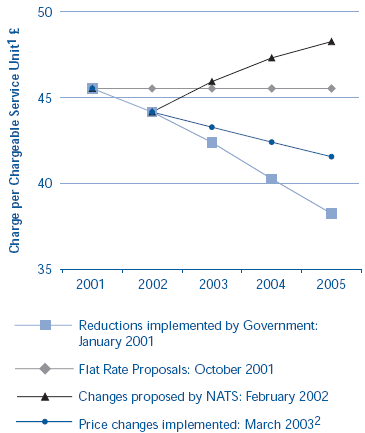
1.33 As a contribution to giving NATS more robust finances, the Civil Aviation Authority has agreed that the Company's prices should fall less in real terms than the price cuts originally planned for the first five years of the PPP. These concessions will cost airlines some £100 million over the period 2003-2010. We have considered these price changes in the context of NATS' original proposals for price increases, relative prices across Europe, and the extent of Airline support for them.
1.34 As shown in Figure 8 below, the price changes that have been granted are less generous to NATS than initial proposals put forward by the Company following September 11th. The Authority told us that they felt that these initial proposals in February 2002 would have restored NATS' finances largely at the expense of its customers, and did not meet the Authority's perception of a truly composite solution.
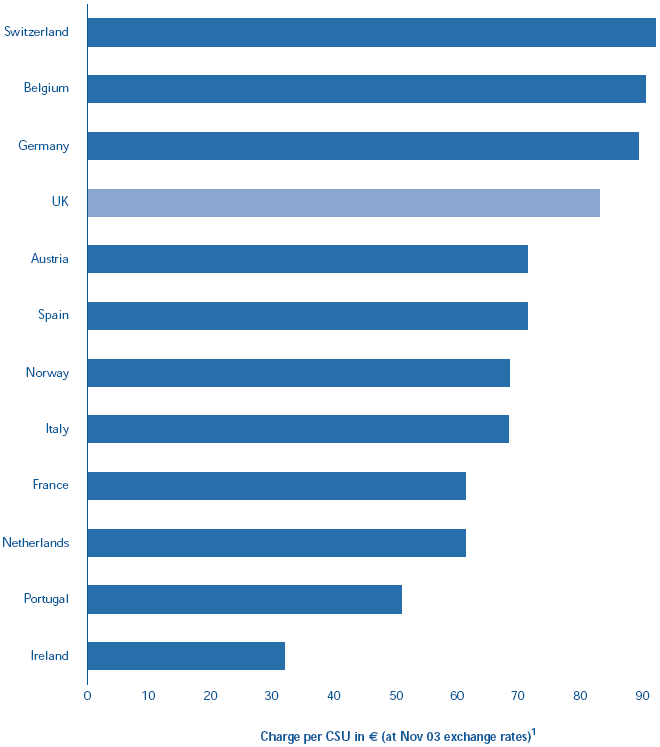
1.35 Our previous report showed that in 2001, before the PPP changes took effect, NATS' charges to Airlines for en route air traffic control were the highest in Europe. Comparisons between international charges are difficult due to different approaches to charging and to cost recovery. In addition, figures should be interpreted with caution since the picture varies from year to year due to fluctuating exchange rates and as under-recoveries or over-recoveries of cost are adjusted in later years. Figures from the published charges (the amounts actually paid by air users through the European air traffic authority Eurocontrol) show NATS to be the fourth most expensive provider (Figure 9) after Switzerland, Germany and Benelux. This appears to be broadly consistent with Eurocontrol's latest analyses of the cost effectiveness of European providers2. Generally, existing cost effectiveness measures are based on costs per kilometre with no account taken of the complexity of airspace. What is not disputed is that after the commencement of the PPP, NATS' regulated prices improved relative to those charged elsewhere in Europe, where operators raised their charges following September 11th by 12 per cent on average in 2002.
8 |
| Changes to NATS' prices to Airlines |
|
| Price changes were less generous than those proposed following September 11th.
|
|
| NOTES 1 This is the Charge per Chargeable Service Unit - the unit of flight activity on which European ATC providers base their charges to airlines. One service unit is generated by a plane of 50 tonnes flying for 100km through UK airspace. Charges are expressed in Constant Prices. 2 The price changes implemented in March 2003 involve demand risk sharing. Hence the actual price is dependent on demand. The prices shown here represent those which would result if demand were as in NATS' November 2001 Base Case. Source: NATS |
1.36 In deciding to relax its caps on prices, the Civil Aviation Authority requested and took into account representations from the aviation industry. Most of the twelve airlines that responded supported the Authority's proposal to revisit the price cap, but three airlines questioned the need for increases and strongly expressed the view that any increases should be tied to improvements in NATS' quality of service. The Authority responded to this argument to some extent by increasing the financial incentives on NATS to reduce delays. Amongst other changes, the maximum penalty for severe delays has been doubled to £10 million a year, about two per cent of turnover. Based on its much improved performance to date in 2003, it appears that NATS may not be subject to penalties this year.
9 |
| NATS' charges to Airlines - the European perspective |
|
| The UK's charges for en route air traffic control will be the fourth most expensive in Europe in 2004.
|
|
| NOTE 1 This is the Charge per Chargeable Service Unit - the unit of flight activity on which European ATC providers base their charges to airlines. One service unit is generated by a plane of 50 tonnes flying for 100km through UK airspace. Source: NATS |
____________________________________________________________________
2 Report by the Performance Review Unit, Brussels, September 2003.