Executive summary
Paragraphs 1.2 and 1.15 | 1 In November 1999, Fazakerley Prison Services Limited (FPSL), a project company formed by Group4 and Tarmac1, refinanced the project it had been awarded by the Prison Service in 1995 to build, maintain and operate Fazakerley prison, the first prison under the Private Finance Initiative (PFI) 2 . The terms of the refinancing included: |
| ■ an extension to the period over which FPSL's bank loan would be repaid; |
| ■ a reduction in the lending margin for the loan; |
| ■ the arrangement of a fixed rate of interest covering the full period of the loan; and |
| ■ early repayment of the subordinated debt invested by the shareholders of FPSL. |
Paragraphs 1.3 to 1.5, 1.10, 3.7, Figure 1 | 2 FPSL was able to refinance the Fazakerley project firstly because of its success in constructing the prison and establishing a track record in its operation, and secondly because of increasing confidence in the financial markets towards PFI projects generally. The refinancing has improved the expected returns to FPSL's shareholders both through the early repayment of their original investment and by generating a more favourable flow of dividends. These expected returns have increased by £10.7 million (61 per cent) as a result of the refinancing, as compared to their originally projected level of £17.5 million 3 at the time the contract was awarded. |
Paragraphs 1.3 and 1.4, Figure 2 | 3 The refinancing has been a major factor - but not the only one - in increasing shareholder returns. FPSL had already been rewarded financially by completing the prison ahead of schedule and by achieving savings on construction and commissioning costs. These factors, in combination with the refinancing, |
Figure 1 |
|
| How the Fazakerley Prison refinancing increases, and brings forward, the returns to the shareholders of the consortium |
| |
| |
| |
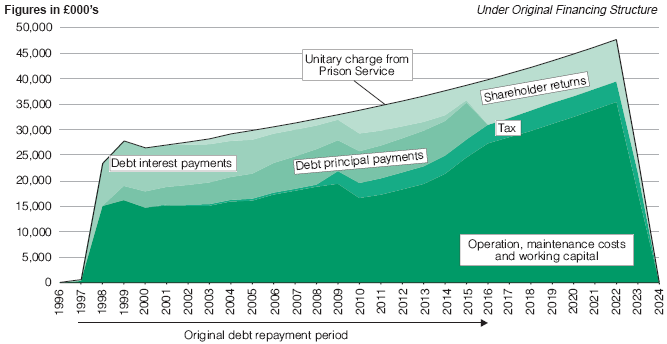
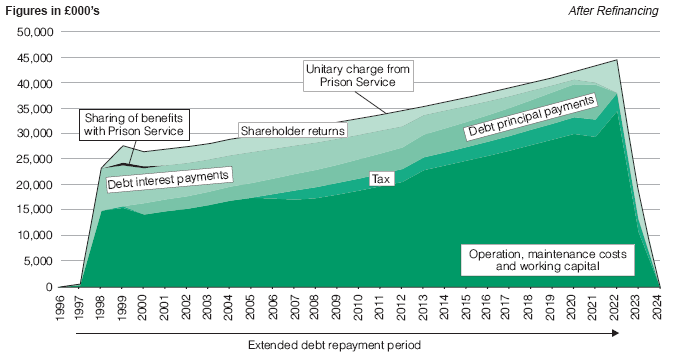
The figures above show how the Fazakerley Prison refinancing affects the costs of funding to the FPSL consortium. The reduction in the interest rate means that annual interest charges are lower throughout the life of the loan. The extension in the repayment term of the loan means that annual debt repayment costs are lower in the next 13 years. The total debt service costs are therefore reduced after the refinancing has taken place and until 2013. Thereafter, FPSL will face additional costs because the loan will not have been repaid in full by this time. As the unitary charge payable by the Prison Service remains the same as under the original contract, before any sharing of the refinancing gains, the refinancing therefore creates earlier and larger dividends for the equity investors in the consortium. The Fazakerley prison was actually completed ahead of schedule, so the operating revenues in 1998 were higher than originally expected. This is the reason for the slight kink in the early years. Source: National Audit Office |
| have increased shareholders' expected returns by a total of £14.1 million, some 81 per cent higher than when the contract was awarded.4 The Prison Service has also benefited from the early completion of Fazakerley through the earlier availability of prisoner places which has helped it cope with prison overcrowding in the North West of England. The Service regards the ability to operate Fazakerley at a higher than planned prison population during the first year of operations as commendable for a newly opened local prison. |
________________________________________________________________________
1 The interests of Tarmac in this project have since been taken over by Carillion plc which operates the former construction business of Tarmac.
2 The prison is now known as HMP Altcourse .
3 Unless otherwise stated, all figures shown in this report relating to the value of benefits to shareholders are quoted in present value terms as at 30 November 1999 - the date of the refinancing - using a real discount rate of 6 per cent.
4 After a payment of £1 million from FPSL to the Prison Service (paragraph 9), the expected net returns to FPSL's shareholders are £13.1 million higher (75% higher) than when the PFI contract was awarded (Figure 2, page 4).
- The Prison Service's position
- Scope of the study
- The Prison Service received £1 million from FPSL as compensation for increased termination liabilities
- Further refinancings of PFI contracts are likely to occur
- There are general principles which departments can apply to refinancings
- Other learning points