The compensation was consistent with the Service's estimate of the extra financial risk it was bearing
1.28 The calculations which Rothschild had prepared for the Prison Service showed that the £1 million compensation offered by FPSL would, on average, be acceptable if the probability of an event which could trigger a contract termination during the contract period was 10 per cent or less (Figure 5). The Prison Service considered that the £1 million offer from FPSL would be acceptable because it would be satisfactory compensation even based on cautious assumptions about the likelihood of contract termination. In reaching this conclusion the Prison Service took into account that:
■ Rothschild's calculations assumed that any event of contractor default would lead to the termination of the contract, whereas the Prison Service would expect many such cases to be remedied without termination occurring. The Fazakerley contract allows, for example, either FPSL's lenders to appoint a replacement operator acceptable to the Prison
Rothschilds' calculation of | Figure 5 |
|
|
| |
Expected value of additional | ||
Probability of termination over the lifetime of the contract | ||
| Rothschilds estimated the expected value of the increase in termination costs resulting from the refinancing, by multiplying the increase in termination liabilities in each remaining year of the contract by the probability of the contract being terminated prematurely in that year, and then discounting the result. An equal probability of default was assumed for each year of the contract. | |
Source: National Audit Office from information supplied by Rothschilds | This figure shows that, assuming a 10% probability of termination over the remaining contract life, adequate compensation for the Prison Service for accepting additional termination liabilities would be between £0.9 million and £1.0 million. | |
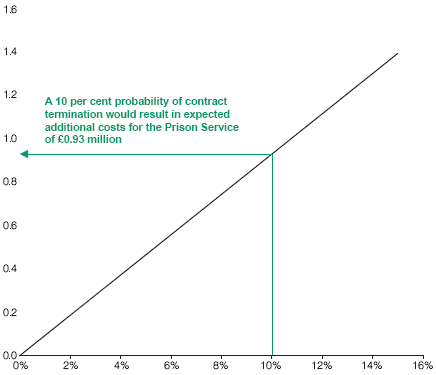
Service, or for the Prison Service to step in and appoint another contractor or itself as the operator of the prison. After taking account of this, the Prison Service judged that it was very unlikely that the probability of contract termination would be as high as 10 per cent; and
■ Rothschild's calculations also assumed that, in the event of contractor default leading to termination, the Prison Service would be liable, as a result of the refinancing, for the full increase in FPSL's liabilities to its lenders. Based on the formula for calculating termination liabilities set out in the PFI contract, in certain cases the termination payment would not have to reflect the full increase in lender liabilities, but only the remaining value of the contract if this was a lower figure.11
The Service recognises that £1 million of compensation represented approximately one fifth of the refinancing benefits for which FPSL considered it was necessary to obtain the Prison Service's consent (Figure 7, page 25):
1.29 Figure 3 (page 15) shows that, if the Fazakerley contract is terminated at any time before 2021, then the actual payment due from the Prison Service to FPSL could be a maximum of nearly £100 million, reducing gradually to zero depending on when termination occurs. The Service recognises that in such an event, £1 million is very unlikely to cover termination costs in full. It therefore regards the £1 million not as a fund for meeting future termination costs should they arise, but as compensation for accepting a risk which it is prepared to shoulder. This approach is consistent with the government's general approach to insurable risks which, on value for money grounds, departments themselves bear.
________________________________________________________________________
11 In the event of contractor default, the termination liabilities would be the lesser of: (a) FPSL's lender liabilities; and (b) the net present value of the unexpired part of the contract, less any rectification costs which would be required to return the prison to an acceptable standard, less the additional cost (if any) of providing alternative accommodation for prisoners while rectification takes place, less any projected additional operating costs incurred in fulfilling the remainder of the services required under the contract up to the date when the contract would have otherwise expired.