2 Procuring the PPP contract
9. In 2000, the scope of the NRTS project comprised extending the trunk fibre optic cable network to create a core resilient network covering the motorways linking London, Bristol, Birmingham, Manchester and Leeds. The Agency hoped that the contractor would renew some life-expired assets and generate revenues through commercial exploitation of these assets. The estimated cost of the project, net of expected revenues was £40 million12 (present value, 1999 prices).13
10. In March 2001, eight months after starting the procurement, the Agency increased the scope of the project to include upgrading the communications technology and installing, operating and maintaining local connections that linked roadside devices to the trunk cable network. The change in scope resulted from potential economy and efficiency gains that the Agency considered it could achieve by incorporating other motorway telecommunications projects into NRTS. Under the changed scope, the contractor would also have end-to-end responsibility for transmission of information between the control centres and roadside devices.14
11. Market interest weakened during the procurement. In August 2001, the Agency invited potential bidders to express their interest in the project and so commenced the competitive stage of the procurement. Interest fell away, however, during the 17-month long short-listing process. The Agency dispatched a pre-qualification questionnaire to those parties that had expressed an interest in the project. Nine of the responding parties returned the questionnaire, from which the Agency judged six were suitable for short-listing. The Agency underestimated how long it needed to complete preparation of its bid documents.15
12. Some potential bidders showed signs of losing interest after they had waited nearly a year to discover whether they had been short-listed. To re-stimulate the market, the Agency re-published its notice in the Official Journal of the European Communities in August 2002. Two of the stronger potential bidders that had responded to the first notice did not reply. In December 2002, the Agency short listed the four sufficiently qualified bidders that remained interested in the project. Two of these dropped out of the competition shortly after receiving bid documents.16
13. There was a significant difference between the pricing offered by the two remaining bidders, LINK (a Serco led consortium) and GeneSYS. In the three competitive bidding rounds, the Agency's assessments of LINK's offers revealed them to be more expensive than GeneSYS's offers by between £230 million and £280 million (Figure 1).17
14. The Agency wanted to transfer the risk of operational performance of the existing telecommunications assets. The Agency, however, possessed all available information about the performance of these assets. The Agency collected together as much material as it had about the assets, but was not prepared to warrant the accuracy of the information because it did not want to compromise the intended risk transfer. GeneSYS was prepared to accept the risk transfer, but only on the basis of its own due diligence of the condition of the existing assets.18
15. After receiving initial bids in July 2003, the Agency conducted an affordability review that resulted in a 168 kilometre reduction in the amount of fibre optic cable that the contractor would lay in the first two years of the contract. While the Agency left 110 kilometres of fibre optic cable laying in the contract, it used conventional procurement means to install 168 kilometres of fibre optic cable between 2003 and the award of the NRTS contract in 2005. As a result, the Agency itself laid some of the cable it originally planned to include in the NRTS deal.19
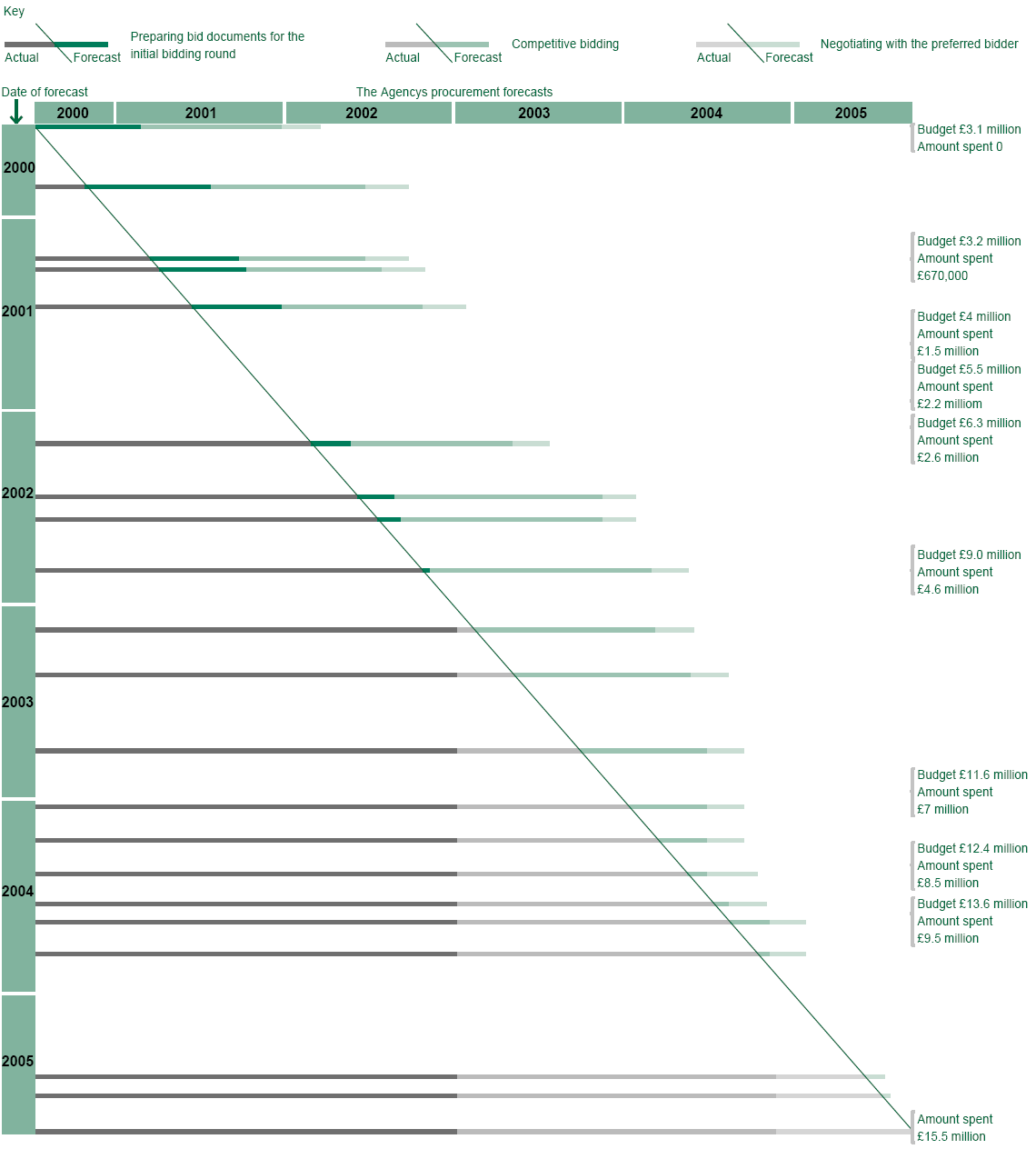
16. When the Agency started the procurement in July 2000, it expected to complete the process in 21 months, for a cost of £3.1 million in advisers' fees. The procurement took over five years to complete, and the advisers' fees amounted to £15.5 million. Some of the growth in the procurement can be explained by the two major changes in the scope of the project and in accommodating changes in traffic services that occurred during the procurement, in particular, the Government's decision to bring forward the replacement of 32 Police Control Offices with seven Regional Control Centres and the introduction of the Agency's traffic officer service.20
17. The majority of the increase to both the procurement timetable and the budget, however, can be attributed to the Agency's desire to produce high quality, clear and unambiguous bid documents. Neither the Agency nor its advisers, a consortium called KHHD (comprising KMPG, Herbert Smith, Hyder and Detica), had any real understanding of the amount of work required to meet the desired quality (Figure 2). With the Agency almost completely dependent on its advisers for the production of the bid documents and other procurement related material, the Agency needed good controls to ensure that its advisers were performing their obligations efficiently, particularly since the advisers were being paid on the basis of hours worked.21
Figure 2: The procurement timetable progressively increased from 21 months to over five years and the budget increased from £3.1 million to £15.5 million
The procurement timetable progressively increased from 21 months to over five years and the budget increased from £3.1 million to £15.5 million
18. Ultimately, the Agency had no effective incentives to influence the behaviour of its advisers. The Agency had only two members of staff dedicated to the procurement. These individuals not only reviewed the considerable volume of material prepared by the advisers, but also had to oversee, on average, a £250,000 monthly spend on advisers. While they focused on the production of quality documents, controls over the advisers were allowed to slip.22
19. Although the Agency was over-reliant on the good faith of its advisers, the two members of the Agency's staff dedicated to the project remained in post throughout the procurement and the two-year long build phase of the contract. The Agency benefited from their detailed understanding of the project and their insistence on high quality bid and contract documents, particularly when during the preferred bidder negotiations, there was no substantial slippage in risk transfer, and GeneSYS's offer actually fell by £2 million.23
20. The Agency's bargaining position in the negotiations also benefited from the detailed knowledge that the Agency and its advisers had acquired about GeneSYS's pricing bases from the financial and cost models that the bidders' submitted as part of their bids. In September 2005, the Agency awarded the 10½-year NRTS contract to GeneSYS, a special purpose company owned by Fluor Corporation and HSBC.24
_________________________________________________________________________________________________________
12 The NAO calculated that GeneSYS's accepted offer had a present value of £345 million in 1999 prices when deflated using the Office for National Statistics' Retail Prices Index CHAW (all items); C&AG's Report paras 1.19, 1.21; Figure 8
13 Qq 7, 19, 27; C&AG's Report, paras 1.13, 1.15
15 C&AG's Report, paras 2.12, 2.13; Figure 10
16 C&AG's Report, paras 2.13-2.15; Figure 11
17 C&AG's Report, para 2.18; Figure 13
18 Qq 23-25; C&AG's Report, paras 2.2-2.4
19 Q 6; C&AG's Report, paras 2.15, 2.36-2.37; Figure 17
20 Qq 7, 19, 21-22; C&AG's Report, paras 1.19, 2.28, 2.36-2.37, 3.2-3.3; Figure 7; Appendix 5
21 Qq 2, 4, 20, 30, 37-38; C&AG's Report, paras 3.5-3.8
22 Qq 28-35; C&AG's Report, paras 3.7-3.8; Appendix 5
23 Qq 2, 4, 20, 28-35; C&AG's Report, para 3.6