1 The staffing and management of change
1. Under the Private Finance Initiative (PFI), the public sector enters into a long-term contractual arrangement with private sector companies to design, build, finance and operate an asset such as a hospital or school. There are now over 500 operational projects with a combined capital value of £57 billion and future payments amounting to £181 billion (a present value of £100 billion).
2. Operational PFI projects cost the taxpayer nearly £5 billion each year. The public sector must ensure that value for money is maintained during the operational life of PFI projects. Value for money largely depends on the deployment of adequate contract management resources.2
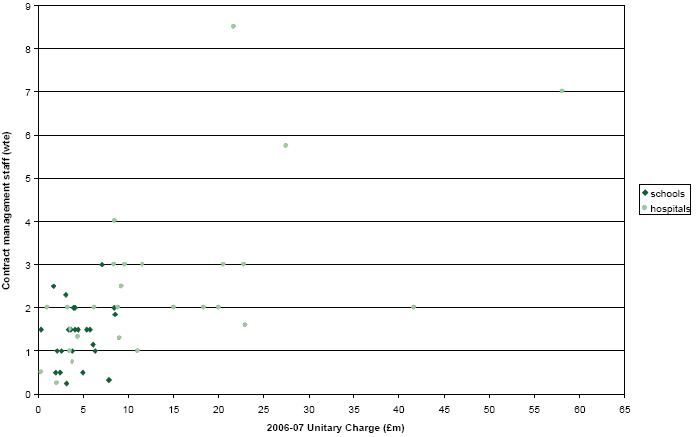
3. There are large variations in the level of resources devoted to the management of PFI contracts of a similar size (Figure 1). One in three contract managers at PFI hospitals and one in six contract managers of PFI schools that were surveyed by the National Audit Office described their teams as under-resourced.3
Figure 1: Staff resources vary between individual projects of similar size
Source: C&AG's Report, Figure 13
4. Recent guidance published by Partnerships UK, an organisation set up by the Treasury to provide support and advice to the public sector on Public Private Partnerships, and 4ps, an advisory body for local authorities, states that PFI projects should have a full-time contract manager. There is a need for some flexibility to suit local circumstances. For example, smaller PFI projects might not need a full-time contract manager. Yet over 15% of PFI projects surveyed by the National Audit Office were not being managed on a full-time basis.4
5. At a local level, successful long-term PFI contracts rely on establishing and maintaining professional relationships between the public and private sectors. This is helped when the public sector retains staff of the right calibre in contract management roles for a reasonable period of time, typically, of around five years. The public sector also needs to adapt its staffing of PFI projects to changing workloads. More staff are needed, for instance, at the time of a benchmarking or market testing exercise or a large contract change. Public authorities have yet to budget with sufficient flexibility to enable this to happen.5
6. The Treasury believes that public bodies should have discretion over how they manage their PFI contracts. The Treasury explained that the balance between the role of central Government and the responsibilities of local procurement bodies had shifted over the last 20 years. While responsibility and accountability for decisions on individual projects now rests with local bodies, the Treasury has nevertheless sought to assist public authorities who have to manage changes to their PFI projects.6
7. The Treasury set up an Operational Task Force in 2006 to provide assistance and training for operational projects. The Task Force is operated for the Treasury by Partnerships UK. By February 2008, the Task Force had held nine regional workshops, each attracting 40 to 50 attenders, which were followed with training courses running at around one a month and attracting on average 20 to 25 people. In addition, the Task Force's helpdesk has received 461 calls from 206 public sector organisations seeking assistance in managing their PFI deals. Major government departments have also established their own Private Finance Units to provide similar services.7
8. The Treasury also supports the efforts of the Office of Government Commerce to improve the public sector's procurement performance. In response to this Committee's previous report on tendering for PFI deals, the Government agreed that there was a continuing lack of experience and skills within public procurement teams across the public sector. To address the issue, the Office of Government Commerce has begun the process of reforming the Government Procurement Service with complex procurement and PFI as priority areas for improved training packages.8
9. The exchange of procurement experts between different areas of the public sector is another important way to raise the quality of procurement. Exchanges are now being encouraged by providing information on relevant vacancies and opportunities to members of the Government Procurement Service. In addition, the Treasury is now working to try to raise the standard of procurement expertise across Government, for instance, through procurement capability reviews of every government department.9
_________________________________________________________________
8 Committee of Public Accounts, Sixty-third Report of Session 2006-07, Tendering and benchmarking in PFI, HC 754; Update on the Treasury Minute to the Thirty-fifth Report, together with the Fifty-seventh to the Sixty-fifth Reports from the Committee of Public Accounts 2006-07, February 2007, Cm 7322