2 Competition for larger changes to projects
10. Over the course of 25 to 30 years of operation, it is inevitable that changes will be needed to the services and assets provided under PFI deals. In 2003, our predecessors recommended that Departments should insist on competitions for the provision of additional work after a PFI deal becomes operational.10
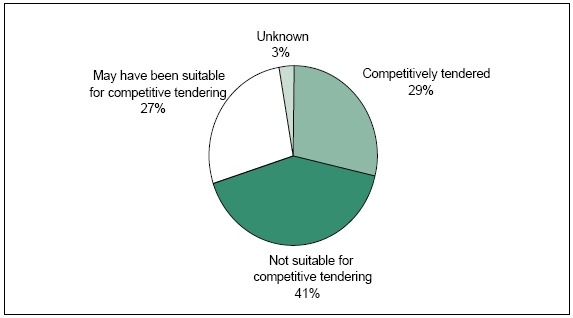
11. In 2006, major changes costing £100,000 or more accounted for 90% of the overall cost of changes to operational PFI projects. 27% of these larger changes might have been suitable for competitive tendering but were let without competition (Figure 2). The value of these non-competed changes was £84 million. 11
Figure 2: High-value changes were not always competitively tendered
Source: C&AG's Report, Figure 7
12. The Treasury has a strong presumption in favour of competition. There can, however, be sound reasons why procuring authorities decide not to put changes to PFI projects out to competitive tender. For example, of the three largest changes that took place in 2006, two were prisons requiring additional prisoner accommodation. As the prisons had to remain in use while building work was underway, the Prison Service judged that the existing contractor was better placed than an outsider to manage the risks involved. The prices offered by the existing contactor had been benchmarked and the Prison Service decided that awarding the work to the incumbent contractor was the right thing to do on operational and price grounds.12
13. The companies involved in a PFI deal establish a separate company, known as a Special Purpose Vehicle (SPV) to manage the project, including any competitive tendering for new work. Operational issues have to be considered carefully, but they are not necessarily a block to competition. For example, East Riding of Yorkshire Schools PFI project has introduced a framework for competitive tendering of changes to PFI contracts. Under the framework, work can be carried out by contractors from the SPV's partners or those from the Local Authority's own list of approved contractors. The SPV also agreed to follow the Local Authority's recently revised requirements for tendering, depending on the value of the work to be undertaken (Figure 3).13
Figure 3: East Riding of Yorkshire Schools
In the early years of the contract, the Local Authority accepted that the SPV would implement any changes using its own sub-contractors and procurement procedures. The Local Authority would verify that the proposed cost of a change was reasonable and in line with benchmark prices, before work was approved. As the project developed, it became apparent that there were opportunities to enhance value for money where work was being sub-contracted. The Authority, therefore, sought to introduce more transparent competition, if necessary using contractors from the SPV’s contract partners or those from the Local Authority’s approved contractor list. The SPV has now agreed to follow the Local Authority’s recently revised competition requirements as below: | |
Up to £2,000: | One oral quotation (confirmed in writing where over £500) |
£2,001-30,000: | Three written quotations |
£30,001-EU Threshold: | Invitations to tender to at least three suppliers |
Above EU Threshold: | EU procedure |
Source: C&AG's Report, Case Example 6
14. In some cases, changes requested by the public sector have reinstated requirements that were excluded from the original contract for affordability reasons. One in five project managers stated that work requested as a change had been considered previously for inclusion in the original deal. In just under half of these cases, work was taken out of the original specification for reasons of affordability. In 2006, such changes ranged in value from £17,000 to £17 million.14
15. Reinstating previous requirements does not appear to be good value for money. Value for money depends, at least in part, on whether changes are essential to the delivery of the service and were required when the contract was being negotiated. In such circumstances it would not be good value for money to remove work from the original contract when potential suppliers are in competition with one another, but then order the same work later, when the project is being run by a single provider. On the other hand, public authorities may be uncertain at the outset whether they will definitely need an additional service. In such circumstances, authorities will need to be sure that there are mechanisms in place to ensure value for money, such as benchmarking and agreed rates for undertaking changes.15
16. The Treasury considered that public authorities needed to be careful when making large changes in the absence of competition. The fact that changes were being made demonstrated the flexibility of PFI deals, which is needed in contracts typically lasting decades. This needs to be balanced, however, against getting good value if the taxpayers' wider interest is to be protected.16
_________________________________________________________________
10 Committee of Public Accounts, Thirty-fifth Report of Session 2002-03, PFI Construction Performance, HC 567
13 Q 23
15 Q 32
16 Q 4