The Agency's aim is to provide passport services promptly and economically
1.2 The Agency was established as an Executive Agency of the Home Office in April 1991. The Agency's main aim, set out in a Framework Document published in May 1996, is to provide passport services for British nationals in the United Kingdom promptly and economically. Its objectives are shown in Figure 1. The Agency is also expected to meet a number of targets, including:
■ to maintain a maximum processing time of 10 working days throughout the year for straightforward, properly completed applications; and
■ to meet customers' declared travel dates for at least 99.99 per cent of passports issued.
Objectives of the Passport Agency | Figure 1 |
|
| ||
On passport security: | ||
| ■ to maintain the integrity of the United Kingdom Passport; and ■ to monitor the incidence and nature of passport fraud, and take appropriate preventive measures. | |
| On customer service: | |
| ■ to provide passport services within performance targets set by the Home Secretary, with priority given to meeting known travel needs; ■ to deal promptly, courteously and efficiently with written, telephone and personal enquiries from the public on passport matters; ■ to provide advice and guidance to the public on passport matters; and ■ to ensure that the passport service meets the needs of its customers in accordance with the principles of the Citizen's Charter. | |
| On financial management: | |
Source: UK Passport Agency | ■ to ensure that passport fees are set at a level to fully recover the cost of passport services and that fees are properly brought to account in accordance with government accounting rules. | |
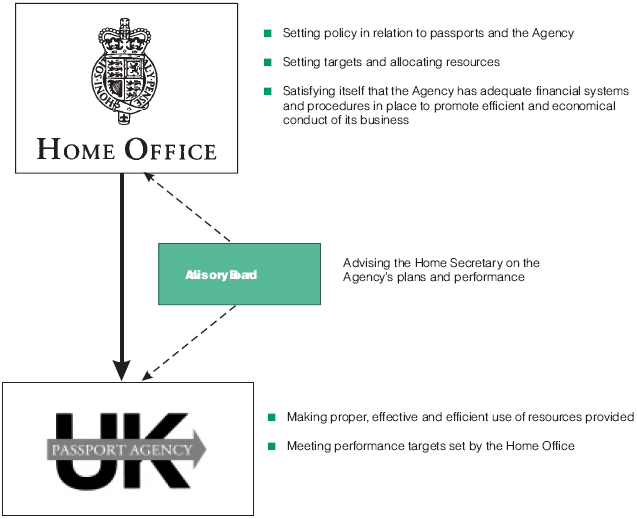
1.3 The Chief Executive, as the Agency's Accounting Officer, is responsible for the proper, effective and efficient use of resources provided to the Agency and for meeting its performance targets. Figure 2 outlines the respective responsibilities of the Home Office and the Agency. An Advisory Board, comprising senior officials from the Home Office and members from the private sector, is responsible for advising the Home Secretary on the Agency's plans and performance.
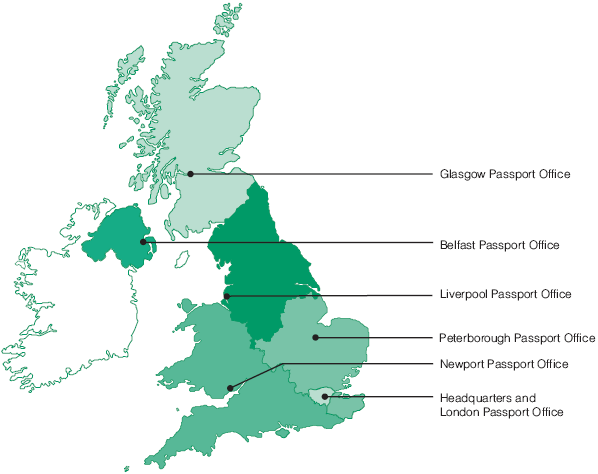
1.4 In 1998-99, the Agency employed an average of almost 1,800 staff in six passport offices, in Belfast, Glasgow, Liverpool, London, Newport and Peterborough, and a Headquarters located in the London office. As shown in Figure 3 on page 11, each office serves a designated area of the country and deals with both postal and across-the-counter applications, apart from the London Office which provides an across-the-counter service only.
Figure 2 |
|
The responsibilities of the Home Office and Passport Agency | |
The Home Office sets policy in relation to passports, and oversees the Agency's performance. The Agency is responsible for operational performance. | |
| |
Source: UK Passport Agency Framework Document | |
1.5 Passport fees are set by statutory instrument and were last increased in March 1998. In September 1999, the fee payable by a member of the public making a postal application for a standard 10-year passport was £21, for a 5-year child passport £11, and an additional £10 for passports issued over-the-counter at an Agency office. For an additional fee, members of the public may submit their application and have it checked over the counter at one of the Agency's high street partners - The Post Office (fee £3.20), or Worldchoice Travel (fee £3.25) - before being sent to the Agency. This use of high street partners helps reduce the number of applications submitted with obvious omissions or errors.
Figure 3 |
|
The Agency's six regional offices | |
The six offices of the Passport Agency are each responsible for processing applications from their geographic region. | |
Shading indicates catchment areas for each office | |
Note: Postal applications from London are processed by the Glasgow office. Source: UK Passport Agency | |
1.6 The Agency's financial objective is to recover the full cost of passport services; the full cost includes the cost of consular protection services provided by the Foreign and Commonwealth Office to UK citizens abroad. In 1998-99 full costs were £93.6 million, including expenditure by the Agency of £57.6 million, and the Agency's income totalled £89.6 million, leading to a shortfall of £4 million.
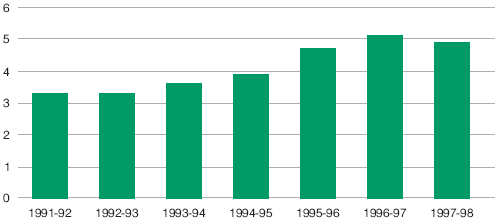
1.7 Since its creation in 1991, the Agency has dealt with a steady increase in the number of passport applications. Figure 4 shows that the number of passports issued rose from about 3.2 million in 1991-92 to a peak of 5.1 million in 1996-97. The Agency attributes this upward trend to a number of factors, including an improved economic climate, greater opportunities to travel, cheaper travel, and primarily the abolition at the end of 1995 of the British Visitor's Passport (a 12-month passport previously available from post offices).
The growth in UK passport issues, 1991-92 to 1997-98 | Figure 4 |
|
| ||
The number of UK passports issued per year has increased since 1991-92, peaking at 5.1 million in 1996-97. | ||
| Passports issued (millions) | |
Source: UK Passport Agency |
| |
1.8 The Home Office told us that during the 1990s it increasingly allowed the Agency to operate at arm's length. In the Home Office's view, the Agency had made good progress in overcoming the longstanding problems of the 1980s and early 1990s; the Agency had improved its services and its efficiency, for example reducing its unit costs, and it compared well with its counterparts in other countries. The Agency had also been accredited for Investors in People and had been awarded a Charter Mark on three occasions for its customer service.