The sequence of events culminating with the problems in 1999
1.9 The Agency's Framework Document, published in 1996, stated that it would be looking at ways of involving the private sector in its operations and support services. By 1997 the Agency had reviewed its operations and decided to use two private sector partners to assist in the processing of passports. Siemens Business Services (referred to as Siemens in the rest of this report) was contracted to carry out initial processing of passports and to provide a new computer system to support passport processing. Security Printing & Systems Ltd (formerly The Stationery Office) was contracted to provide secure printing and despatch of passports. The Agency retained the examination and authorisation of passports as a core in-house function. These new arrangements were intended to facilitate the introduction of a more secure passport, using a digital image of the passport holder, and to share the risk of system development and operation with the Agency's private sector partners.
1.10 The Agency implemented its new computer system and procedures in its Liverpool Office on 5 October 1998 - in keeping with the timetable set out in the original contracts. The Agency had expected output levels in the Liverpool office to reach about 30,000 issues per week by mid-November. However, when the Newport office went live six weeks later, on 16 November, output in Liverpool was just over 8,000 issues per week. On 18 November the Agency, with the agreement of its partners, suspended the planned roll-out to the remaining four offices. By this time the Agency was approaching its busy season, which usually begins in January.
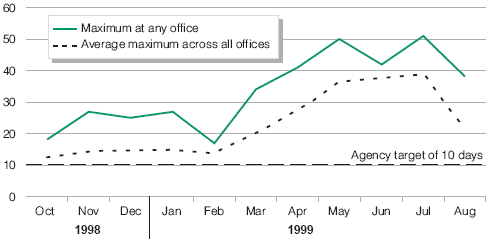
1.11 In February 1999, as the volume of applications began to increase, maximum processing times rose. In response, the Agency concentrated on meeting customers' travel dates, increased overtime working, trained existing staff as passport examiners and, the following month, began recruiting extra staff. The demand for passports continued to increase and, as Figure 5 shows, maximum processing times began to deteriorate further.
The deterioration in processing times for passport applications, October 1998 to August 1999 | Figure 5 |
|
| ||
Maximum processing times increased significantly, especially after February 1999, to reach over 50 working days for passports issued by July 1999. Processing time (days) | ||
|
| |
| Notes: Maximum processing time at any office is a primary measure of service performance used by the Agency. Average processing times will be much lower, and many applications are dealt with more quickly than the maximum. | |
Source: National Audit Office/UK Passport Agency | The average maximum processing time is the average of the maxima at each of the Agency's six offices, which gives a better picture of overall pressure on the Agency. | |
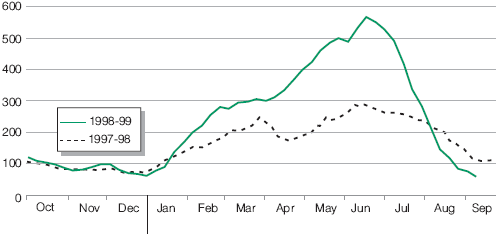
1.12 By March, the delays in issuing passports had begun to attract Parliamentary and media attention. The number of applications then rose steeply, especially in May and June. Whilst the Agency's monthly output rose to 619,000 in May, compared to a peak of 564,000 in the previous year, Figure 6 shows that the backlog reached 565,000 in June, nearly double the largest backlog of almost 300,000 in the previous year.
1.13 In July 1999, the Home Office authorised emergency measures to alleviate the problems, including a call centre to deal with telephone enquiries, an extra 100 staff in passport offices and a facility to extend passports at post offices at no charge for up to two years. These measures, coupled with a seasonal downturn in the number of applications, allowed the Agency to reduce its backlog to 82,500 cases and its maximum processing time to within its 10 day target by the end of August 1999. In September maximum processing times fell further to five days. At the beginning of October 1999, the facility for two-year extensions to passports was withdrawn A summary of the key dates and events is shown in Appendix 1.
The backlog of passport applications awaiting processing, October 1997 to August 1999 | Figure 6 |
|
| ||
From early 1999, the backlog of applications rose steeply, until it reached a peak of 565,000 in June 1999. Backlog (thousands) | ||
Source: National Audit Office/UK Passport Agency |
| |
Queues outside the Liverpool Passport Office in 1999 |
|