To what extent did the Agency forecast and plan for the volume of applications it received in 1999?
The Agency's annual planning forecasts have in recent years proved to be reasonably accurate, although its month by month forecasts have been less reliable.
2.2 The Agency relies on forecasts of applications to ensure that it has the resources, particularly staff, to manage the demands made upon it. Since 1990, at the Agency's request, the Home Office has provided the Agency with forecasts. Taking the Home Office figures into account, but relying on its own experience, the Agency then prepares its own forecasts.
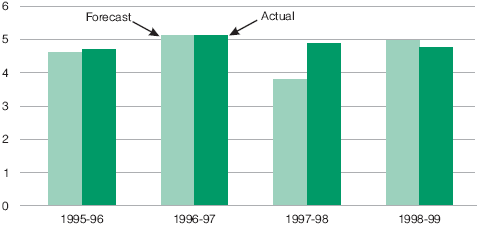
2.3 Figure 7 shows that in recent years the Agency's annual forecasts have been reasonably accurate, except in 1997-98 when passport issues were 27 per cent higher than expected. The Agency attributes this difference to larger than expected residual demand following the abolition of the British Visitor's Passport in 1995.
2.4 The Agency also relies on month by month forecasts, updated periodically, as the basis for short term planning such as the recruitment of casual staff. The demand for passports is seasonal, with over 60 per cent of applications made between February and July each year in anticipation of Summer travel. However, the precise timing of applications has proved less easy to predict. For example, prior to the crisis, between April and December 1998 monthly variances against forecast averaged eight per cent or nearly 30,000 applications - equivalent to the weekly output of one of the Agency's largest offices.
Comparison of annual forecasts prepared by the Agency with actual | Figure 7 |
|
| ||
In recent years, with the exception of 1997-98, the Agency's forecasts of annual passport issues have been reasonably accurate. Passport issues (millions) | ||
|
| |
Source: National Audit Office/UK Passport Agency | Note: The Agency attributed the higher volume of issues than forecast in 1997-98 to a larger than expected residual demand following the abolition of the British Visitor's Passport at the end of 1995. | |
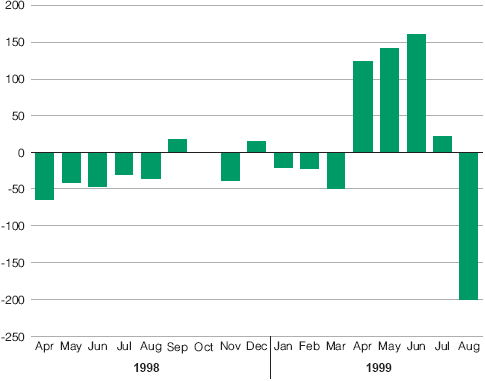
Although applications were lower than forecast in early 1999, a surge in applications between April and June 1999 led to 425,000 more applications than forecast. Applications for child passports were higher than the Agency anticipated. The surge added to an already large backlog of applications.
2.5 The number of applications was less than forecast in late 1998 and early 1999, but by this time backlogs had already begun to accumulate. However, a surge in the number of applications between April and June 1999 exceeded forecasts by a sizeable margin, accounting for an extra 425,000 applications -29 per cent more than expected (Figure 8).
Monthly differences between forecast and actual number of applications, April 1998 to August 1999 | Figure 8 |
|
| ||
For most of the period April 1998 to March 1999, the number of applications was less than forecast. However, between April and July 1999 the number of applications exceeded the forecasts by around 425,000. Applications (thousands) | ||
|
| |
Source: National Audit Office/UK Passport Agency | Note: Data on actual applications is based on applications logged onto the Agency's systems, adjusted to reflect applications unopened awaiting processing. | |
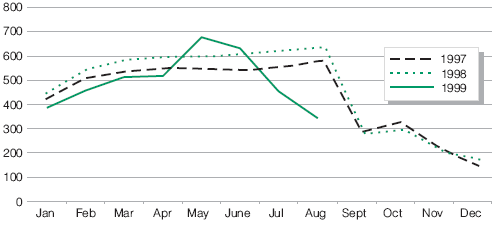
2.6 The volume of applications received in May and June exceeded the number received in the corresponding period in previous years (Figure 9). This surge was fuelled by public awareness, via the media, of problems already experienced by the Agency and the Agency's inability to deal with telephone enquiries and correspondence. The Agency has not been able to measure the extent to which members of the public decided to submit their applications earlier than necessary, thereby contributing to the surge in applications. The Agency believes this was the most significant factor contributing to the surge.
Applications received, 1999 and previous years | Figure 9 |
|
| ||
The pattern of applications received in 1999 shows a clear surge in May and June, over and above the seasonal rise in previous years. Monthly Intake (thousands) | ||
Source: National Audit Office/UK Passport Agency |
| |
2.7 Whilst the pattern of demand for the remainder of 1999-00 remains difficult to predict, the Agency now expects around 5.55 million passport issues in the year, compared to its original forecast of 5.1 million, a difference of 9 per cent. This total includes 5.1 million passports issued by passport offices, 400,000 passport extensions granted by The Post Office and an estimated 50,000 extensions granted by the Agency.
2.8 The surge in applications in May and June, and the greater number of passport applications in 1999-00 than forecast, partly reflect a larger number of child passports than forecast. In April 1998, the Government announced that from October 1998 children under 16 would in time be required to carry separate passports when travelling abroad. Children already included in a passport would be able to travel using this document until they reached the age of sixteen or the passport expired or was amended, whichever was earlier. The new regulations were intended to improve security, facilitate travel, and make child abduction more difficult. The Agency was aware at the time that it let the outsourcing contracts in July 1997 that the introduction of child passports was being considered by Ministers and advised on the timing. In September 1997, a study commissioned by the Agency from the Home Office's Research and Planning Unit forecast that approximately 800,000 child passports could be expected in1999-00, compared to 400,000 the previous year, within an overall forecast of 5.1 million. In July 1999, the Home Office informed the Agency that within the overall forecast of 5.1 million the number of children's applications forecast in the year should have been 1.2 million. In the first six months of 1999, almost 800,000 child passport applications were received by the Agency. The Agency has not established how many of these passports were applied for in advance of need. The Agency now believes that the number of child passports issued in 1999-00 will reach 1.1 million.
2.9 In the Agency's view, demand in 1999-00 may also have been inflated by some applicants wishing to take advantage of the free two-year extension available via post offices even though their passports were not yet due for renewal; although it is unable to calculate how many of these extensions it might otherwise have had to process during 1999-00.
Regardless of the higher than expected volume of applications, the Agency's performance in recent years suggests that it would have been hard pressed to cope with the volume of applications in 1999. It was therefore essential that the new passport processing system did not lead to a loss in productivity.
2.10 In recent years, the Agency had found it more difficult to cope with the flow of applications. Figure 10 shows that over the last three years maximum processing times had increased, and in 1997-98 and 1998-99 had exceeded the Agency's target of 10 days.
Maximum processing times for passport applications, 1996-97 to 1998-99 | Figure 10 |
|
| ||
Maximum processing times, while having a similar seasonal pattern, show a year on year deterioration in the period 1996 to 1998. Monthly Intake (thousands) | ||
|
| |
| Notes: 1. The graph for 1998-99 excludes the impact of the introduction of the new computer system from October 1998 onwards. | |
Source: National Audit Office/UK Passport Agency | 2. The average maximum processing time is the average of the maxima at each of the Agency's six offices, which gives a better picture of overall pressure on the Agency. | |
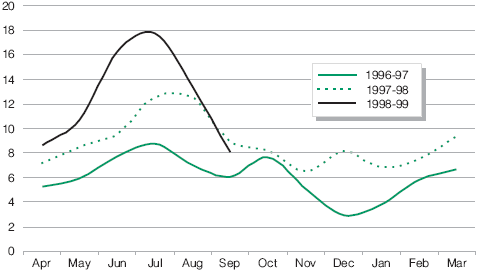
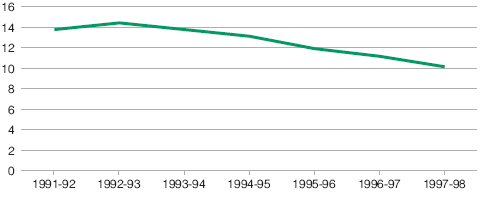
2. 11 This deterioration was unlikely to be due to poor forecasting, because the accuracy of forecasts fluctuated over this period whilst performance steadily declined during peak periods; it also occurred when the volume of applications was relatively constant, at between 4.7 million and 5.1 million issues per year. The Agency was finding it harder to cope with existing capacity and within the reducing unit cost targets it had been set and achieved. Between 1991-92 and 1997-98, as shown in Figure 11, the unit cost of processing a passport fell by over 26 per cent in real terms, from £13.74 to £10.14 (at 1998-99 prices).
2. 12 The volume of applications in 1999-00 was expected to reach 5.1 million, as high as in any previous years. To meet its service targets during 1999, the Agency needed to ensure that its new passport processing system was introduced without any significant detriment to productivity or output; and indeed it needed to improve these if the poorer performance during 1998 in respect of customer service was not to be repeated.
The unit cost of issuing a passport, 1991-92 to 1997-98 | Figure 11 |
|
| ||
The cost of issuing a passport fell between 1992-93 and 1997-98. Unit cost (£s) at 1998-99 prices | ||
Source: National Audit Office/UK Passport Agency |
| |