To what extent did the introduction of a new computer system cause the Agency's problems?
In 1997, to improve the efficiency and effectiveness of the passport issuing process, the Agency let contracts to the private sector to undertake some of its activities and to introduce a new computer system.
2.13 In April 1996, the Agency completed a review of its passport production and issuing arrangements. The existing computer system, known as the Passport Issuing and Management Information System (PIMIS) had been installed in 1989. The review concluded that:
■ existing procedures and equipment were outdated, coming to the end of their useful life, and needed replacement by Autumn 1998; in particular, the Agency did not expect its computer system to be millennium compliant; and
■ secure procedures and better technology, including the use of digital photographs, were needed to reduce the risk of fraudulent use of British passports and improve the efficiency and effectiveness of the Agency's procedures.
2.14 The Agency prepared and updated a business case between late 1996 and July 1997, which considered the five options shown in Figure 12. The Agency concluded that the best option was to run two parallel private finance contracts: one to provide a new computer system and the initial processing of applications; and a second for digital printing and despatch of the new passport from a central site. Examining and authorising passport issues would continue as an in-house function.
Cost of options appraised by the Agency, at an assumed volume of 4 million passports a year | Figure 12 |
| ||
| ||||
According to the Agencys business case, the option to contract out both the initial processing and the printing of passports was the cheapest at an annual volume of 4 million passports. | ||||
| Option | Total discounted cost over 10 years (£m) | Cost per passport (£) | |
| 1."Do nothing" | Not viable1 | Not viable1 | |
| 2."Do very little" | 343 | 13.12 | |
| 3.Upgrade to digital in-house system | 371 | 13.86 | |
| 4.Upgrade to digital system, contracting out the printing process | 346 | 13.07 | |
| 5.Upgrade to digital system, contracting out both initial processing and printing process | 339 | 12.87 | |
Source: National Audit Office/UK Passport Agency | Note: 1. The "do nothing" option was considered not viable because existing equipment was approaching the end of its life | |||
2.15 The Agency's business case assumed 4 million passports a year, below the volume of 5.5 million expected in 1999-00 and 5 million or more thereafter. The Agency also tested the options at a range of volumes and found that at volumes above 4.5 million passports a year it was cheaper to contract out only printing and despatch and to retain in-house all other functions including the development of a new computer system. Whilst the Agency tested the options on volumes ranging from 3.5 to 4.7 million, the introduction of separate passports for children pushed demand levels beyond the volumes tested in the business case. The Agency concluded that the option of letting two contracts remained preferable even at the higher volumes tested because of the greater transfer of risk to the private sector; the Agency expected that its contractors would be responsible for system design and implementation, maintaining service levels, responding to changes in the volume of applications, and providing technological updates and project financing.
2.16 The Agency started the procurement process in 1996, and two contracts were approved by Ministers in June and July 1997:
■ Initial processing and IT support awarded to Siemens. The contract was valued at the time at £120 million over ten years. The Agency considered three other short-listed bids: from Donnelly Pindar, IBM and EDS. The first two bidders withdrew before final negotiations commenced. Negotiations with EDS continued to the final stage, thereby maintaining competitive tension. However, their best and final offer was not evaluated by the Agency as it was ruled to be non-compliant in a number of respects, relating to future price reductions, implementation delays, and the extent of indemnities and guarantees. Under the contract, Siemens is reimbursed at a fixed rate (set at £2.72 following design definition and other changes, and the provision of additional equipment) for each passport processed by the Agency.
■ Final printing and despatch awarded to Security Printing & Systems Ltd. The contract for the printing and despatch of passports was valued at the time at £120 million over ten years. The other bidders were a consortium led by International Data Ltd, and De La Rue. The bid from De La Rue was ruled non-compliant by the Agency for a number of reasons, including limitation of damages and service credits, and arrangements in the event of a delayed roll-out. Security Printing & Systems Ltd is paid a fee for each passport printed, based on the annual volume of issues and whether the Agency uses a 24 or 48 hour service, or the option of a local printing service for urgent cases. For example, the fee per issue for the 48 hour service, assuming a volume of over 5 million, is £3.21.
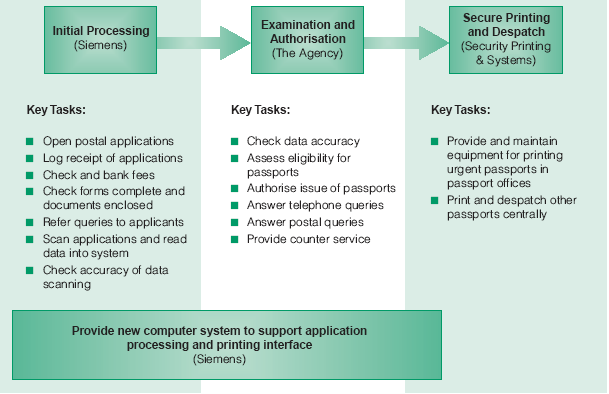
An overview of the new system for processing passports, and the allocation of responsibilities between the Agency and its contractors, is shown in Figure 13 overleaf.
2.17 The new passport issuing process follows the same basic procedures for establishing the eligibility of applicants but the computer system for supporting the examination and printing processes is fundamentally different. The most significant change introduced by the new system was that an image of the application form would be captured, including the applicant's signature and photograph. Key information would be validated and corrected before being made available to Agency examiners within 15 hours of receiving a complete application. The new system would also provide added checks to improve security, better facilities for tracking the progress of applications and an electronic archive of applications for subsequent retrieval should it be necessary.
Figure 13 |
|
The new system for processing passports | |
Passport processing has been split into three functions, two of which are carried out by the private sector. IT support for the examination stage has also been outsourced. | |
Source: National Audit Office | |
2.18 A Project Steering Committee, chaired by the Agency's Chief Executive, oversaw the project and included representatives from Siemens and Security Printing & Systems Ltd. The project control and reporting arrangements adopted by all parties followed the PRINCE 2 methodology, a widely accepted standard in government and industry, and included an analysis of the risks to the Agency's business.
To ensure that it could cope with the seasonal rise in applications expected in early 1999, the Agency began its computerisation programme at its largest offices, intending that they would achieve quickly previous levels of output.
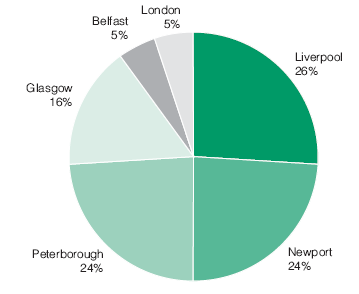
2.19 The Agency expected its new computer system to be rolled out to its regional offices between October 1998 and February 1999. To ensure that it could tackle the usual seasonal rise in applications in early 1999, the Agency decided to begin roll-out at its largest offices, Liverpool, Newport and Peterborough, by the end of 1998. As Figure 14 shows, these offices accounted for 74 per cent of the Agency's output in 1997-98. The Agency expected that with its three largest offices running the new system, most demand would be met by running the three offices at peak volumes as soon as they were capable.
Proportion of passports processed by each Agency office in 1997-98 | Figure 14 |
|
| ||
Liverpool, Newport and Peterborough offices handled around three-quarters of passports issued in 1997-98 | ||
Source: National Audit Office/UK Passport Agency |
| |
2.20 The Agency considered starting with a smaller office, such as Belfast or Glasgow, but had concluded that this would have meant the roll-out for the larger offices falling into the New Year, when applications were expected to rise rapidly. The Agency judged that a significant loss of output at the larger offices at this time in the year would threaten its operational performance and overload other offices. In the Agency's view, no proper pilot could have been undertaken at a small office given it's operational need to begin roll-out in October 1998 and complete by March 1999.
When the Liverpool office went live on 5 October, most elements of the implementation plan, including the staff transfer arrangements, had been completed successfully. However, delays during the design and development stages meant that the new system's impact on productivity had not been tested thoroughly.
2.21 The Agency had intended to award the contracts in April 1997 but negotiations with bidders continued until June and July 1997. Between signature of the contract and the first office going live in October 1998, the Agency needed to ensure that:
■ all issues involving staff transfers to Siemens had been resolved; and
■ the new system met the Agency's needs and was adequately tested prior to implementation.