Did the Agency take timely and effective action to maintain services to the public?
The Agency took action to make up for the lost production in Liverpool and Newport, but despite very high levels of overtime working, increases in staff and changes in procedures, the Agency did not have sufficient capacity to respond to the increase in applications from the end of March onwards.
3.2 In the period leading up to the roll-out to Liverpool and Newport, and for some time after, the Agency transferred work to other offices to make up for what was expected to be a temporary loss of output. The Agency had maintained staffing at all its offices at higher than normal levels to help it cope with the transition. However, when the decision to postpone the further roll-out of the new system was taken in mid-November, the Agency had no detailed contingency plan to cover the situation it now faced, although it had identified it as a risk and had the option to revert to its old system. At this point:
■ output from the Liverpool and Newport offices was at 10,000 per week, well below the planned output at that stage;
■ the Peterborough office had already shut down most of its processing in preparation for the introduction of the new system, and needed to revert to its old system; and
■ the Glasgow and Belfast offices were struggling to keep up with their normal intake of applications plus work transferred from the other offices.
3.3 To revert back to the old system at Peterborough, some of the old printers were reconnected and other newly-installed terminals belonging to Siemens had to be adapted to run on the old system. Because of the changed office layout, the management team had also to devise and introduce new working arrangements to accommodate the old system's processes. With help from Siemens, the Peterborough office was able to resume working within 10 days or so of the decision to halt roll-out.
3.4 At the end of December 1998, the Agency expected an increase in output across all its offices in the New Year to make up for lost production and to tackle the seasonal rise in applications; the Agency continued to transfer applications between offices in order to maintain output overall. In late 1998, Siemens had recruited extra staff and had introduced modifications to the new software. Siemens also provided a specialist in work-flow planning to look at the examination stage of the new system. The recommendations arising from this review, finalised in March, resulted in some improvement to output in subsequent months.
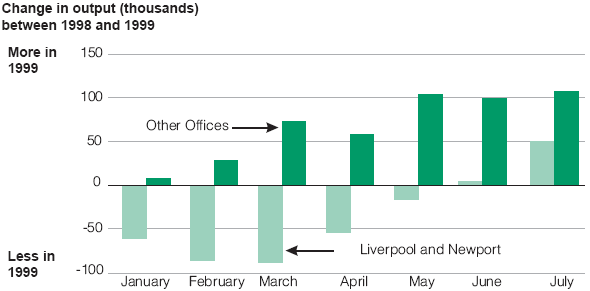
3.5 By the end of February, however, the Agency had serious concerns about its ability to cope. Although output at Liverpool and Newport increased in early 1999 the increase was slower than expected. The Agency needed to urgently increase output from its other offices, beyond normal seasonal levels, to make up for lost output at Liverpool and Newport. Figure 20 shows that output from the other four offices increased significantly in March and remained ahead of the previous year's output level in subsequent months. This increase in output was not sufficient to cope with the surge in demand.
Change in passports issued, 1999 compared to 1998 | Figure 20 |
|
| ||
After March 1999 output from the four other offices (Peterborough, Glasgow, Belfast and London) increased, although initially not enough to match the reduced output from Liverpool and Newport | ||
Source: National Audit Office/ UK Passport Agency |
| |
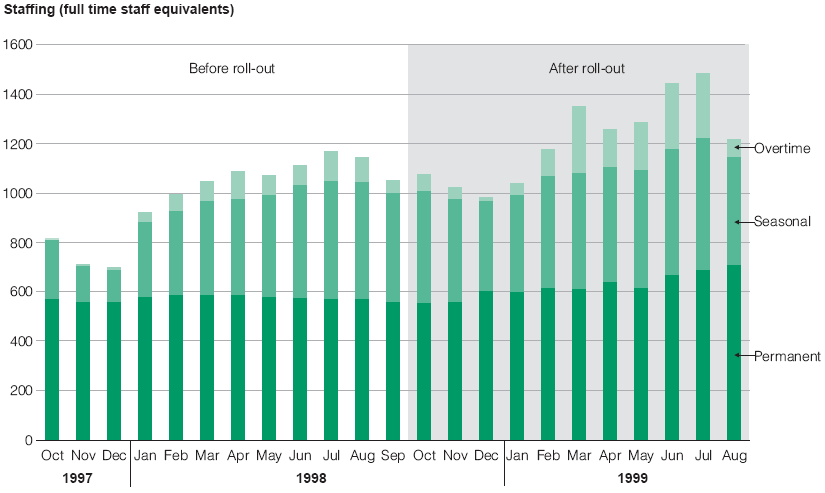
3.6 Most of the additional output from these other offices had come from a large increase in overtime working undertaken by the Agency's staff from March onwards (Figure 21). In January and February, the Agency had authorised some overtime working to help clear some backlogs but this had been restricted by the need to remain within unit cost targets. However, between March and July, overtime working increased significantly, with staff working long hours to deal with the workload. During this period, staff were working an average of four days overtime per month. To maintain overtime at the levels it needed, the Agency agreed a £5 per hour bonus at the end of February in addition to normal overtime rates. This was subsequently increased to £10 per hour, subject to some conditions, at the end of May and £20 per hour in July and August.
Figure 21 |
|
Staffing levels in the other offices, October 1997 to August 1999 | |
Staffing levels in the other offices (Peterborough, Glasgow, Belfast and London) increased in 1999, mainly due to overtime working but also the recruitment of extra staff. | |
Source: National Audit Office/UK Passport Agency | |
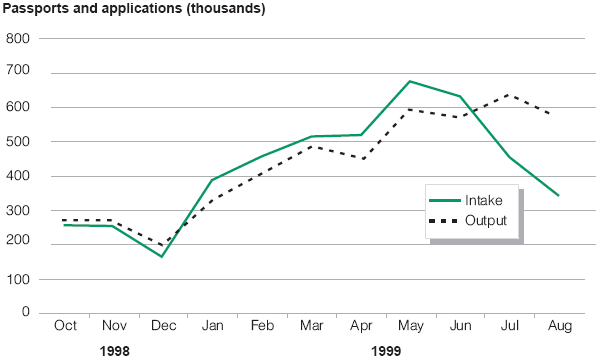
3.7 Despite the transfer of applications between offices and extensive use of overtime, the Agency was not able to generate sufficient extra output to deal with the volume of incoming applications (Figure 22), leading to a growing backlog.
Comparison of monthly output with the number of applications received October 1998 to August 1999 | Figure 22 |
|
| ||
Although output rose during 1999 it failed to keep pace with the volume of new applications. | ||
Source: National Audit Office/ UK Passport Agency |
| |
3.8 In March, the Agency drew up a recovery plan in consultation with the Home Office. The Home Office authorised the recruitment of an extra 300 staff and improvements were introduced to streamline the systems at Liverpool and Newport. As a result of these actions the Agency expected to reduce the maximum processing time from 34 days in March to 20 days in May, 15 days by the end of June, and 10 days by the end of September. At the request of the Home Office, the Agency also reversed a decision it had taken in February to allow examiners greater discretion about the security checks needed in individual cases. The Agency's intention had been to speed-up processing, but the Home Office were concerned that the move might be misinterpreted as a relaxation in security. The measures to allow examiners greater discretion were reintroduced in a modified form from mid-June.
3.9 The additional staff did not immediately ease the pressure on the Agency. Whilst additional casual staff were recruited quickly to tackle basic clerical tasks in place of staff who had been promoted to passport examiners, the Agency needs two and a half months to recruit, train and obtain security clearance for new examination staff. By early July, the Agency had trained an additional 275 passport examiners since the beginning of the year, with plans to train a further 50 before the end of the year. It was only in July that the Agency's output exceeded the volume of applications received.
3.10 Initially, the Agency did not seek to influence the volume and timing of demand for passports. To publicise the change to child passports, it issued press releases at the time of the announcement and in October 1998 when the measure was introduced, and distributed leaflets to post offices. The Agency issued no releases in 1999 until July. The Agency does not have a press office of its own, and relied on the Home Office's press office to deal with the media throughout the period. When the problems began to develop early in the year, the Agency considered the option of launching a public information campaign to reassure the public but was concerned that news about lengthening processing times would have the effect of fuelling concern rather than alleviating it. As a result the Agency adopted a low profile to publicity during the early part of 1999. From March onwards, staff from the Agency gave interviews in response to requests from the national and regional media, but by this point the situation within the Agency was already serious. At no time did the Agency develop a formal communications strategy for dealing with the media.
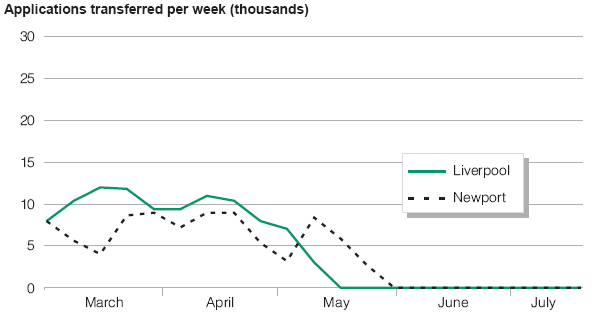
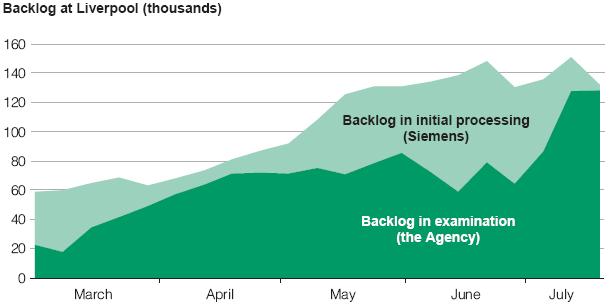
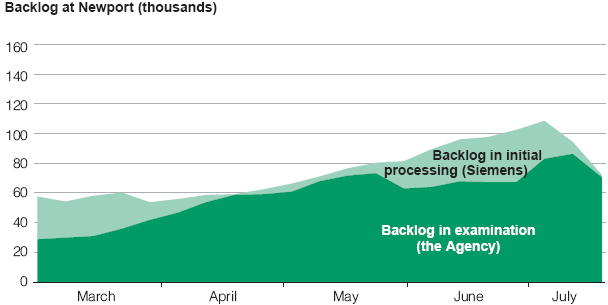
3.11 During April, May and June backlogs and processing times continued to deteriorate as applications surged. Between half and two-thirds of the backlog accumulated at the four offices using the old system, in part because of applications transferred from Liverpool and Newport during the early part of the year (Figure 23). Backlogs also continued to grow at Liverpool and Newport during the Summer months, both in initial processing by Siemens and examination by Agency staff (Figure 24) - after transfers of unopened post out of these offices ceased in May.
Applications transferred from the Liverpool and Newport offices, March to July 1999 | Figure 23 |
|
| ||
Applications were transferred from the Liverpool and Newport offices, until transfers stopped in May. | ||
Source: National Audit Office/ UK Passport Agency/ Siemens |
| |
Backlogs at the Liverpool and Newport offices, March to July 1999 | Figure 24 |
|
| ||
Backlogs in Liverpool and Newport grew in the period up until July, both in initial processing and the examination stage. | ||
Source: National Audit Office/ UK Passport Agency/Siemens |
| |
Once the backlogs had begun to build up, members of the public had significant difficulty contacting the Agency to check on progress with their applications. By March, the telephone enquiry service was overloaded.
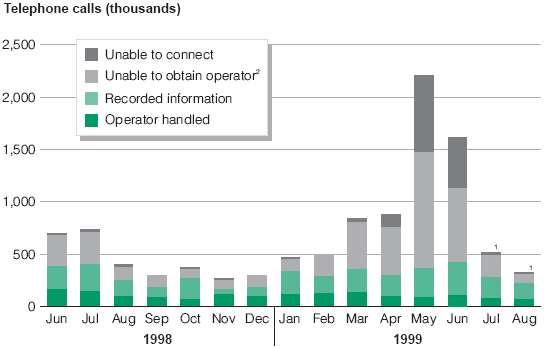
3.12 The Agency had experienced problems with its ability to answer incoming calls in 1998, but it was overwhelmed by the volume of calls received from March until July 1999. Members of the public calling the Agency usually receive a recorded message providing a menu of options offering further recorded information, plus the option of speaking to an operator based in the relevant regional office. The Agency normally has a capacity of 60 to 70 phone lines. Figure 25 shows that by March over half of all calls were failing to get through to the Agency. As the backlog of applications built up, telephone queries took longer to resolve as more applications became urgent. In March, the Agency decided to withdraw some staff from telephone duties in order to devote more resources to processing applications. At peak periods in Liverpool, the telephone enquiry service was virtually shut down.
Public telephone calls to the Passport Agency, June 1998 to August 1999 | Figure 25 |
| |
| |||
As backlogs and processing times increased during 1999, telephone calls to the Agency quickly overwhelmed its telephone answering system | |||
|
| ||
Source: National Audit Office/ UK Passport Agency | Notes: | 1. The figures for July and August 1999 exclude calls to the call centre - 218,000 in July, 46,000 in August. 2. "Unable to obtain operator" represents those callers who, on connection, opted to speak to an operator but were unable to do so. | |
3.13 In March, the Agency altered its recorded message to advise callers to write to the Agency and provided a fax number for members of the public to use. The number of written queries received however quickly exceeded the Agency's ability to cope. In May, the Agency paid for Siemens to send out 135,000 letters to applicants explaining the situation. A call centre, set up in early July under a call-off contract administered by the Central Office of Information, helped to ease the pressure on the Agency.
3.14 Surveys of passport applicants conducted by the Agency during 1999 as part of its routine monitoring of performance suggest that the telephone service was one of the biggest sources of frustration and complaints amongst applicants (for example, see the cases in Figure 26). In May and June, over 50 per cent of applicants responding to the Agency's survey found the recorded information service either not very helpful or unhelpful. Members of the public getting through to an operator tended to be more satisfied, with 85 per cent of these respondents to the survey being either satisfied or highly satisfied
Figure 26 |
|
Examples of customer complaints | |
Mrs C "I applied for four passports on 18th March and given the fact that our holiday was on the 21st April I thought I had ample time to receive the passports. Having not received the passports 10 days before we were due to go away, I thought I should ring to see what the hold up was. After trying to get through to the Liverpool office for three hours I was told that the applications had not been received. I rang up almost every day until I was eventually told to come down to the Liverpool office. I was also told to fetch new applications counter-signed by the same person as before, duplicate birth and marriage certificates, duplicate divorce certificate and new counter-signed photographs. With a lot of help from my family I got them. I set off early for Liverpool and got there at 10 am. I was told that I would have to pay a charge of an extra £10 per passport. I was very annoyed at this, but if I wanted to go on holiday I had to pay the charges or lose a holiday that cost well over £1,000. End of story? No. When we came back from holiday there were two letters from Belfast. I opened them and inside was two passports - both had been issued after I got our passports from Liverpool." Miss W "Myself, my partner and my brother Simon were due to fly on 27th June. We were taking Simon as he has never been abroad before. Our passports arrived two weeks prior to departure and we assumed that Simon's would arrive not long after. To cut a long story short, the week prior to departure I tried on numerous occasions from 9am to 4pm to speak to someone at the passport office with no success. My partner and I decided after reading so many reports in the newspaper that the only option was to take time off work on the Friday and go down to collect the passport in person. We arrived at Liverpool at 9am and waited until about 3pm and there was no-one to speak to as there were hundreds of people waiting with the same dilemma. We came home hoping that the passport would be in the post for Saturday morning, but no passport. We had to cancel Simon's holiday which was very disappointing to a 14 year old who had been looking forward to his first ever holiday abroad, as you may be able to imagine." | |
3.15 The Agency told us that it is looking at options for reorganising its telephone enquiry service to enable it to improve its response during peak periods. The computer system will allow operators to trace progress on all applications via their terminals - a facility not available under the old system. Equipment has now been installed at all the Agency's offices to enable operators to track any application logged on to the new system.
The emergency measures introduced in late June helped to reduce processing times to within the Agency's ten-day target by the end of August.
3.16 At the end of June the Home Office, in response to public and Parliamentary pressure, introduced a series of emergency measures. These included free two-year extensions from The Post Office to members of the public seeking renewals, the establishment of a call centre to handle queries, and the recruitment of 100 staff in addition to the 300 already authorised. Between July and the end of September, 400,000 people had their passports extended at post offices. Coupled with a quicker than expected downturn in seasonal applications in August, these measures enabled the Agency to reduce the backlog to 74,500 and processing times to within the ten day target by the end of August.
The Agency estimates that the number of missed travel dates will total almost 500, out of the 4.8 million passports issued between October 1998 and the end of August 1999. Compensation to the public amounts to £161,000 but is likely to rise as a number of outstanding claims are settled.
3.17 When backlogs started to rise in January and February, the Agency introduced procedures - used during peak periods in previous years - to give priority to those applications with urgent travel dates. So far, the Agency has received 487 claims for missed travel dates between October 1998 and the end of August 1999, compared to around 75 in the same period the previous year and 55 the year before. These figures compare with the total of 4.8 million passports issued in this period.
3.18 Applicants with urgent travel dates but who were unable to contact the Agency had in some cases to visit a regional office to make a personal application; in very urgent cases, the Agency can issue passports across-the-counter. The Agency does not keep a record of the total number of visitors to its regional offices, including those for example seeking information. However, it does record the number of applications received. For example, in May 1999, the Liverpool office received about 15,000 personal applications, compared to 10,800 in May 1998; and the average waiting time increased to 2.5 hours compared to the target of one hour, excluding time spent by the public waiting outside the building. To meet the extra demand, opening hours at regional offices were lengthened and, from May onwards, to speed up processing, some 50,000 free extensions to passports were granted to personal callers. The Agency also bought umbrellas for the use of people queuing outside and provided luncheon vouchers for those facing a long wait.
Queues outside the London Passport Office |
3.19 Compensation payments to the public over the period October 1998 to August 1999 so far totals approximately £161,000, compared to £52,000 for the same period the previous year. This includes £61,000 for compensation for missed travel dates and £38,000 to reimburse members of the public who, having made a postal application, had to travel to a regional office to obtain an urgent passport. The amount of compensation paid will rise as outstanding claims are settled.