5.2 Risk analysis
Project alliancing involves delivering a project with a degree of predictability; however, unanticipated consequences or substantive risk events can be expected to arise during the project alliance. Risk analysis involves identifying, quantifying and modelling the probabilities and consequences for each of the unanticipated consequences or substantive risk events. The risk profiles are used during the risk mitigation planning stage to:
• identify which events contribute most to the overall risk of the project;
• provide input into the target outcome costs;
• focus potential treatment actions on the higher risk; and
• design strategies to avoid or to allocate the risks.
Insurance for project alliancing is a potential treatment for risks, but it is not available, or desirable, for all risks. In alliancing, insurance should be purchased where it is considered best for the state and only where sufficient controls are in place so that alliance insurance does not de-risk projects and lead to negative Non-Owner Participant behaviour. These are two key concepts, which, although difficult to define, are described below:
• Best-for-state: This context considers the optimal position for the state rather than the project (it is similar to taking a portfolio-wide rather than a project-specific view). Regarding insurance, this may mean that less project insurance is best-for-state-either because it is comfortable assuming certain risks, or because it already carries the risk. This is different to a best-for-project approach, which would generally require that all identifiable project risks are insured at the project level.
• Project de-risking: The alliance framework for project delivery incorporates collective sharing of (nearly) all project risks, and agreement of no fault, no blame and no dispute regime between alliance Participants. While alliancing is usually used for more technically complex projects, it does result in a lower risk profile for Non-Owner Participants compared with a design and construct approach; given that their financial risk exposure is usually capped. It is possible that a Non-Owner Participant may consider that the project has been de-risked for them when insurance is added to this framework for delivery.
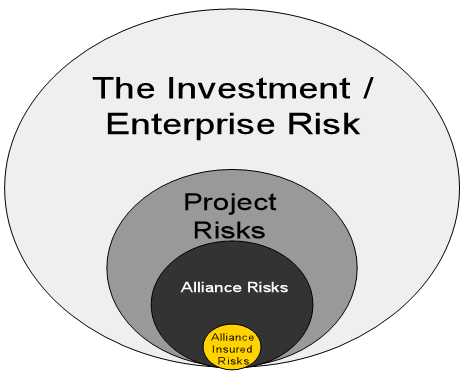
As shown in Figure 1, the project alliance risks that are ultimately insured may only be a small part of the overall investment or enterprise risk.
Figure 1: Alliance risk versus overall investment/enterprise risk