2.5 Themes in this Guidance Note
There are several key themes which underpin the advice provided in this Guidance Note:
a) 'TOC as a dollar value' and the 'TOC development process'
There is a clear and significant difference between the concept of the TOC as 'a dollar value', being a component of the Proponent's offer to the Owner, and the 'process of developing the TOC'.
b) Risk sharing and risk quantification
Alliances generally share the majority of the delivery risk, instead of allocating to the Owner, the constructor(s), the designers or other stakeholders, as occurs in traditional contracting. The Owner has exposure to the cost consequences of all of the shared risk. The TOC includes the expected cost consequences of the risks shared by the alliance taking into consideration the constraints of the Risk or Reward regime. The amount ultimately paid for risks is a function of the cost consequences of a risk event taking place and the TOC.
c) TOC represents output cost, not input price
The TOC is the expected cost at completion for the alliance scope and risk ('output cost'). Tender prices under traditional contracts are generally the actual price ('input cost') offered by the Tenderer to deliver the project. In both cases, these are subject to considerable adjustment depending on the level and nature of retained risk and the realisation of retained risks as the project is delivered.
d) TOC and the TOC development process are unique to alliancing
The TOC and TOC development process are prepared transparently by the Proponent with collaboration from the Owner and are therefore different from the 'tendered price' and the process undertaken by a tenderer in a traditional (risk allocation) delivery project, where this is undertaken at arm's length.
e) The benefits to the Owner of using both effective competition and effective collaboration through participation in the TOC development process
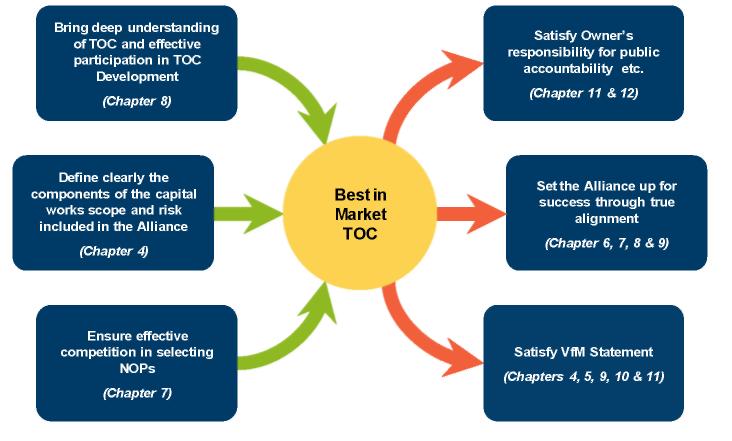
Owners will, by using effective competition in selecting the NOPs and also by increasing their own participation in developing the TOC, simultaneously satisfy both the VfM Statement and discharge their duties as public officials in protecting the public interest. This is illustrated in Figure 2 below.
Figure 2: Benefits to the Owner of competition and Owner participation in TOC development
f) Effective competition in selecting NOPs is achieved through intellectual effort
The focus of competition must be on the intellectual effort6 (and outcomes) between Proponents as they seek to satisfy the Owner's VfM Statement at a fair price. It is not about squeezing profit margins below reasonable industry levels (recognising the nature of the project).
g) Best-in-market TOC is not necessarily the lowest TOC
The best-in-market TOC represents the Proponent's Final Proposal (including risk profile, construction methodology and team) which, in combination with non-price components of the offer and other attributes, best achieves the Owner's VfM Statement objectives as determined by the Owner (i.e. the best-in-market project solution). The best-in-market TOC will not necessarily be the lowest TOC.
h) TOC must be consistent with the approved Business Case
The scope and risk allocated to the alliance and the TOC must be consistent with the approved Business Case. Any modification to the Owner's approved Business Case and the Owner's VfM Statement will require approval in accordance with the applicable governance process (and this may include seeking government approval of the proposed modification).
i) TOC is not the Owner's capital works budget
The Owner's capital works budget must exceed the TOC to include:
• all sunk costs incurred prior to alliance selection;
• all project scope that is not to be delivered by the alliance;
• all costs to be incurred by the Owner in managing and governing the alliance including gainshare; and
• all risk that is not taken by the alliance; and a contingency allowance to cover the Owner's exposure to cost overrun.
__________________________________________________________________________________
6 'Intellectual effort' can be described as the application of the Proponent's expertise and capability, in collaboration with the Owner, to innovate across all elements of the Project Solution, as opposed to a focus solely on cost reduction.