3.3 How does the TOC relate to VfM?
Guidance Note No 4: Reporting VfM Outcomes in Alliancing Contracting provides an extensive discussion on the application of VfM concepts in planning, government decision making and reporting project outcomes. In summary, VfM is a decision-making criteria that applies in different (but consistent) ways at different stages of planning. The following figure from Guidance Note No 4 illustrates this.
Figure 4: Relationship of TOC to VfM
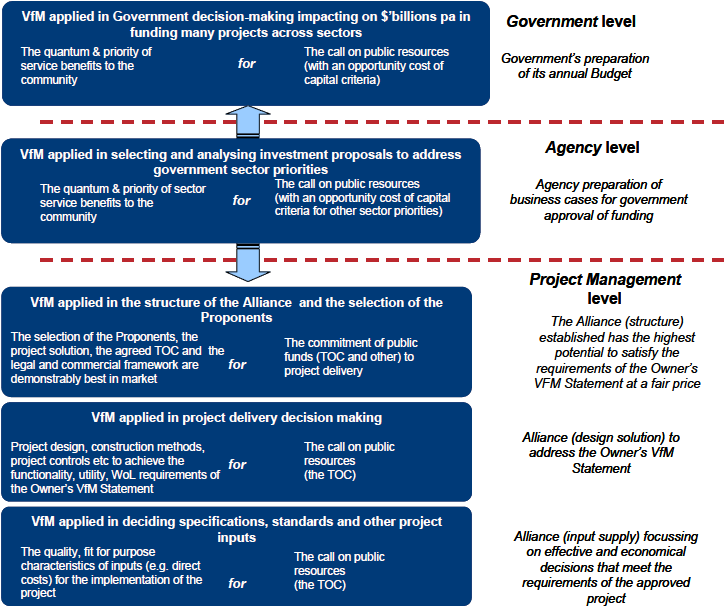
Government approval of a Business Case Proposal is based on a judgement of the value to the community of the service benefit balanced against the cost of achieving this benefit. In effect, does the balance of the price and non-price impacts of a Business Case Proposal provide an attractive proposition, and does it demonstrate better VfM in comparison to other Business Case proposals (i.e. the 'opportunity cost of capital' considerations)?
This balance of the price and non-price considerations needs to be followed through in subsequent decisions. For example, the Owner's decision in selecting its Preferred Proponent will be a balanced judgement of the price and non-price attributes of the TOC development outcome (including a Proponent's proposed project solution) and the team capability it offers, the commercial and legal arrangements, etc (which have a significant implication for the final actual price paid). The Owner demonstrates VfM in their selection of the Preferred Proponent by taking into consideration all such matters not just the 'lowest price'.
Similarly, as the Owner Participants and the NOPs continue to plan and deliver the alliance project, there will be ongoing decisions that need to be made on a balance of the price and non-price impacts of, e.g., design decisions, stakeholder management and supply of construction inputs. These VfM decisions will need to be informed by the objectives and requirements of the Owner's VfM Statement and issues of affordability regarding the agreed TOC.
The VfM outcome in any complex project is significantly influenced by the Owner's procurement strategy for the selection of NOPs (i.e. full price competition or partial price competition or non-price selection), as well as by market conditions and the experience, capabilities and capacity of the Owner and Proponent individuals involved.
The Policy requires that the Owner complete a report (i.e. a Business Case Alignment Report (BCAR)) which reconciles the preferred project solution with the Business Case and Owner's VfM Statement. Further detail is provided in Chapter 12.