4 Scope and Risk Included in the Alliance
| This chapter describes how the scope is developed and risk defined consistent with the Owners VfM Statement. |
Guidance Note No. 4 Reporting VfM Outcomes in Alliance Contracting discusses the scope definition that is required in the Owner's VfM Statement, and the likely need for further scope definition for the alliance.
Consistent with the Owner's VfM Statement, the Owner must, through collaboration, take the lead in providing understanding, definition and guidance on project objectives in the scope and risk development undertaken by the Proponents through the TOC development process. This leadership role is the responsibility of the Owner, not the Proponents, and the TOC is a direct reflection of this scope and risk development.
The Owner must also define all requirements of other government departments or related entities unless these departments will participate directly in the alliance, or be treated by the alliance as authorities.
The functional specifications provided by an Owner in tender documentation for an alliance should include a definition of asset functional requirements in a manner and standard similar to that required for a traditional risk allocation in a Design and Construction (D&C) contract, although the further technical and delivery process risk allocation that is also included in a D&C contract should be excluded. Whist it is to be expected that functional specifications will evolve during TOC development, it is essential that a comprehensive description exists at the start of TOC development. This avoids wasted effort and provides clarity for Proponents (whether the process is competitive or not). Figure 6 below illustrates how functional specifications and requirements should be developed.
Figure 6: Defining Functional/Performance Requirements in the Functional Specification
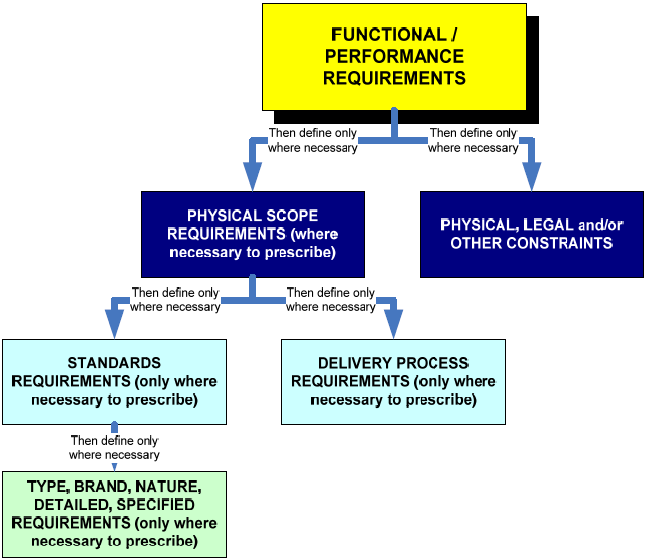
The diagram illustrates that the Owner should first define the functional or performance obligations, then, and only where necessary, provide progressively further detailed information about requirements. This allows the Proponent maximum opportunity to provide their industrial and technical 'smarts' to provide the Owner with potentially innovative solutions right through the TOC development and delivery process. It also reduces the unintended potential of having 'alternative proposals' being submitted by Proponents (highly prescriptive and detailed specifications may generate a higher number of alternative proposals if Proponents suggest different technology to deliver the Project or different approaches to the Project design).
During the TOC development phase, the Proponent will develop a specific engineering, construction, procurement and management solution to the Owner's functional specification (this project solution is formally referred to as a Proponent's 'Project Proposal'). This Project Proposal is owned by the Proponent and should be consistent with the scope and risk definition in the Owner's VfM Statement.
The relationship between the Owner's VfM Statement, the functional specifications/requirements and the Project Proposal is illustrated in Figure 7 below.
Figure 7: Scope Resposibilty Over Project Delivery Life Cycle8
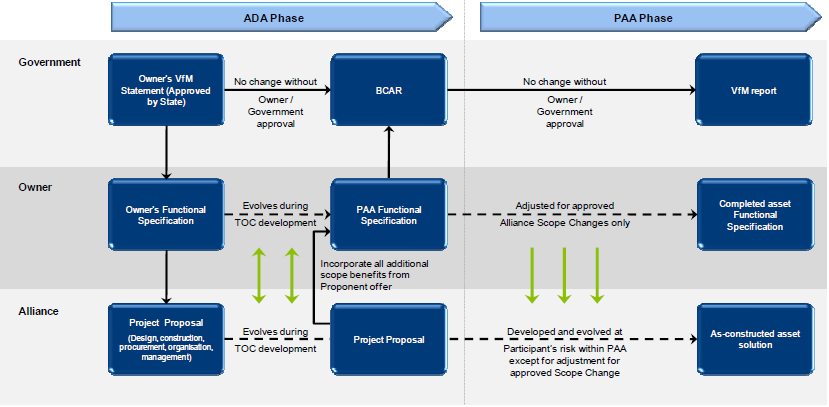
The successful Proponent's Project Proposal, including the additional value to the Owner over the functional specifications/requirements identified in the Owner's VfM Statement, becomes a schedule of the executed PAA.
Subsequent to execution of the PAA, the alliance Participants, including the Owner, share the benefits of refining the delivered asset consistent with the PAA, on a best-for-project basis.
___________________________________________________________________________________
8 As an outline to the process of establishing an alliance, the tender process normally commences with interested respondents participating in a competitive process comprised of three phases: the Expressions of Interest Phase (open to all interested organisations); the Request for Proposal Phase (open to Proponents on the Initial Shortlist); and the Alliance Development Phase (open to the two Shortlisted Proponents). The Selection Process is designed so that Initial Proposals submitted at the RFP Phase can be developed in conjunction with the Project Owner during the Alliance Development Phase (pursuant to an Alliance Development Agreement or ADA) to produce a final proposal, the Project Proposal, which satisfies the Project objectives. Once a Project Proposal is accepted by the Owner (and government), the Owner executes the Project Alliance Agreement with the Preferred Proponent and the alliance commences (these processes are documented in Templates 1 to 4 published by Department of Infrastructure and Regional Development, Commonwealth of Australia, website: www.infrastructure.gov.au).