6.3 Why do Owners need to understand and participate in the TOC development process?
The differences between a traditional tender price and the Proponent's offer of a TOC also means there are differences in the role and participation of the Owner during the procurement and delivery phases. These differences are summarised in Table 2 below.
Table 2: Comparison of pricing in traditional and alliance contracting
| Component | Traditional Project (e.g. D&C) | Alliance Contracting |
| Focus of Competition | Price. | Intellectual effort leading to efficiency, innovation and alignment rather than price discounting. |
| Tendered Price | Developed in (relative) isolation of Owner by Tenderer. Composition is not transparent. | TOC developed by Proponent in collaboration with Owner. Composition is transparent. |
| Risk (and Opportunity) | Transferred risk borne by Tenderers. Developed in (relative) isolation of Owner by Tenderer. Composition is not transparent. Owner retains some risk. | Shared by Proponent and Owner, expected cost included in the TOC. Developed transparently by Proponent with Owner input. Risk only excluded and retained by Owner by exception. |
| Level of Estimating | 'First Principles', not cost plan. | 'First Principles', not cost plan. |
| Management of Project | By successful Tenderer. | By NOP and Owner through a joint management structure and team. |
| Project Costs | Closed book to Owner. | Open book to Owner-reimbursable. |
| Performance Outcomes | Borne by successful Tenderers. | |
| Private/Public Monies | Private party manages own costs within agreed contract sum paid by government. | Management of 'public monies jointly by private and public sector Participants'. |
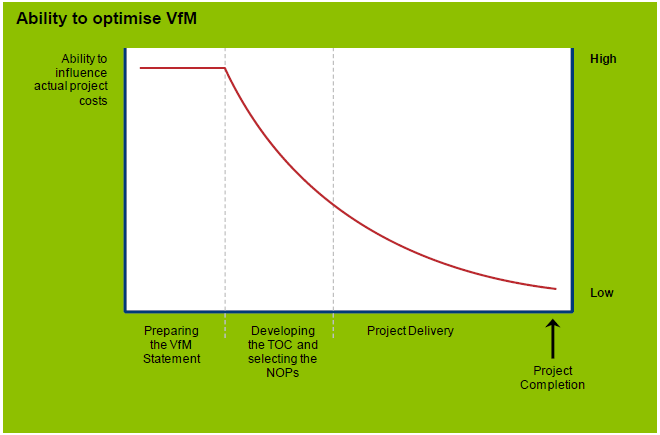
It is an accepted truism of value management that the ability of a project Owner to positively influence VfM outcomes diminishes with progression through the project life cycle. In alliancing, the opportunity for the Owner to participate in the TOC development can be of significant benefit to the success of the project, including by reducing the overall cost. This upfront opportunity does not diminish the importance of Owner participation during project delivery but rather emphasises the potential to optimise value from an effective TOC development process.
Figure 12: Ability to optimise VfM over time
In the context of the TOC development process and the Business Case Alignment Report, it is worth recalling that all agencies and their public officials are accountable for the use of public funds and the consequences flowing from their use, and for successful project delivery. Agencies are required to discharge this accountability in a transparent way, accepting responsibility for their decisions and actions, striving to make the best use of public resources, and submitting themselves to appropriate scrutiny.11 This means that Owners cannot delegate their accountabilities to the Proponents for the management of funds in their control, and that they should, independently from the NOPs, verify and ensure that the public interest is being protected throughout the procurement process and for the life of the alliance.
Additionally, as required by the Policy, the Owner must demonstrate that it has achieved VfM in the outcome of the TOC development process (the Preferred Proponent's Project Proposal). In pursuing VfM, the Owner must satisfy other policy requirements including accountability for public funds and ensuring the public interest is protected. The consequence of these requirements for public officials is that Owners must be actively and effectively involved in both the development of the TOC and the subsequent expenditure of public funds.
________________________________________________________________________________
11 Paraphrased from the Victorian Public Administration Act 2004.