The TOC
The TOC is the quantitative representation of the above three factors and is a financial estimate of the expected actual outturn cost of the project, including the expected cost of risks and opportunities and escalation. The NOPs and the Owner agree to use the TOC to measure the performance of the alliance.
Although prepared iteratively, the build-up of the detailed target estimate into a TOC is usually the final outcome of the alliance development process.
The team defines scope and quantities from a design and delivery solution informed by the Owner's VfM Statement and other project information. The team develops and optimises construction methodologies, delivery plans, and the best procurement plans to suit the market constraints and project schedule.
The team's structure is developed on a 'best-for-project' basis and is costed into the Indirect Costs component.
The risk profile is modelled using the price information and a contingency allowance to account for the expected cost of risk is inputted into the estimate, along with escalation and other allowances.
Final scope checks can be performed and corrections made to quantities and assumptions with base estimates. Adjustments to contingent allowances can be made by the Proponents' management in line with commercial and contract terms agreed with the Owner and a Risk or Reward Regime designed to suit the project risk and cost profiles. Finally, the Proponents will tender the Fee by applying the agreed percentage mark-up to complete the TOC number for inclusion in their final Project Proposal.
Figure 14 illustrates the progressive build up of components making up the TOC and highlights the magnitude and impact of each (which is very similar to the preparation of a traditional (D&C) tender estimate by Proponents).
Figure 14: TOC Iceberg-relative impact of TOC components
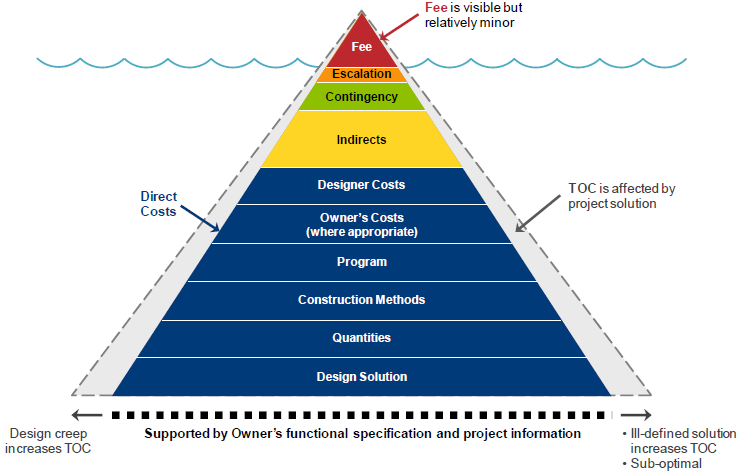
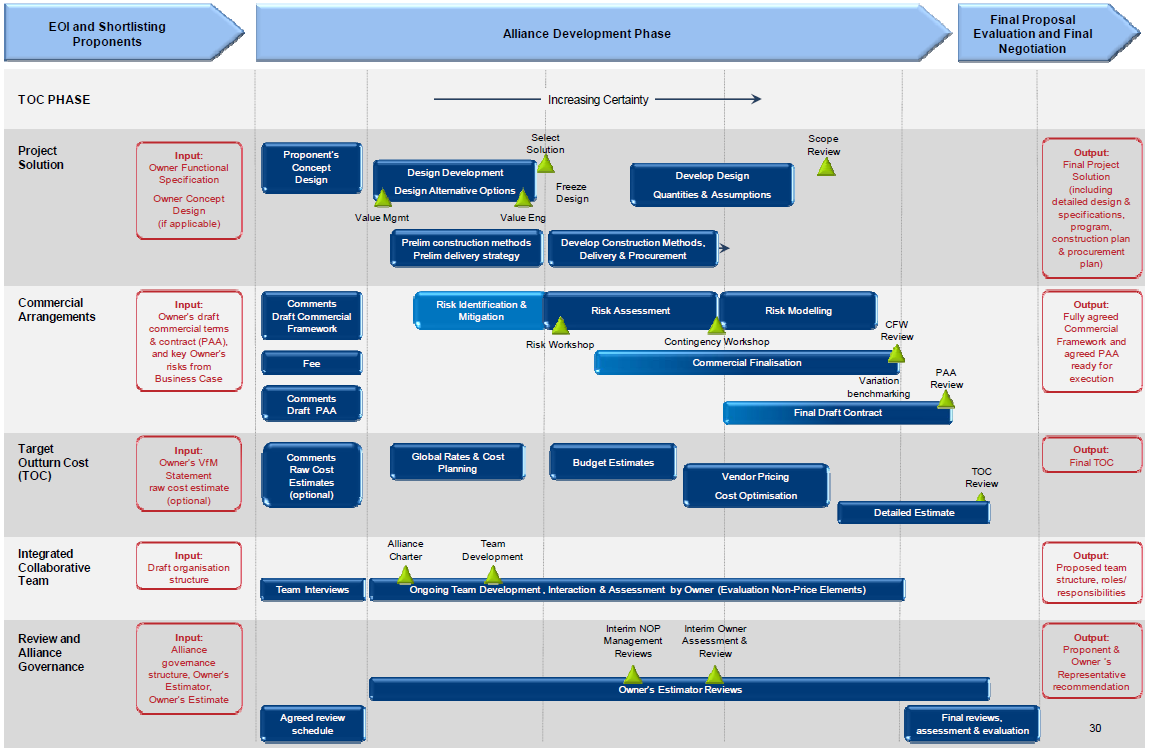
Figure 15 below illustrates the typical activities included in the TOC development process. The generic TOC development process in Figure 15 is representative of most Project alliance development processes; however, it may differ for particular alliance projects, e.g., long-term alliance for the operations and maintenance of a complex waste water treatment plant where the Owner will be more interested in the Proponents' ability to develop safe and reliable methods to work in an operating environment rather than design development expertise. It is provided here to highlight the amount of effort required and the frequency and types of interaction that might be expected for an Owner to complete the process and achieve a final Project Proposal.
Figure 15: Generic Alliance TOC Development Process