7.1.2 Overcomes misalignment in TOC development
There is commercial misalignment and generally commercial asymmetry between the Owner and the Proponents during the TOC development phase that can be reduced with competition. This misalignment in a tender process is legitimate and normal. Indeed there are legislative obligations on publicly-listed corporation to ensure that they act in the interest of their shareholders. Therefore, the misalignment, between the corporate objective of growing shareholder value versus the sovereign obligations for the delivery of public services, needs to be recognised and respected. Failure to do so is a significant project management risk.
Figure 16 illustrates the issue of Owner and Proponent misalignment and the effect that price competition has on refocusing tension away from the Owner to a competing tension between opposing Proponents, and thereby promoting alignment between the Owner and the successful Proponent.
Figure 16: Focus of Competition in TOC development
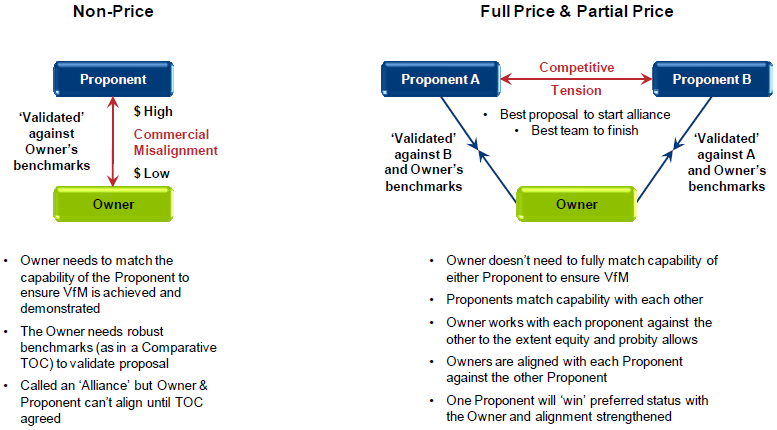
In the process of interacting with each Proponent in meetings and workshops, the Owner is collaborating with the teams to develop their Project Proposal to satisfy the VfM Statement.
This interaction, within the bounds of good probity, informs relationships and connections with each Proponent which are strengthened by the common goal to win preferred status over the opposing Proponent.
Provided that the Owner's Evaluation Team has appropriate capability and the confidence of Proponents, this can be done with a Proponent in a way that motivates the collaborative experience without compromising probity and is enhanced by the fact the same thing is happening with the other Proponent.
The knowledge that the Owner is interacting with a competing team is sufficient for a Proponent to strive to better differentiate itself from the other competitor and to build a good working relationship with the Owner and seek to innovate and develop the best solution to achieve the Owner's VfM Statement.
|
Using Competition to Build the Alliance Relationship 'The analysis revealed that a price competitive alliance facilitated stronger relationships as it enabled parties to work closer together and understand each organisations' cultural background, so that the trust building process could be facilitated more effectively.' 'Surprisingly, the determination of the TOC was found to be a factor that influenced the establishment of trust between the client and their partners during the competitive bidding process. If the client thought that the TOC signified VfM, then there was a greater propensity that confidence would be established with the alliance partner's ability. For the client confidence in the TOC enabled the foundations for trust to commence...When trust is absent, confidence in decision making may be jeopardised and opportunities for innovation can be missed.' Price Competitive Alliance Projects: Identification of Success Factors for Public Clients |