7.2.2 Determining the appropriate level of competition
In principle, price competition on the total price should continue for as long as it is practicable to do so. It is unusual that price competition cannot be effectively incorporated into the selection process, at least to some extent.
In both full and partial price processes, the Owner has the significant benefit of assessing in real time, the non-price performance attributes of two Proponents in developing the project solution.
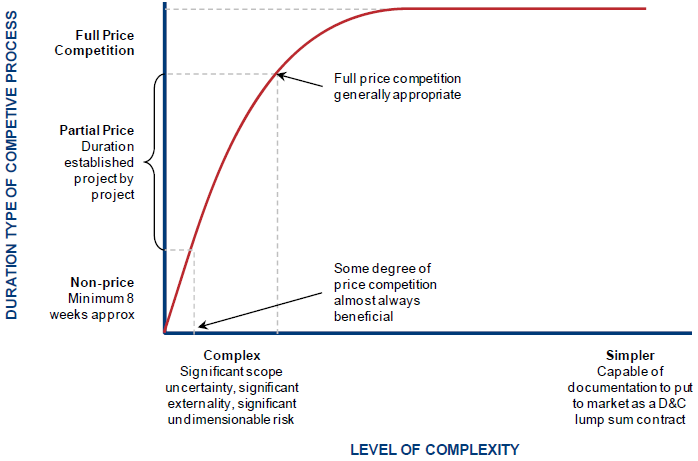
Significant scope uncertainty, undimensionable risk or the need for external consultation prior to completing pricing are reasons that price competition should be terminated at some point prior to completion of TOC development.
Determining the point when price competition should cease will depend on the individual project circumstances as illustrated below.
Figure 18: Duration of competitive process as a function of project complexity
The opportunity to competitively tender elements of the TOC will largely be dictated by the project nature and circumstances, the selection process and the requirements of the Owner. Table 4 provides some guidance as to the TOC elements on which effective TOC pricing competition should be applied in NOP selection.
Table 4: Effective TOC element pricing competition
TOC Element |
| ✓/✗ effective competition |
|
Full Price | Partial Price | Non-price | |
Fee* | ✓ | ✓ | ? |
Escalation | ✓ | Recommend first pass escalation forecast. | ✗ |
Contingency | ✓ | Recommend first pass risk and opportunity register and contingency calculations. | ✗ |
Indirect Costs | ✓ | Recommend budget indirects estimate, draft organisation chart, and overhead attendance costs. | ✗ |
Direct Costs# | ✓ | Recommend budget estimate including pricing (say) '80%'† of project scope including construction method, schedule and draft delivery and procurement arrangements. | ✗ |
* - It is recommended maximum fee percentages are offered by Proponents in shortlisting processes to be assessed against industry norms.
- Shortlisted Proponents can then offer their tendered fee in the final Project Proposal to the Owner following the TOC development phase and the finalised commercial/legal framework.
# - The Owner will achieve the best solution by ensuring the selection process aims to reduce the base cost of the project through the application of intellectual effort to develop a better Project Solution in order to reduce the resources needed and efficiently construct the scope of work, which impacts on Direct then Indirect Cost and risk and, to some degree, design costs. For example, through competition the Proponents may be incentivised to reduce the overall volume of concrete required from 20,000 m3 to 15,000 m3 than simply tendering the unit price of concrete to save a few dollars per m3.
✝ - Applying the Pareto principle (80/20 rule), although the final percentage will change from project to price.
An effective full price selection process culminating in a full Project Proposal (including a TOC) offer to the Owner represents 'best-in-market' offers for the Owner and the best opportunity to acquire the best project solution, team, commercial arrangements and price for the state.
The Owner will have less reliance for external benchmarks such as the Owner's Comparative TOC (OCT) (see section 10.8) when provided with two valid and complete TOCs in a full price competition process. Whilst the Guide recommends the use of an OCT and benchmarks to compare Proponent Proposals with the Owner's VfM Statement, the ability to compare two full Project Proposals will provide the Owner with greater confidence that they have ensured optimal VfM.
Partial Price competition will achieve improved TOC and AOC outcomes and increased levels of TOC and AOC certainty, relative to a TOC process without any price competition. However, a poorly conceived partial price competition process may not achieve this.
Proponents must be clearly instructed as to the activities and deliverables expected of them in the competitive process and how they will be evaluated. In particular, to ensure that the process is focussed on intellectual effort for improved VfM, the relative importance placed on delivering improved value compared with lower cost must be made clear.