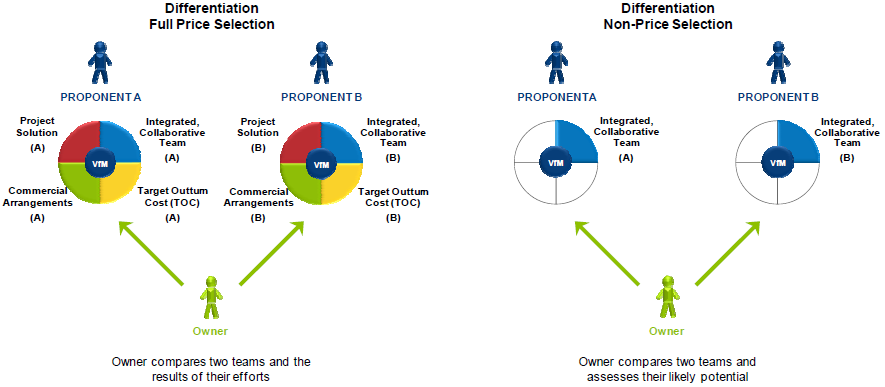
7.3.4.1 Full price Proponent differentiation
As noted in section 7.2 above, in a full price selection process, the opportunities for the teams to differentiate are available at every step of the process on:
• design development and identification of the preferred solution;
• construction methods development, scheduling and delivery strategy decisions;
• cost estimating, risk analysis, modelling and TOC development and review; and
• commercial negotiations and reaching agreement on PAA terms.
Through the Owner Participants and by direct observation (in a full or partial price selection process), the Owner's evaluation panel has access to a detailed and direct visibility of what each team can bring to the specific project, not just in engineering capability and alliancing behaviours, but also in project management, in developing project costs, in assessing the risks and on their overall potential to drive better outcomes in all of the KRAs. These observations relate directly to the key attributes required of Proponents to deliver on the Owner's project requirements and will be part of any effective selection criteria.
Proponents are well versed with this environment as it aligns with their business model. They are likely to use every competitive advantage available to differentiate themselves from the other Proponent to ensure that they submit the best Proposal they can. Therefore, the Owner should structure the selection process in such a manner that capitalises on the processes and outputs of each Proponent team to differentiate in a substantial way against effective and competitive tender selection criteria.
Figure 20 illustrates the complete suite of selection criteria available to both Proponent and Owner in full price selection.
Figure 20: Full price vs non-price selection comparison