8.3 Alternative Owner Participation Arrangements
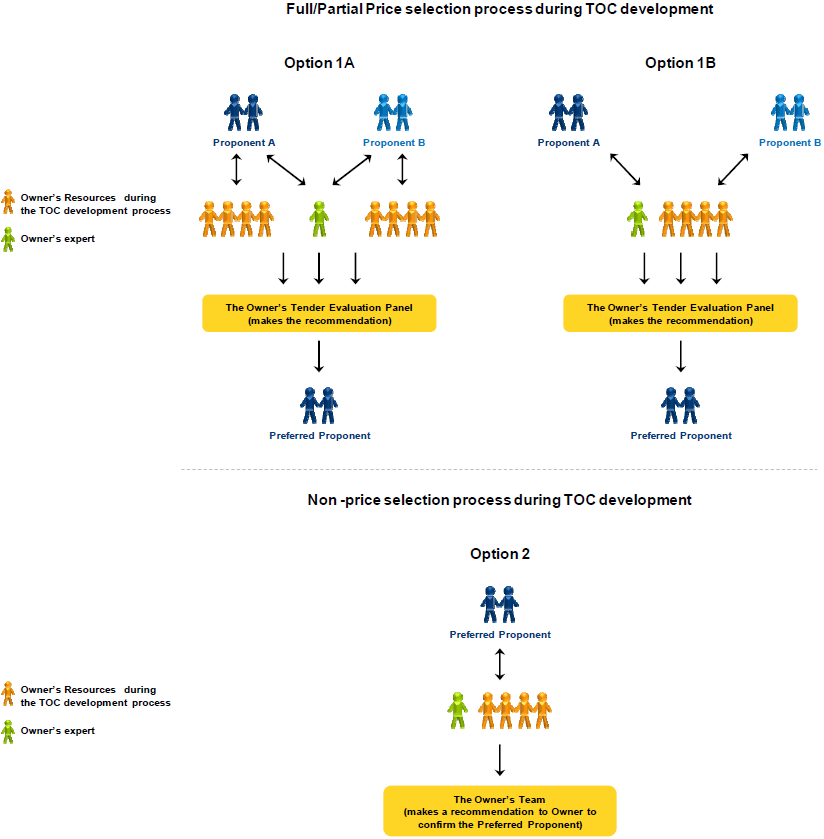
Each Proponent, with the Owner's input, develops its own design, construction methodology, delivery strategy and associated TOC consistent with the project objectives and performance and functionality requirements. There are a number of options (and variants) possible for structuring this collaboration that feeds into the tender selection process. Below are a few possible options:
Table 6: Options for structuring collaboration during selection process
|
In the full price and partial price selection process |
|
|
Option 1A: Two Owner Teams • The Owner appoints one senior Representative (usually the Owner's future ALT nominee) to work with each of the two shortlisted Proponents to facilitate the common interfacing and transfer of information with the Owner. |
Option 1B: A Common Team • The Owner appoints one senior Representative (usually the Owner's future ALT nominee) to work with each of the two shortlisted Proponents to facilitate the common interfacing and transfer of information with the Owner. |
|
• The Owner appoints two core teams to work separately and collaboratively with each of the two Proponents. These embedded teams would have significant involvement in the technical reviews and clarification meetings, in the risks and opportunities workshops, and be the initial point of contact for commercial and legal negotiations with its Proponents (these discussions are usually conducted at ALT nominee level). |
• The Owner appoints one core team to work with each Proponent in a collaborative and interactive manner; The team would have significant involvement in the technical reviews and clarification meetings, in the risks and opportunities workshops, and be the initial point of contact for commercial and legal negotiations with its Proponents (these discussions are usually conducted at ALT nominee level). |
|
• Where necessary, the Owner may also appoint specialist subject expert(s) to work with both Proponents and share his/her unique expertise. |
• Where necessary, the Owner may also appoint specialist subject expert(s) to work with both Proponents and share his/her unique expertise. |
|
• The Owner establishes a tender selection committee (or evaluation panel) that is responsible for the development and implementation of the tender selection criteria. This committee receives structured evaluations from the core teams that feed into the evaluation process. (It is also common to have some 'external' committee members to avoid corporate 'group think', and provide some diversity.) The recommendations of the committee are forwarded either to a project steering group or directly to the Owner. |
• The Owner establishes a tender selection committee (or evaluation panel) that is responsible for the development and implementation of the tender selection criteria. This committee receives structured evaluations from the core teams that feed into the evaluation process. (It is also common to have some 'external' committee members to avoid corporate 'group think', and provide some diversity.) The recommendations of the committee are forwarded either to a project steering group or directly to the Owner. |
|
Non-price Selection Process |
|
|
Option 2: One Team |
|
|
• The Owner appoints a team, which also serves as the evaluation team, to work collaboratively with the Preferred Proponent. (However, as in Options 1A and 1B, the Owner may call on assistance of external commercial advisors to bolster capability and counter asymmetry.) |
|
|
• The team will have significant involvement in the technical reviews and clarification meetings, in the risks and opportunities workshops, TOC development, and the commercial and legal negotiations with the Preferred Proponent during the TOC development stage. |
|
These options are illustrated in the following diagram:
Figure 23: Selection Process during TOC development