2.1 What is an alliance?
Alliance contracting is delivering major capital assets, where a public sector agency (the Owner) works collaboratively with private sector parties (Non-Owner Participants or NOPs). All Participants are required to work together in good faith, acting with integrity and making best-for-project decisions. Working as an integrated, collaborative team, they make unanimous decisions on all key project delivery issues. The alliance structure capitalises on the relationships between the Participants, removes organisational barriers and encourages effective integration with the Owner.
| Risk sharing v risk allocation The most significant difference between traditional contracting methods and alliance contracting is that in alliancing, all project risk management and outcomes are collectively shared by the Participants. In more traditional methods of risk allocation, specific risks are allocated to Participants who are individually responsible for best managing the risk and bearing the risk outcome. This concept of collective risk sharing provides the foundation for the characteristics that underpin alliance contracting including collaboration, making best-for-project decisions and innovation. If substantial and significant risk is allocated to individual Participants, then it may not be an alliance and those characteristics may not be necessarily required or appropriate. |
Alliance agreements are premised on joint management of risk and opportunity for project delivery. All Participants jointly manage that risk within the terms of an 'alliance agreement', and share the outcomes of the project (however, the financial outcomes are not always shared equally between the Owner and the NOPs)12.
| Sharing management and consequences of risks | |
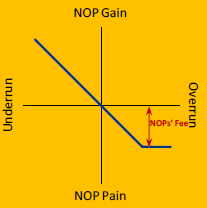
| Historically, most alliances have been delivered on the basis of a 50:50 sharing of risks (and opportunities) and a capped downside for NOPs. This means that although risks may have been jointly managed by the Participants, potential financial consequences were not equally shared. |
|
| Figure 2.1: Historical Risk or Reward Models - Cap on NOPs' Painshare | |
| An alliance contract works very differently to a traditional contract Traditional contracts are founded on the traditional role of buyer and seller. The buyer wants an asset delivered at fair cost or better and the seller wants to deliver the asset for a fair return or better. The buyer describes its requirements and terms, often in the form of an Request for Tender and the seller proposes a solution, terms and price to deliver that requirement, in the form of a Tender response. This means that both parties build their own risk assessment into their price and stand to win or lose if the risk outcome is higher or lower than predicted for each of them. The resulting contract encompasses both the requirement and the offer and allows variations to these to be made as the work progresses, as per the agreed risk allocation model and Commercial Framework. This approach works well where the project has few unknowns and the outcome is predictable. Whilst the buyer and seller are aligned on delivering the project, the buyer's motivation is to minimise the cost and the seller's motivation is to maximise the profit. The only moderator to this behaviour is the parties' desire to maintain a sustainable position (i.e. they will be concerned about reputation and staying in business) beyond the life of this project. Where projects are more complex, with more unknowns, and the parties have less ability to confidently predict the outcome using traditional contracting, the parties will allow for higher levels of risk which will mean a higher tendered price, and/or they will have significant variations as the work progresses. This can lead to highly complex risk-allocation models and commercial frameworks with significant time and effort spent negotiating variations to the original agreement. Resolving these variations can be time consuming and costly. Alliance contracting provides an alternative approach where the buyer and seller collaborate to develop the requirements and the proposal, combining their knowledge and experience to address the complexities and unknowns, with an objective of increasing their shared confidence in the outcome. They share exposure to the project outcome, which forms the basis of the Commercial Framework. The buyer and seller are aligned as minimising actual cost to the buyer and increasing profit to the seller. Time otherwise spent negotiating variations under a traditional contract becomes time spent finding the best solution to resolve issues and problems through the life of the project. The time and energy of the leadership team is spent on value-adding activities rather than contractual disputes; solving the overall project outcome is the objective and this aligns to each party's individual commercial objectives. |
Alliancing is a complex delivery method, and success is based on four interdependent success factors of:
an integrated collaborative team;
the project solution;
the agreed commercial arrangements; and
the agreed Target Outturn Cost (TOC).
These are shown in Figure 2.2 and are enabled by seven key features:
• risk and opportunity sharing;
• commitment to 'no disputes';
• best-for-project unanimous decision-making processes;
• 'no fault - no blame' culture;
• good faith;
• transparency expressed as open book documentation and reporting; and
• a joint management structure.
It is the collective dynamic of these key features which characterise the function and contractual structure of the alliance. That is, the key features operate in an integrated manner to ensure that the Participants exercise common behaviours and pursue common goals to deliver the project. Essentially, this is what makes alliancing unique compared to other delivery methods, where each contracting party has its own independent goals and risk allocation.
A current trend in the procurement and delivery of infrastructure projects is for the Participants to apply one or more select features of alliancing as part of a non-alliancing project. For example, the traditional form of contract might be amended to include elements of collective decision-making, a joint management structure and a form of risk or reward regime, but will not have a 'no disputes' clause and will still transfer the key construction risks to the designer/contractor. However, under an alliance, each of the above key features is present, integrated and incorporated in the contractual framework for the project.
___________________________________________
12 The commentary in the Productivity Commission 2014, Public Infrastructure, Inquiry Report No. 71, Canberra, is noteworthy. It states "Under alliance contracting, risks are shared between government and the private party. Alliances may work well in some circumstances but recent practice has been increasingly wary of the model due to uncertainty about the overall cost of construction and potential to put off rather than deal with risk issues early (chapter 12). Alliances may nevertheless still have their place. In particular, they may offer value in specific circumstances where projects must proceed out of necessity, but where substantial risk cannot be clearly allocated to one party. For example, because risks are difficult to identify and quantify or there is disagreement over the price. These examples should be rare in an effectively-planned infrastructure environment (page 122)".