2.7 The fundamentals of Government Procurement
Government seeks to observe high ethical standards and conduct in commercial engagements. Government and public officials must be able to demonstrate high levels of integrity and transparency in processes while pursuing VfM outcomes in the public interest.
A standard requirement for the public sector procuring building and construction works is contestability and competition.
These requirements are the foundation stone of public procurement and the building blocks of VfM outcomes. The inclusion of contestability and competition in procurement processes strengthens incentives to innovate and provides the most effective way of ensuring and demonstrating that taxpayers get the required outcomes at a fair cost (i.e. best-in-market pricing for the required supply at specified metrics of performance/quality). The capital cost of alliancing projects, which is generally greater than $50 million, suggests that full contestability and competition is appropriate.
In relation to contestability requirements, departments and public bodies are required to make reasonable attempts to seek a wide field of tenders or quotations for public construction services. Unless the construction works are less than a specified threshold value27 (which means a pre-qualified panel can be used), an open tender is normally undertaken.
The requirement of competition28 is satisfied by applying a tender selection criteria that includes both price and non-price considerations. The selection of suppliers is encouraged on a VfM basis, meaning that decisions must be made on the basis of tender selection criteria which address a balance of both price and non-price factors.
Although the weighting and importance of price for a project can vary, depending on the project and the related circumstances, price needs to be included in the overall evaluation of a tender for both contractors and consultants. Price should be a key selection criterion for differentiating suppliers. Public sector multi-million dollar contracts are normally signed in circumstances where the risk exposure to the government is well dimensioned and government's contract costs clearly defined.
Any departure from using competition on the outturn price as a key tender selection criterion for a proposed alliance project or program represents a departure from government policy and therefore requires a formal exemption to be approved. 29
If the Owner considers that the public interest may be better served through restricted contestability and/or limited competition, then the rationale should be documented and approval sought for an exemption in accordance with the applicable government policies. This exemption would usually be sought as part of the Business Case for the project. Certain 'exemptions' are traditionally recognised where full contestability (e.g. a sole supplier situation) and/or full competition may not actually be possible or a more limited approach will better satisfy the public interest. For example, this will be relevant where works are of an urgent nature due to unforseen events or occurrences such as:
life threatening situations;
occupational health and safety;
security;
loss of essential services;
avoiding significant loss or damage to assets, or significant service delivery disruption; and
weather protection.
| 'The level of competition is of significant importance when selecting procurement options, as any procurement strategy or delivery model that departs from a price competitive route, such as alliancing or exclusive partnering, should only be agreed following a thorough analysis of the benefits afforded and when they can be clearly demonstrated.'30 |
The following figure illustrates the principles of competition and the requirement for seeking exemptions:
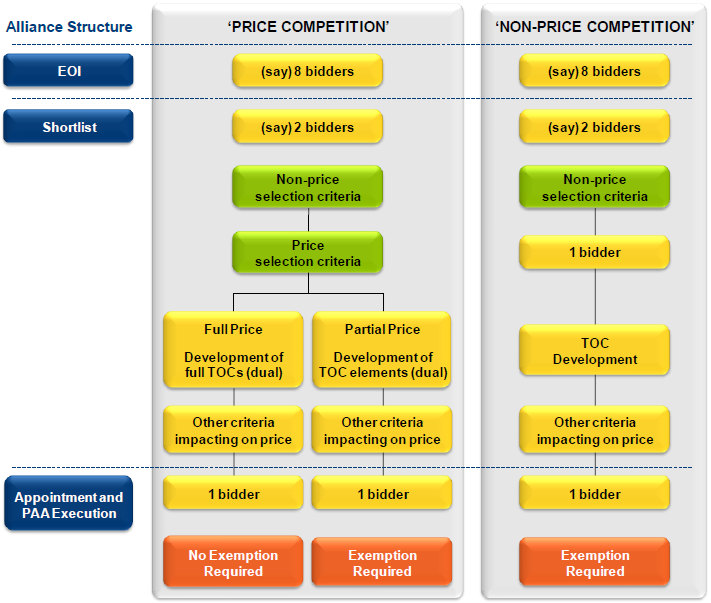
Figure 2.6: Application of competition in alliancing options
Australian governments have national and international obligations in relation to procurement such as the Australia and New Zealand Government Procurement Agreement; the Australia New Zealand Closer Economic Relations Trade Agreement; and the Australia - United States Free Trade Agreement. These are bilateral agreements which impose mutual obligations on government procurement. Owners need to ensure they conform to such international agreements where applicable.
_________________________________________________________________________________
27 The threshold value, beyond which a pre‐qualified panel is normally not appropriate, and an open tender should be used varies across jurisdictions.
28 The term 'competition' should be understood as meaning competition on all elements of the project which are relevant to performance of contractual obligations for that project, and which are material to differentiating one tender party from another. These elements include outturn cost, relevant corporate track record, management systems, quality control systems, capability of the nominated people, etc.
29 Writing in terms of good governance, the Productivity Commission 2014, Public Infrastructure, Inquiry Report No. 71, Canberra, reinforces this as good practice, stating that all governments should ensure use of transparent, innovative, and competitive processes for the selection of private sector partners for the design, financing, construction, maintenance and/or operation of public infrastructure (Recommendation 7.1).
30 Procurement Guidance Series - Relational Procurement Options - Alliance and Early Contractor Involvement Contracts, Chief Procurement Office, Queensland Government, July 2008.