4.9 Specialist advisers
The following specialist advisers may be used by the Owner to assist with various stages of the procurement process. The Owner can source its specialist advisers internally, or engage external consultants.45 It is recognised that some advisory firms may be able provide specialist advice across two or more skill sets. However, although it may be convenient (and may appear to be the most efficient option) for the Owner to engage one firm, it is important to ensure that the quality of the fit-for-purpose advice is consistent across all of the roles required to be performed46 and that advisers should not be asked to provide advice which is outside of their competency (or PI insurance). Agencies need to ensure any potential conflicts of interest are appropriately managed.
Table 4.2: Specialist Advisers
| Adviser skill set | Role |
| Commercial Adviser | The Commercial Adviser has a specialist in-depth understanding of the markets and commercial workings of Proponents for an alliance project. They advise on how to tailor the selection process to achieve the project objectives and requirements set out in the Owner's VfM Statement. They support the Owner from the Business Case stage (once alliancing is confirmed) through to selection and often in the delivery and close out stages, providing commercial advice and evaluation. The Commercial Adviser assists the Owner in coordinating the involvement of other specialist advisers. Key activities may include: • assisting the Owner to develop the alliance strategy, Commercial Framework and selection process; • assisting the Owner to develop procurement process documentation including the Expression of Interest, Industry Briefing, Request for Proposals, proposed PAA (including the Commercial Framework), and the Evaluation Plan; • assisting the Owner to determine and facilitate the most appropriate workshops for project development; • providing insights into the Proponents' offer and subsequent delivery; • assisting the Owner in evaluating the Proponents' Project Proposals; • reviewing Owner budget estimates (including Owner's Comparative TOC if appropriate); and • assisting the Owner during Finalisation and Award stage to optimise technical and contract requirements. |
| Transaction Adviser | The Transaction Adviser programs and leads the implementation of the procurement strategy. Key activities may include: • assisting the Owner's team to develop and quality assure procurement process documentation including the Expression of Interest, Industry Briefing, Request for Proposals, Proposed PAA, Commercial Framework, and Evaluation Plan; • assisting the Owner to coordinate and manage the selection process; and • facilitating Selection Panel discussions and evaluation workshops. |
| Insurance Adviser | Assisting the Owner to determine the most appropriate approach to insurance requirements.47 |
| Legal Adviser | The alliance legal adviser provides legal input and advice to the Owner. Key activities may include: • providing advice in EOI & RFP terms and conditions; • developing the draft PAA; • providing advice to the Owner on the Proponents' comments on the draft PAA; • finalising and coordinating execution of the PAA; and • providing advice on legal issues as they arise (e.g. adjustment events). |
| Financial Auditor | The Financial Auditor provides an assessment of financial aspects of each Proponent's offer for use in the selection process. Key activities may include: • investigating the financial capacity of individual Proponents; • investigating the Proponents' costing structures so that a clear understanding is gained of the proposed allocation of costs between Corporate Overhead and Reimbursable Costs; • assisting to establish appropriate definitions of Reimbursable Costs and Corporate Overhead; • confirming that the Reimbursable Cost rates (including direct cost multipliers) submitted by the Proponents reflect actual costs; and • considering the use of specialist support to assess not only whether costs were actually incurred, but also whether they should have been incurred. |
| Owner's Estimator | The Owner's Estimator has in-depth understanding of how designers/contractors cost infrastructure (or building) works and provides cost-estimating services to the Owner. The role of the Owner's Estimator is described in detail in Guidance Note No 548. Key activities may include: • developing an Owner's Comparative TOC if required and refining it as the project develops and further information emerges; • reviewing and commenting on the Proponent's proposed Project Solution and risk assessment; • validating that the Proponent's TOC (or each TOC component) is robust; sufficiently covers the key elements of the works (i.e. the TOC is sufficient to meet the Owner's requirements set out in the Business Case), and includes an appropriate risk contingency; • calculating a risk-adjusted price for each Proponent's TOC (or partial TOC) that will provide the Selection Panel with a better understanding of the commercial offering from each Proponent; and • verifying that the estimated cost of any Adjustment Events after the finalisation of the TOC represents an appropriate estimate of the associated cost. (Owners may find that some Transaction Advisers or Commercial Advisers can provide this service.) |
| Independent Verifier | The Independent Verifier (IV) provides assurance to the Owner that the alliance has effectively and efficiently designed and constructed the work to meet the requirements of the PAA. The need for an IV may arise if an Owner considers that they have a governance responsibility to be assured by independent parties that the alliance has designed and constructed the work in accordance with the PAA. To do this, the Owner engages an Independent Verifier (IV) who sits outside of the alliance and reports to the Owner. The IV may be one of the Owner's employees. The decision to use an IV will reflect several factors including the: • Owner's internal governance requirements; • risk and complexity of the project and the Owner's familiarity with these; • likelihood and consequences of non-complying quality (either in design or construction); • capability and capacity of the Owner's Representative(s); and • additional cost of the IV balanced against likely benefits. Owners will need to assess the above factors when deciding whether to use an IV and determining the scope of service. |
| Probity Adviser | The Probity Adviser ensures that the relevant Government probity standards and requirements are met through the selection and delivery process. The Probity Adviser will ensure that Owner interaction and/or integration with Proponents / NOPs can be achieved while satisfying probity requirements. |
| Behavioural Coach | Behavioural coaches can assist the Selection Panel to develop a better understanding of the Proponent's potential to form an alliance with the Owner's personnel. Key activities may include: • undertaking behavioural assessments; and • providing training and tools to allow the Selection Panel to undertake behavioural observation and assessment. After the PAA is signed, the alliance may decide to use a Behavioural Coach to consolidate alliancing behaviours. |
These advisers are typically engaged as outlined in Figure 4.3, however each adviser may also be involved on an ad hoc basis as required.
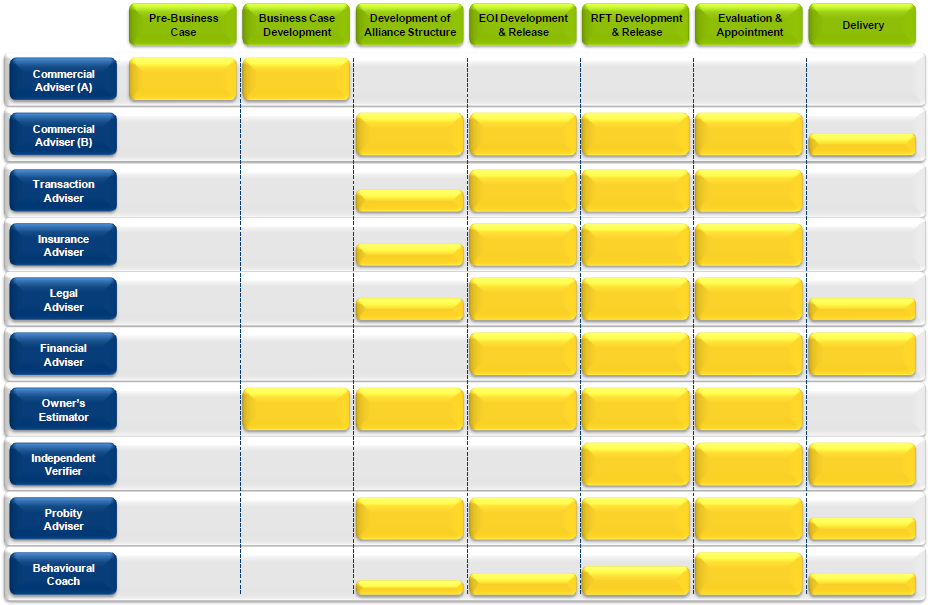
Commercial Adviser (A): specialist in preparation of Business Cases, including advising on various procurement options generally.
Commercial Adviser (B): specialist in alliancing with in-depth understanding of the markets and commercial workings of Proponents for an alliance project. This expert advice would be called upon full-time once the alliance procurement option is confirmed as part of the Business Case approvals.
Figure 4.3: Typical engagement of advisers
_________________________________________________________________________________
45 The government's preferred approach is to use its own public service resources with external providers employed to fill capability gaps but not to fulfil leadership roles.
46 For example, an Alliance Facilitator is a common term for various parts of the Commercial Adviser, Transaction Adviser and Behavioural Coach roles. Other consultancy firms will offer commercial advisory services that cover Commercial Adviser and Transaction Adviser. The Owner needs to make an informed judgment as to whether one person/firm can satisfy the combined requirements of these roles.
47 Refer to Guidance Note No 2, Insurance in Alliance Contracting - Selling Insurable Risks, Department of Infrastructure and Regional Development, Commonwealth of Australia, March 2011.
48 Refer to Guidance Note No 5, Developing the TOC in alliance contracting, Department of Infrastructure and Regional Development, Commonwealth of Australia, March 2011.