5.1 Alliance success dynamics
Once the Owner has made the decision to use an alliance as the method to deliver its project, the Non-Owner Participants (NOPs) should be selected with reference to the requirements set out in the Owner's VfM Statement. In particular, the selection process should be targeted at assessing the Proponents on the basis of their potential to optimise VfM for the Owner. This will be determined by their ability to satisfy the requirements of the Owner's VfM Statement at a fair actual outturn cost (AOC).
The Owner's starting point should be to determine which bids are likely to achieve this outcome through a detailed selection criteria and process which requires the Proponents to develop and tender a Project Proposal addressing price and non-price selection criteria.51 Effectively, the proposal tendered by the Proponents will address the following four interdependent components of the alliance project as shown in Figure 5.1:
• The project solution-comprising the design solution and construction and delivery methods that will be used to deliver the capital asset requirements set out in the Owner's VfM Statement;
• The integrated collaborative team-which covers the capability and capacity of the NOPs, and culture of the integrated NOP/Owner team members;
• The commercial arrangements-the remuneration framework (including definitions of Reimbursable Costs and Corporate Overhead), the Risk or Reward Regime, and other terms and conditions which comprise the PAA; and
• The Target Outturn Cost (TOC)-quantum of the total outturn cost, which should fairly estimate the expected outturn cost at the end of the project, as well as the breakdown and risk profile of that TOC.
These components need to be considered in the context of tender selection criteria that also assesses the NOPs likely performance on the following key features of alliancing:
• risk and opportunity sharing;
• commitment to 'no disputes';
• best-for-project unanimous decision-making processes;
• 'no fault - no blame' culture;
• good faith;
• transparency; and
• a joint management structure.
Tender selection criteria should be designed (and documented) that addresses all these components in order to select the NOP that is best placed to deliver the requirements set out in the Owner's VfM Statement.
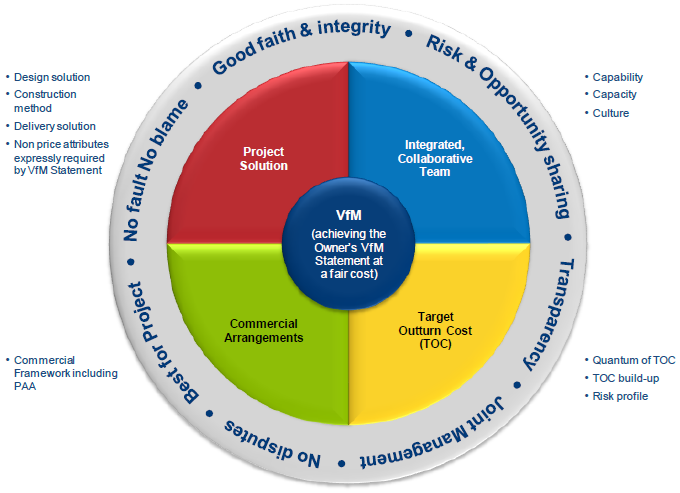
Figure 5.1: Alliance Success Dynamics
_________________________________________________________________________________
51 In addition to the Guide, further detail is provided in Guidance Note No 5, Developing the TOC in alliance contracting, Department of Infrastructure and Regional Development, Commonwealth of Australia, March 2011.