5.5.1 When to use the various NOP selection processes
The Guide explains that an alliance should only be considered as a suitable project delivery method when the Owner has the right capabilities and when one or more of the following characteristics exist:
• The project has risks that cannot be adequately defined or dimensioned in the Business Case nor during subsequent work prior to tendering.
• The cost of transferring risks is prohibitive.
• The project needs to start as early as possible before the risks can be fully identified and/or project scope can be finalised, and the Owner is prepared to take the commercial risk of a sub-optimal solution.
• The Owner has superior knowledge, skills, preference and capacity to influence or participate in the development and delivery of the project (including for example, in the development of the design solution and construction method); and/or
• A collective approach to assessing and managing risk will produce a better outcome, e.g., where the preservation of safety to the public/project is best served through the collaborative process of an alliance.
Once the decision is made to use an alliance, the next step is to decide how to select the NOPs: full price, partial price or non-price. The default position, (as detailed in the Guide) is full price competition. Partial price or non-price processes represent a departure from Policy and the Owner must seek an exemption58 as part of the Business Case.
Characteristics 1 and 2 from the above list could justify the use of partial or non-price competition if undefined or undimensionable risks would have a significant impact on cost estimates. Depending on the extent, or potential severity, of this undimensionable risk, the optimum selection process may be full, partial or non-price. Included in such a characteristic is that the scope of the design and works, for whatever reason, cannot be adequately dimensioned upfront and is best done post TOC development (during the construction phase).
The other characteristics (3, 4 and 5) would generally not be considered in themselves as justification for departure from full price competition. It is possible in uncommon circumstances, that the potential price premium for departing from the policy and full price competition can be justified in the request for exemption contained in the Business Case.
To seek exemption on the basis of possible time savings would normally be an insufficient justification, since under best practice conditions there is considered to be no material difference in the timeframes for the three available selection processes (full, partial, non-price). However, it is acknowledged that there are occasions, albeit rare, where community needs require a start to construction (not just 'early works') as soon as possible (this situation should be distinguished from completing the project as soon as possible). Truncated planning and procurement processes may be required to meet the need to 'start as early as possible'. To effect a time saving, it may also require that the PAA is executed much earlier than set out in this Guide. The Owner needs to fully dimension the risks and cost premiums associated with such special strategies.
Normally, it is the expertise of private sector Proponents that an Owner seeks to utilise in partnership when selecting NOPs. However, there may be cases where the Owner has exclusive abilities or superior skills (e.g., managing design risk) and is looking for a special alliance partner to develop unique project deliverables. Here the Owner should request exemption from the policy for the use of non-price competition on the basis that it is not possible to have effective competition because of a limited range of competitors.
The following diagram provides further guidance in the use of full, partial and non-price processes where the project risks are undimensionable.
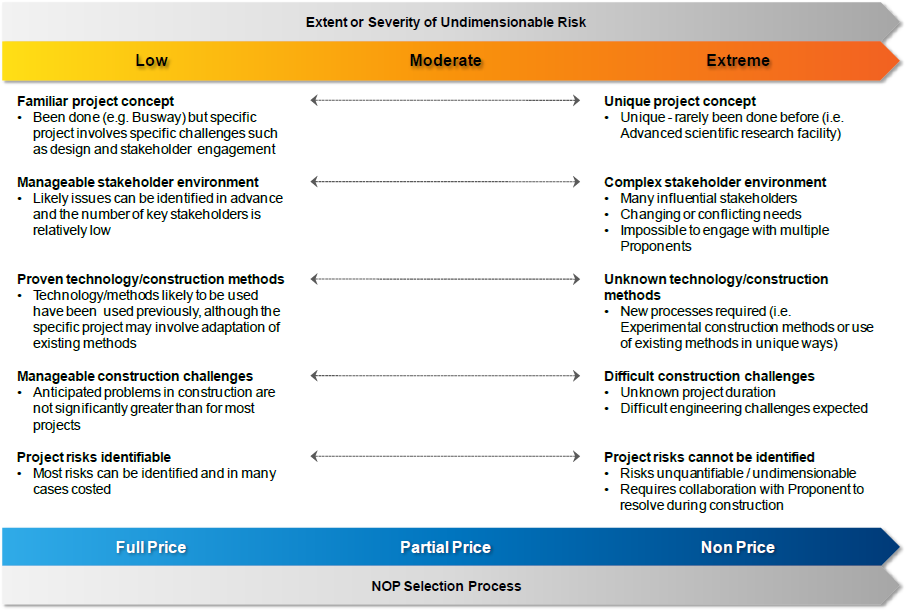
Figure 5.4: NOP selection process and the ability to dimension the project solution
This diagram illustrates that as the extent of or severity of undimensionable risk increases, so will the suitability of other than full price competition NOP selection processes. When exemption from using full price competition is sought, Owners should demonstrate that the presence of undimensionable risks preclude the effective use of the full price selection process and the Owner should work through the partial process before, as a last resort, approval to use the non-price process is sought.
_________________________________________________________________________________
58 The process for applying for an exemption is specific to each jurisdiction.