The interrelationships of the key parties
The government's interest is normally driven by the service benefit to the community and not by the asset solution, which is the basis upon which the alliance is formed5. The Owner's Business Case documents the research and analysis done:
• that identifies and dimensions the 'VfM proposition' for the community (i.e., the proposed services benefits to the community balanced against the estimated capital and non-capital costs/risks of realising those service benefits); and
• that supports a recommended procurement strategy (i.e., the best way to realise the capital assets required to enable the services benefits to be delivered);
The alliance team is appointed to deliver the capital project component of the Business Case. The team is expected to plan, design and construct the project to meet the Business Case parameters and objectives at a fair cost.6 In undertaking its work, the alliance is also expected to apply the general concept of VfM (see chapter 3) in its decision making for the delivery of the capital project.
The Owner (or sometimes another government agency) is responsible for achieving the service benefits associated with the Business Case. The Owner is accountable to the government for the performance of the alliance.
| The Sugarloaf Alliance (Victoria) The Sugarloaf Pipeline Alliance was established by Melbourne Water in 2007. The Alliance's purpose was to construct a 71 km pipeline from Yea in northern Victoria, to the Sugarloaf Reservoir in southern Victoria. An investment rationale of the project was to enable one-third (up to 75 gl) of water saved through the modernisation of the Goulburn Murray Irrigation District (GMID) to be delivered to Melbourne. This was a challenging project, given that the pipeline route traversed sensitive forest areas and the concerns of a number of different stakeholders needed to be addressed. The Alliance took the risk for construction of the pipeline within the parameters of the approved Business Case, but was not responsible for the annual sourcing of water to be delivered down the pipeline from independently audited GMID water savings. The Alliance's role was to construct enabling capital assets, but this did not include ensuring the availability of supply of (saved) water for the residents of Melbourne over the longer term. |
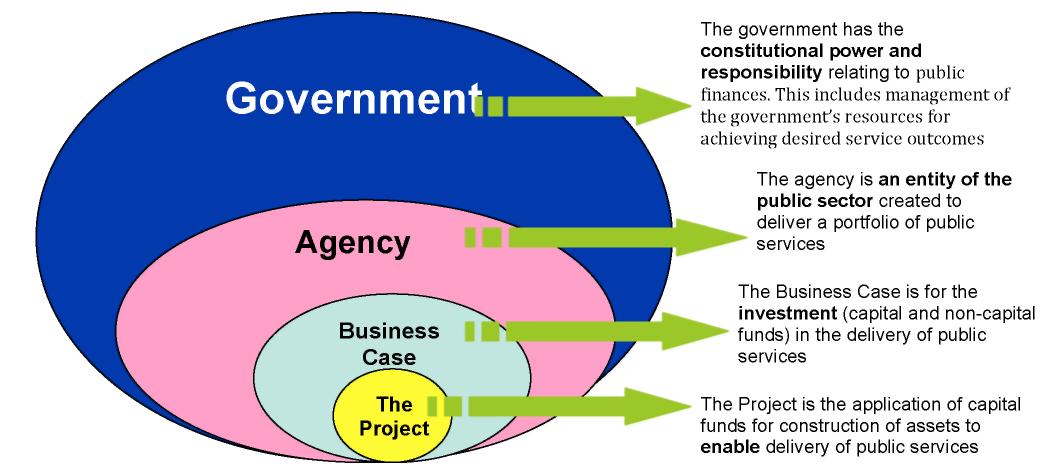
The following illustration shows the context in which an alliance project takes place in relation to public sector governance roles.
Figure 3: The 'project' context in relation to governance responsibilities
If the Owner believes that a particular social, economic or environmental objective is important and wants it addressed as part of the capital project, then the Owner should analyse the costs, risks and benefits associated with this objective and make it part of the Business Case objectives/deliverables. Following Business Case approval by the government, any proposed change to the Business Case by the Owner may require further approval from the government, and any proposed change by the alliance from the Owner. The Owner normally needs to seek further approvals from the government if the changes are significant and outside agreed governance thresholds.
| Which is the 'approved Business Case'? The 'approved Business Case' is the initial document approved through the established government process (which can include a statutory authority's Board, the portfolio Minister, the Treasurer and/or a Committee of Cabinet), plus any subsequently approved variation to this document. Any proposed variation to the Business Case must be approved by the Owner (as distinct from the Owner Participants in the alliance). If the changes are significant and outside agreed governance thresholds, these must be approved by the government. Effectively, governments processes normally operate on the position that the original approver of the Business Case needs to approve any subsequent material changes to that Business Case. |
______________________________________________________________________________
5 To ensure success in a project investment, it is critical to have a clear linkage from the Government's approved service need to the project definition, project budget, tender documentation, contract awarded and to project completion. This is also recognised in Recommendation 7.1 of the Productivity Commission 2014, Public Infrastructure, Inquiry Report No. 71, Canberra, which makes the point in relation to good governance that all governments set clear and transparent public infrastructure service standards.
6 'Fair cost' or 'fair price' is used to denote a total project cost to the state based on the best-in-market pricing of the required supply at specified metrics of performance/quality and based on whole-of-life criteria. Fair price or best-in- market price (or for that matter lowest-acceptable-price) does not mean the 'cheapest price'.