Agency level
(Recommendations for project funding are normally made by the agency's leadership/board to the responsible Portfolio Minister for prioritisation and submission to the government budgetary process)
Service agencies are established to focus on particular sectors of government service delivery to the community. Service agencies develop long-term and short- term investment programs and specific proposals in response to community needs and the government's priorities. Specific investment proposals are analysed by the agency in business cases.
The Business Case includes the detail required to articulate the VfM 'story' of the agency's investment submission to government.
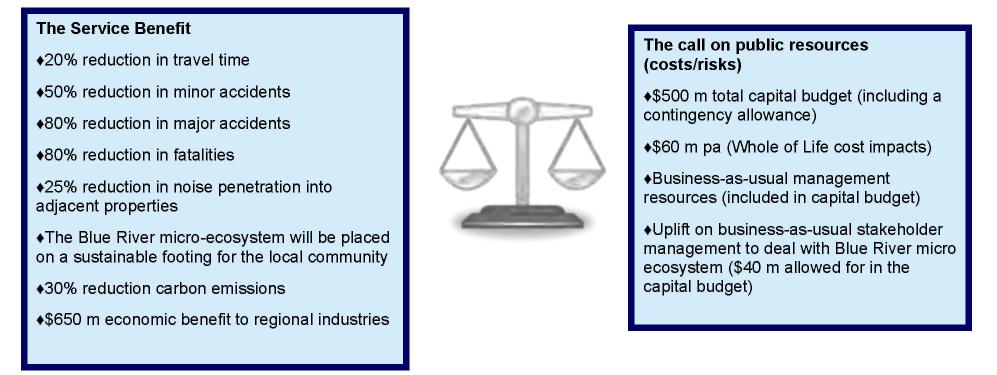
The VfM proposition-the service benefits to be delivered to the community weighted against costs and risks of this delivery-should be specifically articulated in the Business Case. The following diagram is a simple illustration of the concept.
Figure 4: Simple illustration of the VfM proposition for a major road upgrade:
It is expected that the Agency's Business Case will fully analyse and dimension the costs, benefits, risks and opportunities involved achieving those service benefits. This analysis should be founded on the efficient, effective and economical planning and use of public resources. The Business Case should make this analysis on a whole-of-life basis. (See Chapter 4.)
Those business cases which pass the agency's own evaluation process are submitted by the portfolio minister to the government budgetary process. As all governments are faced with the necessity to ration public funding, the majority of business cases submitted by agencies to the government budgetary process are not approved.
The Owner also demonstrates VfM considerations in the selection of the preferred Proponent. Generally the Owner's decision will be based on a balanced judgement of the price (i.e. the 'headline' price quoted) and non-price factors, which may have significant implications for the final/actual outturn price paid as well as other project objectives (non-price factors include those arising from the TOC development phase, e.g., the Proponent's proposed project solution, the team capability it offers, commercial and legal arrangements, etc).
What comes first? VfM definitions or parameters in the Business Case are the subject of agreement between the government and the Owner, and these cannot be changed by the alliance team engaged to deliver capital assets. The VfM proposition, along with the careful consideration of the project characteristics and risk profile, determines the selection of the procurement strategy that is recommended in the Business Case. That is, the procurement method does not determine or define the VfM proposition. |