(d) PRINCIPAL DIFFERENCES BETWEEN CONVENTIONAL AND MULTI-YEAR CONTRACTS
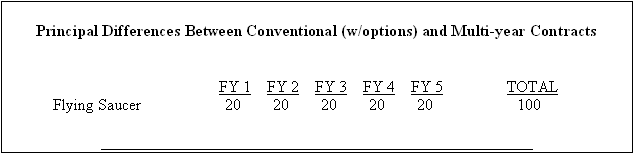
(1) Figure 2 outlines the principal differences between conventional (annual-buy) and multi-year contracts. The example uses a conventional contract with priced options. The use of options is sometimes referred to as "multiple year" contracting, which is distinctly different from "multi-year" contracting.
ANNUAL-BUY | MULTI-YEAR | |
Initial Contract | One contract for the FY 1 requirement of 20 flying saucers | One multi-year contract for all 100 flying saucers |
Congressional Commitment | To FY 1 buy of 20 flying saucers | To total buy of 100 flying saucers from FY 1 through FY 5 |
Treatment of out- year requirements in the initial contract | Option for each fiscal year's requirements | Separate line item for each fiscal year's requirements |
Required to "activate" contract commitment to buy the next year's requirements* | 1) Same quantity authorization as was provided for in FY 2 option 2) Annual appropriation by Congress adequate to fund FY 2 of the option 3) Contracting Officer determines that exercising the option is the best method of fulfilling the Government's need, price and other factors considered | Annual appropriation by Congress adequate to fund FY 2 of the multi-year contract |
Contractual action required to "activate" commitment to buy the next year's requirements* | Contract modification to exercise FY 2 option | Contract modification obligating funds for FY 2 requirements |
* Note that these differences are relevant to each of the out-years: FY 2, FY 3, FY 4, and FY 5 | ||
Figure 2 | ||