(c) HOW TO APPLY THE FUNDING RULES TO A MULTI-YEAR CONTRACT
(1) A multi-year contract has two funding components:
(i) The end items being acquired in each year; and
(ii) The cancellation ceiling for each year, consisting of
(A) The termination liability created by advance procurement, and
(B) The nonrecurring costs the contractor plans to recover in the price of out-year end items.
(2) This section will address each of these components, in turn. For purposes of this discussion, consider the example below:
Example Funding Requirement: XYZ Satellite Production
The program office planned to award the multi-year contract in FY 97 in order to initiate advance procurement of long lead and EOQ effort. |

(i) You can think of funding this multi-year contract in the following way:
Example Funding Application: XYZ Satellite Production | |||||||||
Funding Applied In This Year | FY 97 | FY 98 | FY 99 | FY 00 | FY 01 | ||||
Will Go Toward | FY 98 | L & E | P | ||||||
Production of | FY 99 | E | L & E | P | |||||
to be Acquired | FY 00 | E | E | L & E | P | ||||
FY 01 | E | E | E | L & E | P | ||||
L = Advance procurement funds for long lead items and effort E = Advance procurement funds for EOQ items and effort P = Procurement funds for procurement of end items | |||||||||
(3) Funding the End Items Being Acquired in Each Year
(i) The Department of Defense has a long-standing "full funding" policy. That policy is to "fund fully procurements that are covered within the procurement title of the annual DoD Appropriations Act." (DoD 7000.14-R, Volume 2A, Chapter 1, paragraph 010202A, "Full Funding of Procurement Programs.") The objective of the policy is to provide funds at the outset for the total estimated cost of a given item so that the Congress and the public can be fully aware of the dimensions and cost when it is first presented in the budget.
(ii) It would be logical to assume that to comply with the full funding policy, you would have to fund in FY 97 (at the time of award) the total estimated cost to the Government of all five XYZ Satellites being acquired in the example multi-year procurement. But, neither the Congress nor the DoD requires this. For funding purposes, you deal with each fiscal year's requirement, rather than with the total quantity of end items represented by the multi-year contract. Paragraph 010203A of DoD 7000.14-R, Volume 2A, Chapter 1 states, "Multi-year procurements are budgeted and funded annually."
(iii) In the XYZ Satellite example, one end item is being acquired in FY 98. It must be fully funded in FY 98. This means you should obligate the amount that results from the following calculation:

In the same example, two end items are being acquired in FY 99. They should be fully funded in FY 99. This is how the "full funding policy" is applied to a multi-year contract. This same principle applies to the remainder of the contract quantities.
(4) Funding the Cancellation Ceiling for Each Year
(i) According to 10 USC 2306b(c), you can either fund the cancellation ceiling or treat it as an unfunded contingent liability; except that 10 USC 2306b(1) prohibits unfunded cancellation ceilings for EOQ procurements and FAR 17.104(c) states "..the funds obligated for multi-year contracts must be sufficient to cover any potential cancellation and/or termination costs...". For a complete perspective of funding guidelines and limitations, review the current policy in OMB Circular A-11 and OMB Circular A-11, Part 4, along with the current FAR and supplements.
(ii) Pertinent Law
"Section 814 of the National Defense Authorization Act for FY 2005 requires the Department of Defense to provide notice and supporting rationale to Congress before awarding a multiyear contract containing a cancellation ceiling exceeding $100 million that is not fully funded.
(iii) Pertinent Law - General
10 USC 2306b(f) provides that if a multi-year contract is canceled or terminated, the costs of cancellation or termination may be paid from--
"(A) appropriations originally available for the performance of the contract concerned;
(B) appropriations currently available for procurement of the type of property concerned, and not otherwise obligated; or
(C) funds appropriated for those payments.''
(iv) Pertinent Law - Liability Associated with Advance Procurement
(A) 10 USC 2306b(h)(2) authorizes multi-year contracts to be used for "advance procurement of components, parts, and materials necessary to the manufacture of a weapon system" (i.e., long lead procurement) and for "advance procurement ... in order to achieve economic lot purchases and more efficient production rates" (i.e., EOQ procurement).
(B) A cancellation ceiling may consist of two kinds of costs: nonrecurring costs and recurring costs. Any recurring costs are attributable to the advance procurement (i.e., long lead and/or EOQ) being done under the multi-year contract. The EOQ procurement must be funded with advance procurement dollars. This is illustrated as follows:
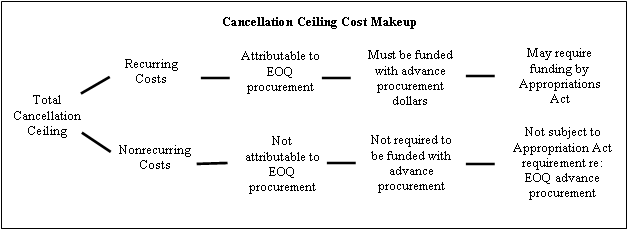
Figure 7
(v) DoD Policy.
(A) DoD 7000.14-R, Volume 2A, Chapter 1 recognizes both "advance procurement (long leadtime items)" and "advance EOQ procurement (multi-year procurement)" as general exceptions to the full funding policy. DoD 7000.14-R, Volume 2A, Chapter 1 also states that "It is the general policy of the Department of Defense not to create unfunded contract liabilities for EOQ procurements." It goes on to require that budgets for EOQ procurement cover at least the termination liability of the EOQ procurement. This means that the DoD's policy is to fund the recurring cost portion of cancellation ceilings.
Note: Those who believe in funding cancellation ceilings are committed to a policy of "pay as you go." This means you quantify the Government's worst-case liability and hold that amount in reserve. Then, in the event of contract termination or cancellation, funds are available to cover associated costs. Those who advocate unfunded cancellation ceilings (i.e., carrying an unfunded contingent liability) argue that the risk of a multi-year contract being terminated or canceled is too low to warrant tying up large amounts of Total Obligation Authority. This position relies on the logic that any program meeting the statutory multi-year criteria is very unlikely to be terminated or canceled. This position also (in the opinion of many financial experts) puts the program in a potential Anti-deficiency Act (ADA) violation situation if cancellation costs cannot be fully covered.
(B) DoD 7000.14-R, Volume 2A, Chapter 1 prescribes the following procedures for dealing with each of these exceptions:
(1) Long Leadtime Items. Fund them at least to termination liability.
(2) EOQ Procurement. Fund it to the estimated termination liability unless it would be more effective to fully fund the EOQ.
To fully fund the advance procurement, you should fund the amount needed to cover the total estimated cost to the Government of the items and effort being bought in advance. To fund the advance procurement to termination liability, you should fund the recurring cost portion of the cancellation ceiling, as explained below.