5.5 Past Performance Evaluation.
a. Step One. Conduct Relevancy and Recency Screening.
The first step in the Past Performance evaluation is for the PCAG to screen the contracts presented by the offerors and make an initial determination of its relevance and recency to the instant acquisition. The PCAG must conduct this relevancy and recency screening in accordance with the definitions and criteria set forth in Section M of the RFP. The objective of the screening is to remove those contracts that are clearly not relevant or recent from further consideration. Other source selection members and advisors may provide assistance in determining relevancy.
b. Step Two. Search for Additional Relevant Contracts.
In addition to the contracts provided by the offeror, the PCAG must aggressively research other sources for other relevant contracts. Sources to be considered are CPARS via PPIRS, DCMA, FPDS-NG/DD350, EZQuery (SPS offices only), Dun and Bradstreet, Security Exchange Commission (SEC) 10K Reports, Better Business Bureau, and pre-award survey monitors. We highly recommend that you not rely solely on the contracts identified by the offeror since these may not give a true picture of the contractor's past performance. Send questionnaires to POCs for relevant contracts except for contracts covered by CPARS that may not require a questionnaire. Generally, for information available in CPARS, only request updated information. These sources are the starting points, not the ending points for past performance information.
c. Step Three. Obtain CPARS Data via PPIRS.
Contact the PPIRS focal point for available CPARs on relevant contracts. The past performance evaluation team will request CPARs not in PPIRS directly from the CO on that individual contract.
d. Step Four. Questionnaires.
(1) Issue Questionnaires.
If the PCAG transmits questionnaires, a PCAG member should telephone at least two points of contact (POC) for each contract referenced by the offeror. In addition to Program Managers and Contracting Officers, POCs could include the end user, government agency and/or commercial customer, equipment specialist, systems engineer, contracting officer technical representative (COTR), or pre-award survey monitor. POCs may also include private contractor personnel when the contracts are commercial/non-government. Telephone the POCs, explain we will fax a questionnaire to them and ask for a response by a certain date. The PCAG must protect completed questionnaires as they contain source selection sensitive information. The questionnaire should include instructions to contact the PCAG or CO when the completed questionnaire is ready to return via fax so that it can be protected at all times.
Commercial firms are reluctant to provide any performance information on their commercial customers. The consent form, completed by the offeror when a commercial contract is provided as a relevant contract for past performance history, will provide the offeror's approval for the commercial firm to release performance information. Some commercial POCs may still not want to openly discuss the offeror's performance even with a consent form. The PCAG's best efforts are required in obtaining information and assuring the commercial POC that all information provided is source selection sensitive.
(2) Follow-up and Receive Questionnaires.
The PCAG will make follow-up phone calls or e-mails confirming that the POC received the questionnaire from the PCAG or from the offeror and will meet the requested submission date. The PCAG will make a follow-up telephone call or e-mail the POC inquiring about completion of the questionnaire and when it will be faxed if a completed questionnaire is not received by the requested date. The PCAG cannot hold offerors accountable for failure of the respondents to send in questionnaires. The past performance team needs to aggressively pursue return of the questionnaires. Make follow-up calls or send e-mails encouraging timely submission of the completed questionnaires. The PCAG may request the SSET or SSAC chairperson's assist in obtaining the information if PCAG calls are not obtaining a high rate of return.
(3) Conduct and Document Interviews on Completed Questionnaires.
Next, the PCAG will conduct interviews, if needed, with POCs who completed the questionnaires. History indicates that questionnaires provide useful but incomplete information. Each PCAG member will conduct interviews and document results of the conversation. However, a group conference call is sometimes beneficial to collect information. PCAG will conduct interviews in person or by telephone. We recommend that all POCs for a specific contract attend the same meeting or on a conference call to ensure that, they discuss different opinions with all parties. Before initiating an interview, by telephone or in person, a PCAG member will gather all available information on a specific effort and generate a list of questions. Advise the POCs that we will document the information provided in the interview and fax it to them for review and signature. Interviews often provide additional information concerning the past or present performance of the offeror, subcontractor, or teaming partner not apparent from the questionnaire. Consider PCAG site visits to interview customers for large products/services acquisitions. See Attachment 9 for an example of a PCAG site visit.
Immediately following the interview, the PCAG member must prepare a summary of the conversation. Carefully prepare the conversation record to ensure accuracy, clarity, and legibility because these records will provide written documentation supporting the performance confidence assessment. We recommend the PCAG member send the conversation record to the POC either requesting that the POC sign and return the record or stating explicitly that if the POC does not object to its content with the time specified, the conversation record will be accepted as correct. See Attachment 10 for a conversation record example.
e. Step Five. Rate Performance for Each Offeror and Each Offeror's Critical Subcontractors/Team Partners.
(1) Rate Performance on Each Relevant Contract.
Accomplish an analysis of each contract against the Mission Capability factor or subfactors and Cost/Price factor. Rate the offeror's performance on each relevant contract for Mission Capability factor or subfactors and Cost/Price factor. For each contract or task/delivery order, determine the relevancy rating (very relevant, relevant or somewhat relevant) for Mission Capability factor or subfactors and the Price/Cost factor. The PCAG must document results of individual contract analysis. Attachment 14 is a sample; however, use the criteria in Section M of your acquisition.
(2) Evaluate Poor Performance, If Necessary.
Accomplish a critical analysis of each contract to ascertain performance, cause and effect of poor (adverse) performance record, e.g. who was really at fault: Government, contractor, or both.
(3) Consolidate Data For Each Offeror.
Consolidate results of the relevant contract analysis showing the total relevant contract information for an offeror; see Attachment 15 for a sample format.
(4) Identify positive and negative performance indicators for the Past Performance Factor
Identify evidence that leads to confidence or plants doubt in your mind for each Mission Capability subfactor and Cost/Price factor based on past and present performance.
f. Step Six. Site Visits.
(1) Determine Need for Site Visits.
After analyzing the data, the PCAG should determine whether site visits to customers are required for this acquisition. PCAG should consider site visits for large, complex or critical products/services acquisitions. If the PCAG decides to conduct site visits, they should accomplish site visits on each offeror or each offeror in the competitive range, whichever is applicable.
(2) Conduct Site Visits.
The PCAG plans the visits, prepares a travel book, and prepares follow-up notes for discussion. After the visit the PCAG documents the discussions during the visit and determines whether ENs are required as a result of the information obtained during the visit. See Attachment 9 for an example of a PCAG site visit.
g. Step Seven. Performance Confidence Assessment.
The PCAG will consider recency, relevancy, and quality of performance for the prime and the subcontractors, as it relates to the work each will perform, when assigning the performance confidence assessment.
Performance confidence assessment is an evaluation of the likelihood (or government's confidence) that the offeror will successfully complete the solicitation's requirements; the evaluation is based upon past performance. The performance confidence assessment is established through an integrated analysis of those positive performance indicators and negative performance indicators identified at the Mission Capability subfactor and Cost/Price factor level as determined by the offeror's recent, current and relevant contract performance (MP5315.3). This integrated performance confidence assessment is the rating for the Past Performance factor.
Below is a methodology process flow to show how the information flows from individual contract ratings into one performance confidence assessment rating for the Past Performance factor.
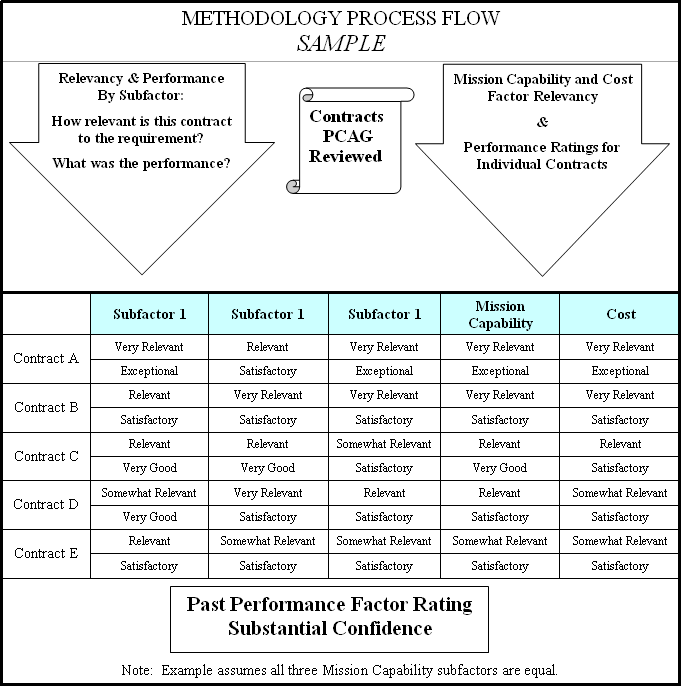
h. Step Eight. Adverse Past Performance.
PCAG prepares an EN for all adverse past performance information to which the offeror has not previously had the opportunity to respond, or previous response was inadequate, when the contract is determined to have a somewhat relevant or higher relevancy rating. Even when contemplating award without discussions, ENs for clarification may be required. Remember Section M of the RFP defined what is adverse past performance in this acquisition. Also, prepare other ENs required for past performance.
i. Step Nine. Evaluate Responses to ENs.
Evaluate responses to ENs on adverse performance. Determine changes to the individual contract evaluations based on additional information received from the offerors. Discuss additional information with POCs on questionnaires.
j. Step Ten. Review Performance Confidence Assessment.
Review performance confidence assessment based on additional information received in Step Nine. Review evidence that leads to confidence or plants doubt in your mind (positive and negative aspects). Make revisions as justified and document reasons for changes.
k. Step Eleven. Assist Other Source Selection Team Evaluators.
The PCAG can assist mission capability team evaluators by serving as a resource in cases where a proposal risk rating of other than low is under consideration for a proposed approach because the team is unfamiliar or uncomfortable with that approach. For example, if an offeror used a novel approach successfully in the past, this could mitigate a moderate or high risk rating for the mission capability subfactor in question.
l. Step Twelve. Documentation
Review the documentation using the questions in Attachment 12 and verify that the past performance evaluation was completed in accordance with Section M of the RFP and correctly documented.
m. Step Thirteen. Prepare Briefing Charts.
The PCAG prepares charts for SSAC and SSA briefings, as required. Then the PCAG determines chart(s) that we will not use to brief the offeror and highlights that chart(s) to the SSAC and SSA. Attachment 16 provides a sample of the PCAG portion of a briefing.