(b) THE MULTI-YEAR PROCESS: PLANNING AND ANALYSIS, ESTIMATING, BUDGET, AND CONTRACTING
(1) The use of MYC involves four interrelated, parallel processes: the planning and analysis process, the estimating process, the budgeting process, and the contracting process. Figure 3 shows how long these processes take and how they are integrated in a successful multi-year contract. This schedule is representative of an annual Planning, Programming, and Budgeting System (PPBS). Key elements of these processes are included in Figure 3.
(2) A 1996 AF Multi-year Integrated Product Team (IPT) found a direct correlation between the number of approved multi-year contracts and budget factors. The IPT's overall finding was:
"Congressional approval of MYC is directly related to service commitment and budget availability - NOT estimated cost savings." |
The IPT's overall recommendation was for AF leadership to "support establishing MY as a long-range planning process conducted by Air Force acquisition leadership to identify MY candidates." This would:
(i) Ensure that, when there is budget availability, multi-year candidates are planned and implemented; and
(ii) Avoid wasted effort on feasibility studies and the subsequent approval process when there is no budget availability.
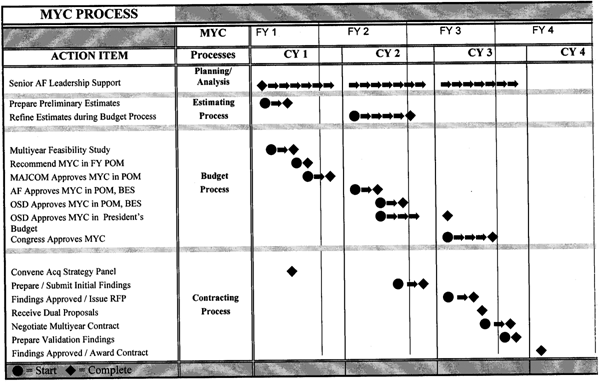
Figure 3
(3) The importance of initial planning and analysis of the acquisition and budget environment is critical. This is especially true of major multi-years. Upfront discussion and support of your multi-year contract by senior acquisition leadership is essential and should always precede expending critical resources on multi-year feasibility and execution.
(i) Prepare Preliminary Estimates. The first step in any multi-year effort is to prepare preliminary estimates for the feasibility study. This is to estimate the costs and savings of using a multi-year contract versus conventional annual-buy contracts. This estimating effort will run in parallel to the feasibility study and directly feed required data to it. The contractor is usually the best source of information for these kinds of estimates. The System Program Office financial analysts should work with the contracting officer to obtain information from the contractor(s) that will help the IPT develop sound budgetary estimates.
Note: If the contemplated multi-year contract would result from a competitive procurement, your ability to obtain contractor input at this stage may be limited. It is essential that the contracting officer be involved, so any such exchanges are conducted in a way that does not compromise the eventual competition.
(ii) Conduct a Feasibility Study. A feasibility study should be accomplished to see if MYC makes sense for your program. The main thrust of this step is to evaluate your program against the multi-year criteria outlined in Chapter 1. The study team should consist of representatives from financial management, contracting, and manufacturing and should be led by the program office's IPT leader. To the extent possible, the contractor(s) should also be involved.
Note: Contractor input at this stage is voluntary and informal. This feasibility study occurs long before any formal solicitation is issued.
The output of the study is a partial Multi-year Justification Package (MJP) that demonstrates whether the program meets the basic multi-year criteria. Given positive results, this initial feasibility determination will also serve as the basis for the formal MJP.
(iii) Develop Acquisition Strategy. If, based on the results of the feasibility study, the program manager decides that MYC makes sense for the program; a multi-year acquisition strategy must be developed. A review of the study's findings and the recommended MYC approach should be items covered by the ASP. The ASP should be scheduled as early as possible in order to have the panel's strategies input into the POM. The headquarters OPR for multi-year should be invited to attend field-level ASPs for programs that have multi-year potential. If the panel concurs, the program manager should recommend the use of MYC for the program in the POM submission.
(iv) Recommend Multi-year Contract in the Program Objective Memorandum (POM). If the feasibility study indicates that MYC will offer substantial savings and the ASP confirms this approach, the next step is to recommend in the POM that the program use a multi-year contract. Following POM-Call instructions, a budget document (called an "initiative," which takes the form of a "delta Program Decision Package (PDP)") will be submitted showing the funds needed to support the recommended multi-year contract. This "initiative" is a funding alternative to the normal annual-buy program. It will be supported by the MJP generated during the feasibility study. The multi-year funding profile will generally require more funds in the early years, but fewer funds in the long run.
(v) Approval of the Recommended Multi-year Contract in the POM. This step involves the normal budgeting process in which the MAJCOMs, the Air Force, and the Office of the Secretary of Defense (OSD) review the POM inputs and make decisions on funding levels.
(vi) Refine the Estimates. If your multi-year candidate survives POM reviews at the MAJCOM and/or Air Force levels, the cost and multi-year savings estimates will be a year old. You will probably need to revise them for the Budget Estimate Submission (BES) cycle to reflect changes in approved inflation rates and expenditure patterns. If there have been any substantial changes in the program or the assumptions underlying the original estimates, it is important for the MJP to reflect those changes.
(vii) Approval of the Recommended Multi-year Contract in the BES. This step involves the normal budgeting process in which the Air Force and OSD review the POM inputs and make decisions on funding levels in the BES.
(viii) Prepare Initial Multi-year Findings. If support for MYC exists at the Air Force level, the financial management and contracting offices should begin preparing a complete multi-year justification package. The "Initial Multi-year Findings" is a one-page document with the MJP attached. The findings basically certify that the program meets the statutory criteria for the use of MYC; in other words, that multi-year makes business sense for the program.
Note: See Chapter 10 for detailed information on preparing initial findings.
(ix) Approval of the Recommended Multi-year Contract in the President's Budget. This step involves the inclusion of the multi-year in the various iterations and final submitted/approved President's Budget.
(x) Obtain Approval of Initial Multi-year Findings and Issue RFP. It may take 60 days for the Initial Multi-year Findings package to get through the review cycle. Consequently, the letter requesting approval of the Initial Multi-year Findings should be submitted as soon as possible after the Air Force approves the program's multi-year candidacy. Timely submission of the request will prevent the initial findings procedure from delaying the issuance of the Request for Proposals.
Note: See Chapter 10 for detailed information on review and approval cycle.
(xi) Receive Dual Proposals. Once the RFP is issued, it may take several months to receive firm dual proposals from the offeror(s), depending on the complexity of the acquisition. Remember that each offeror is preparing two proposals, one of which (the multi-year proposal) the offeror may have little or no experience in preparing. Therefore, you may want to allow more than the normally allotted time for proposal preparation. Clear proposal preparation instructions in the RFP are absolutely necessary. In accordance with FAR 17.1, the requirement for dual proposals can be waived.
Note: See Chapter 14, Section B for detailed information on dual proposal concept.
(xii) Congressional Approval of the Recommended Multi-year Contract. This step involves the inclusion of the multi-year in the annual Authorization Act/Appropriation Bill.
(xiii) Negotiate a Multi-year Contract. After receiving the dual proposals, you need to decide if multi-year still makes sense and, if so, proceed with negotiating and/or awarding the multi-year contract. Congressional hearings will be taking place during this time. This is a critical stage in the process when a final "go/no-go" decision is made. If the multi-year approach is disapproved, the annual-buy proposal can be negotiated and/or awarded instead. If applicable, request audits and/or field analyses on both proposals and conduct a separate factfinding/ analysis session focusing on the differences between the cost of the two proposals to validate whether the proposed multi-year savings appear reasonable (this is referred to elsewhere as a "preliminary savings validation based on evaluated proposals"). If the savings look reasonable and are in line with the savings estimate in your MJP (being considered by Congress), proceed with negotiating and/or awarding the multi-year proposal only. If the savings are less than the estimate in the multi-year justification package, you need to decide if the savings are still substantial enough to go on with MYC. In either case, if you negotiate and/or award a multi-year contract, multi-year savings should be validated.
(xiv) Prepare Validation Findings. Based on the final multi-year price, the financial management and contracting offices jointly prepare a multi-year savings validation package to support "Validation Findings." The Validation Findings are approved by the authority set forth in the FAR supplements before you can award the multi-year contract.
Note: See Chapters 15 and 16 for detailed information on validation preparation and approval.
(xv) Award the Multi-year Contract. After all contract details are finalized and multi-year savings are validated, normal procedures are followed for award.